


Hoa Lu Ancient Capital — Vietnam’s first imperial capital
For a place with this much history, Hoa Lu is small and quiet. This was the capital of the first independent Vietnamese state, back in the 10th and 11th centuries, when the country was finding its feet after a thousand years under Chinese rule. The emperors ruled from here for just over 40 years before the capital moved to what is now Hanoi. Then Hoa Lu faded, and over the centuries the palaces and citadel disappeared almost entirely. What you visit today is not the ancient city itself, but the site where it once stood.
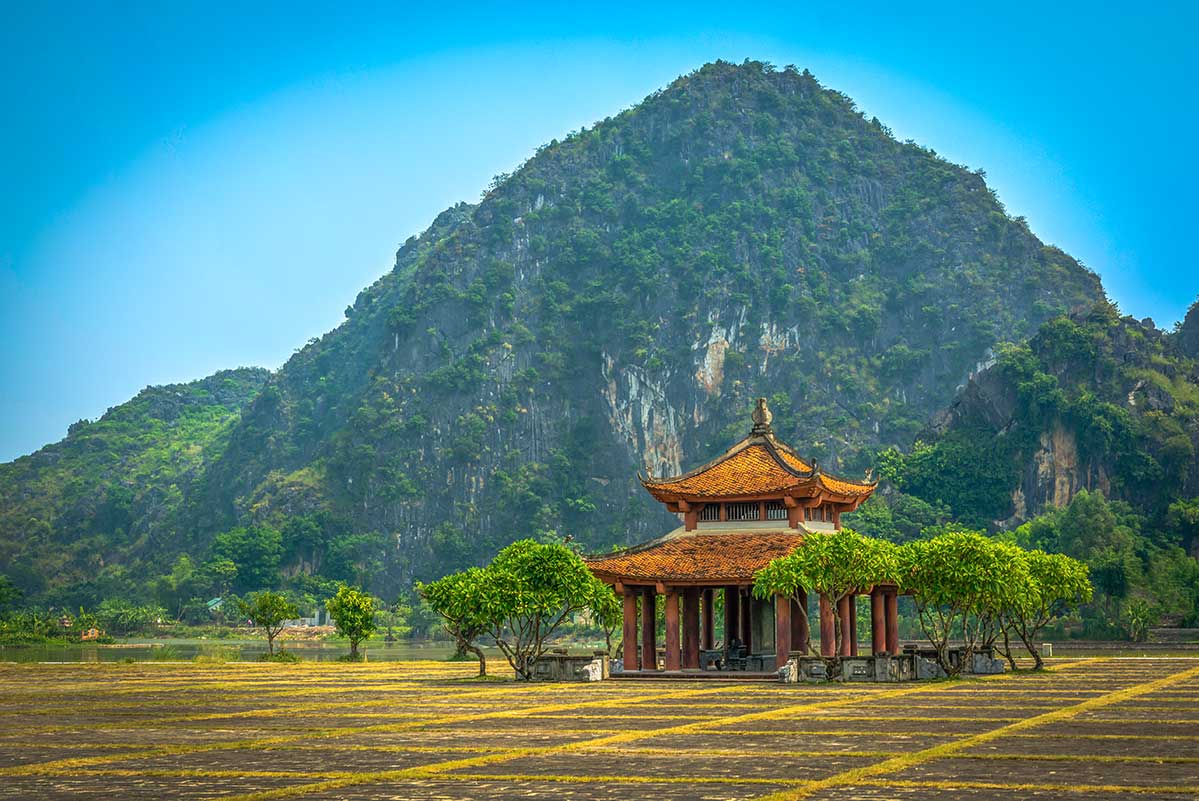
So set your expectations right. There are no grand ruins to climb over. What remains are two temples, built later to honor the founding emperors, sitting in open grounds ringed by limestone mountains and rivers. The temples are modest in size but rich in history, and the scenery around them is a big part of why the visit works. Many people find the setting as memorable as the temples. Come for the history and the calm, not for scale, and Hoa Lu makes a lot of sense.
History of Hoa Lu Ancient Capital
To understand why this quiet spot matters, you have to go back to the year 968. Vietnam had only recently broken free from a thousand years of Chinese rule, and the country fell into chaos, split between twelve warlords fighting for control. One man, Dinh Bo Linh, beat them all and united the country. He declared himself Emperor Dinh Tien Hoang, named his new state Dai Co Viet, and chose Hoa Lu as its capital. This was the first time Vietnam existed as a single, independent kingdom with its own emperor. That is what makes this place the birthplace of the nation.
The choice of Hoa Lu was practical, not pretty. The ring of steep limestone mountains and the surrounding rivers formed a natural fortress, easy to defend against invasion from China to the north. Inside those walls of rock, the emperor built palaces, temples and shrines across an area of around 300 hectares. For a young and fragile kingdom, safety mattered more than grandeur.
The story turns dark quickly. In 979, Dinh Tien Hoang and his eldest son were assassinated, leaving a six-year-old boy as heir. With China preparing to invade and take advantage of the chaos, a senior general named Le Hoan stepped in as regent, then took the throne himself as Emperor Le Dai Hanh. He also married the former emperor’s widow, Empress Duong Van Nga. She is the thread linking the two dynasties, and the reason both emperors are honored side by side here today. Le Dai Hanh went on to defeat the invading Chinese army and hold the young country together.
The capital’s time was short. In 1010, Emperor Ly Thai To decided Hoa Lu was too cramped, hemmed in by its own mountains, and moved the capital north to Thang Long, which became Hanoi. Hoa Lu lost its purpose. The palaces were abandoned, the citadel crumbled, and over the following centuries almost nothing of the original city survived. What you see today was mostly built later, to keep the memory of those founding emperors alive.
What to see at Hoa Lu Ancient Capital
1. The grounds and Nhat Tru Pagoda
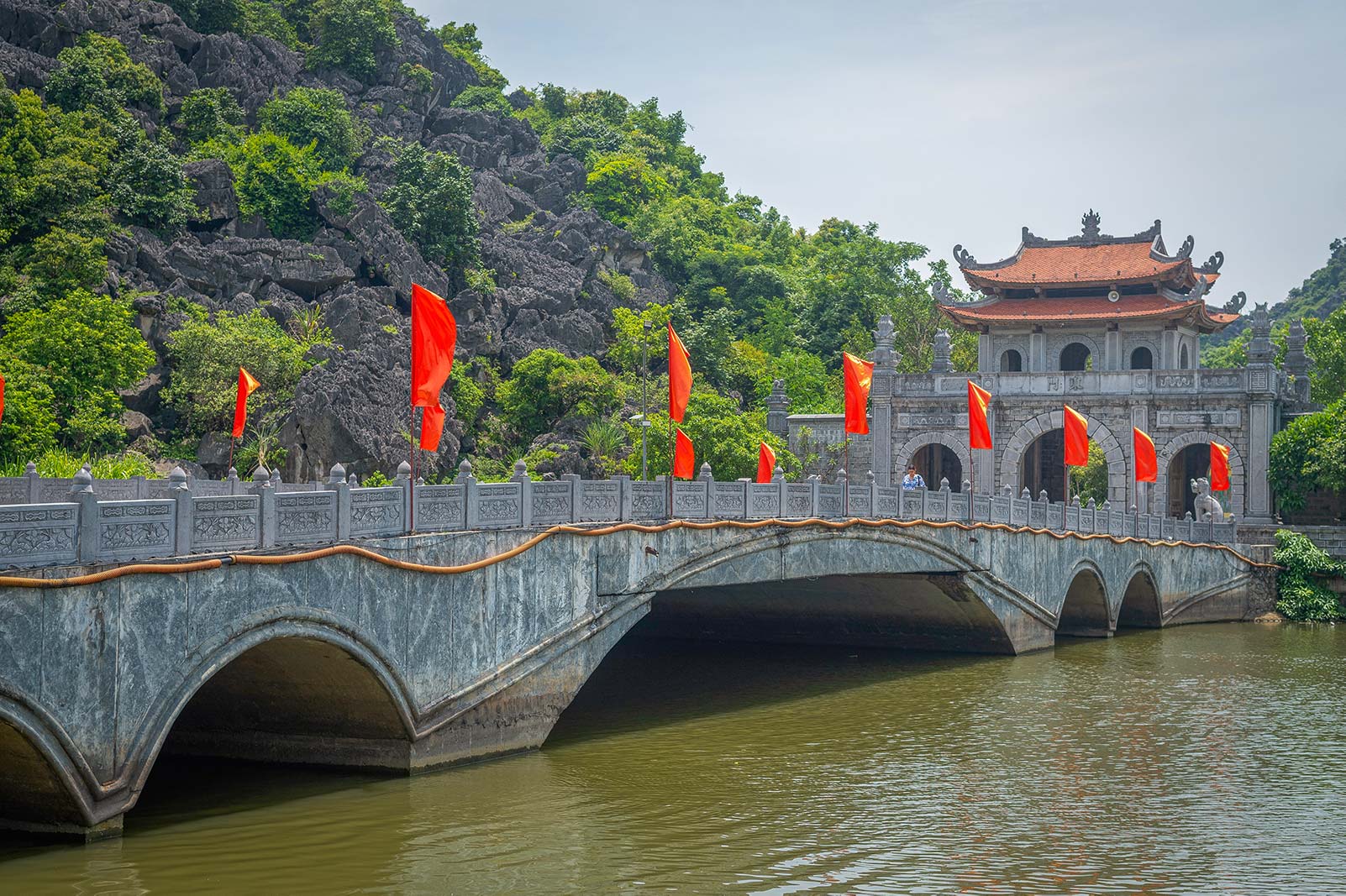
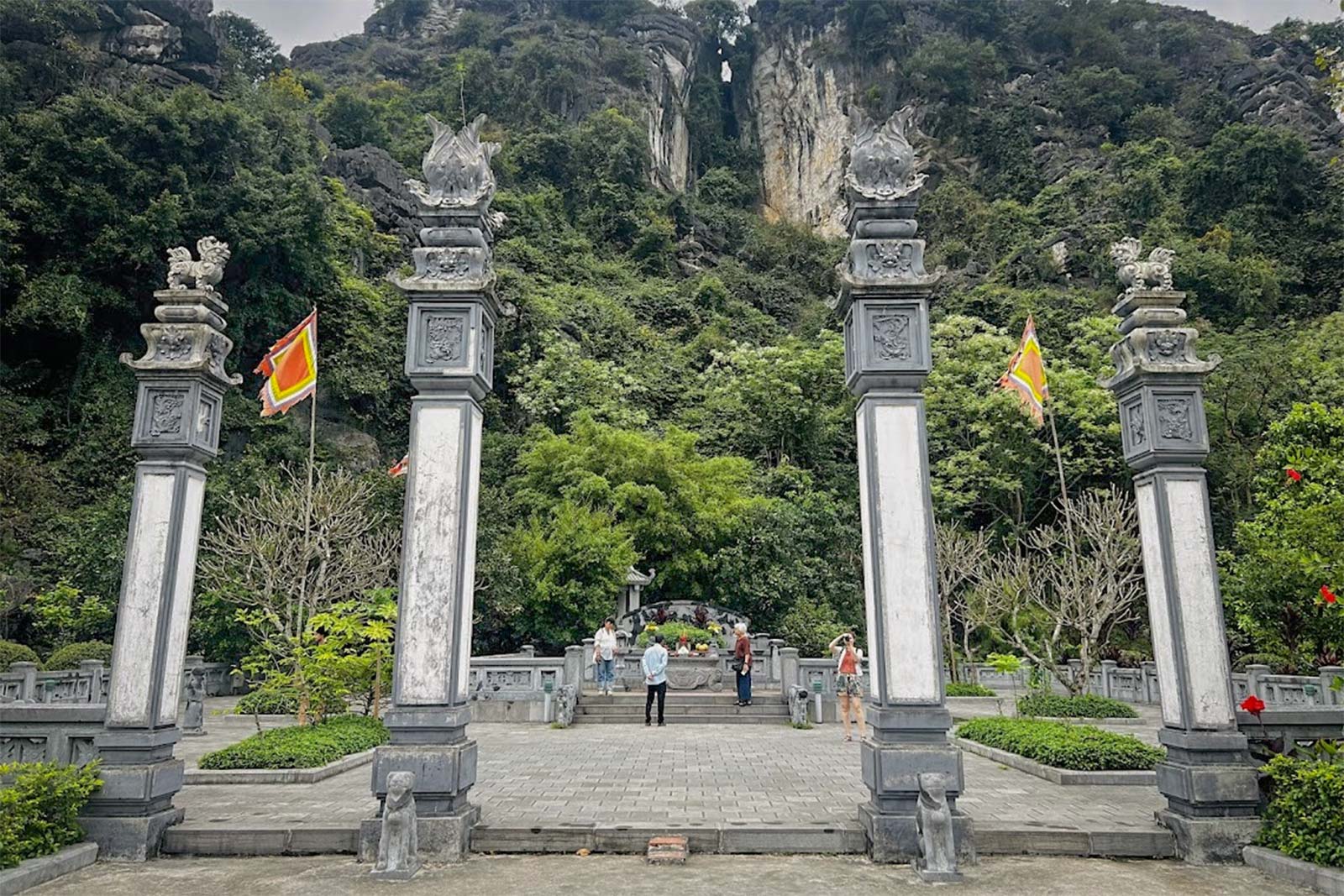
The visit starts before the temples. From the main road you cross a bridge and pass through an old stone gate, and this is the first moment the place feels historic — weathered stone, mountains rising behind it, a clear line between the modern road and the old capital. It is one of the most photographed spots on the site.
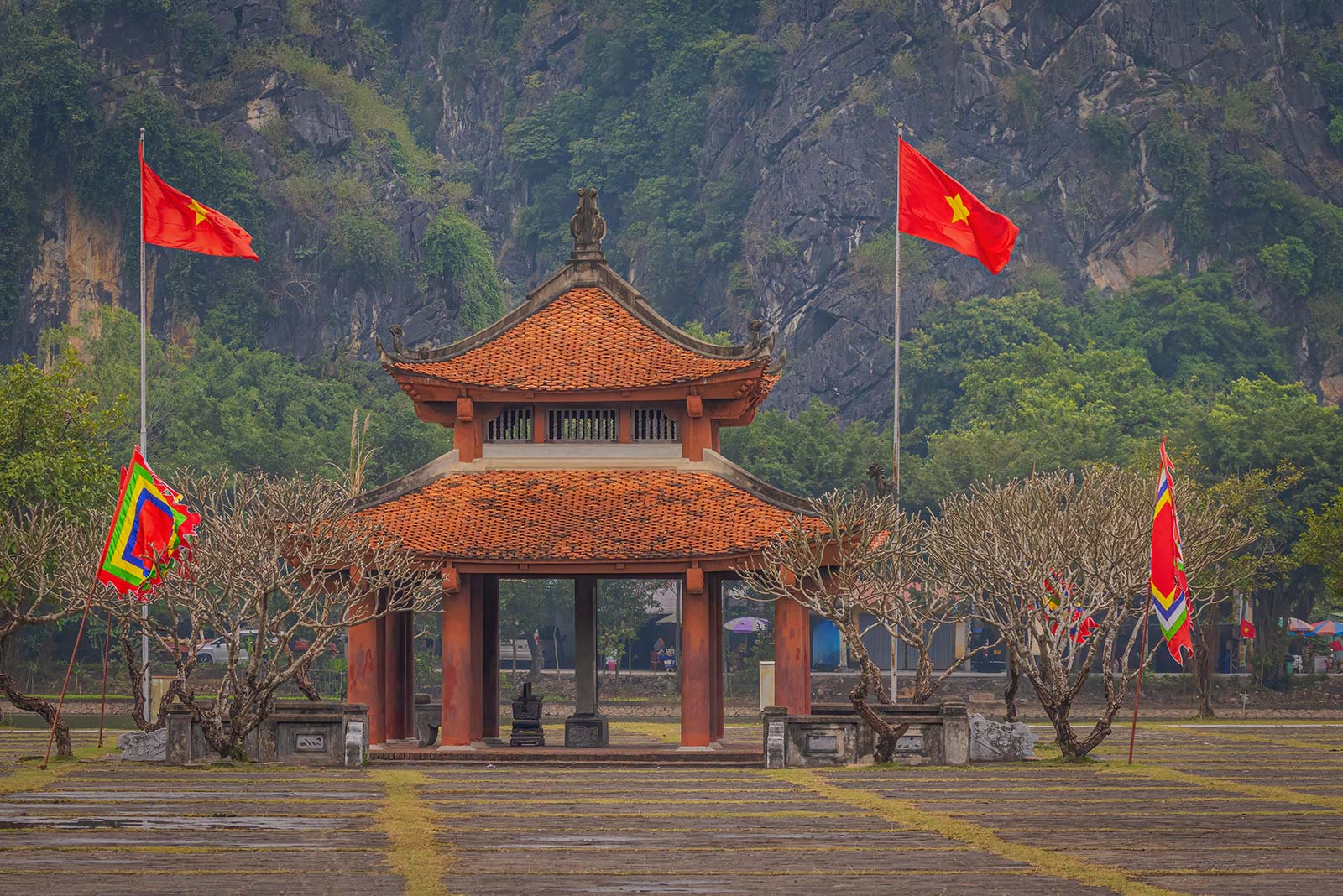
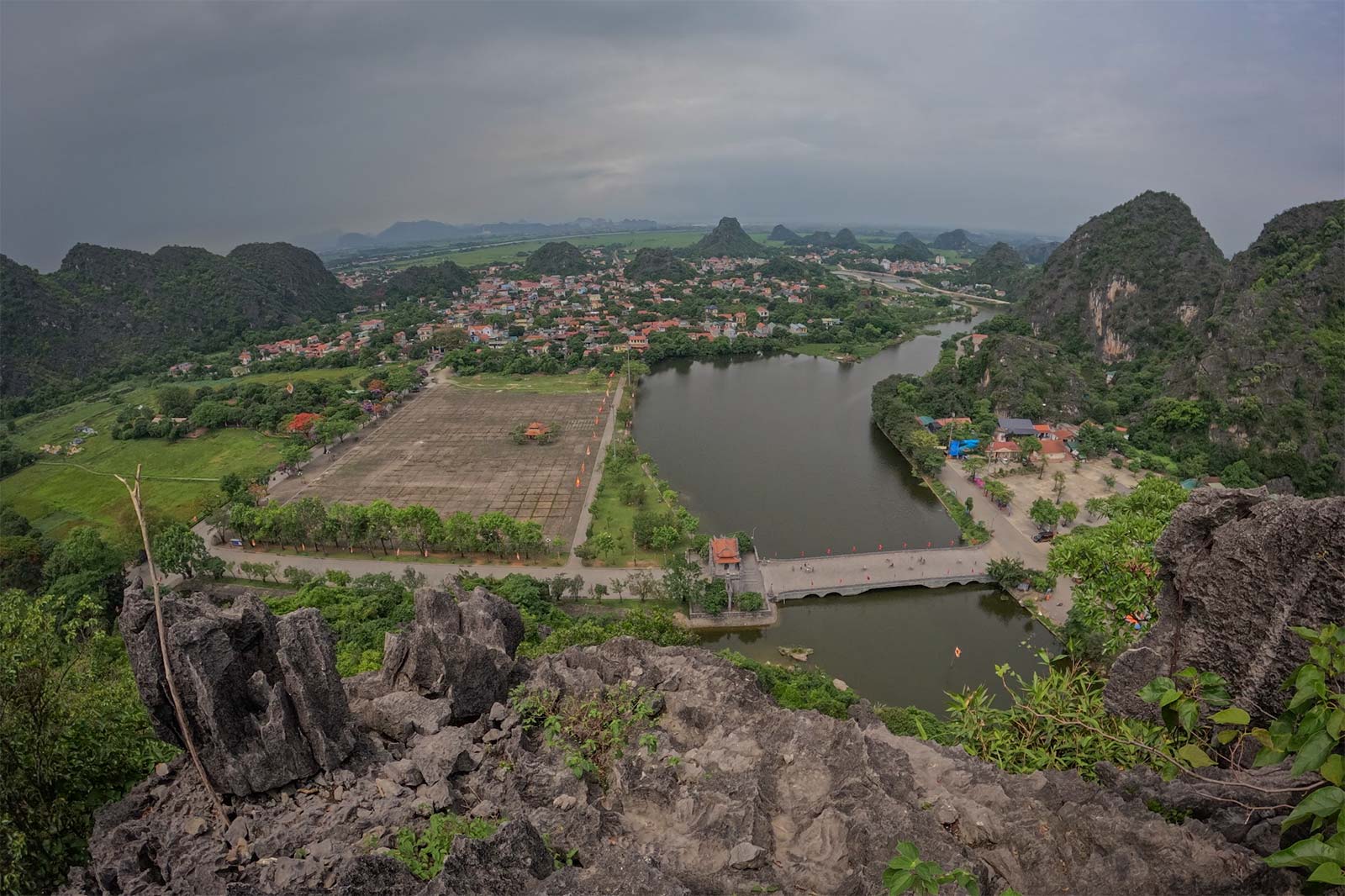
Beyond it opens a large ceremonial square, once used for major events of the old capital. In the middle stands a memorial pavilion holding a stone stele to Ly Thai To, the emperor who later moved the capital north to Hanoi. It is a quiet detail worth noticing, because it means all three founding-era rulers are marked here: Dinh and Le in their temples, and Ly with this stele. Around the square are a river bank to sit by and karst peaks on every side.
A short walk away stands Nhat Tru Pagoda, a 10th-century Buddhist site with an ancient stone pillar carved with Buddhist scriptures. Monks once gathered here to advise the emperor on affairs of state. Most visitors skip it, but it is quiet and quick if you want a little more history.
2. Dinh Tien Hoang Temple
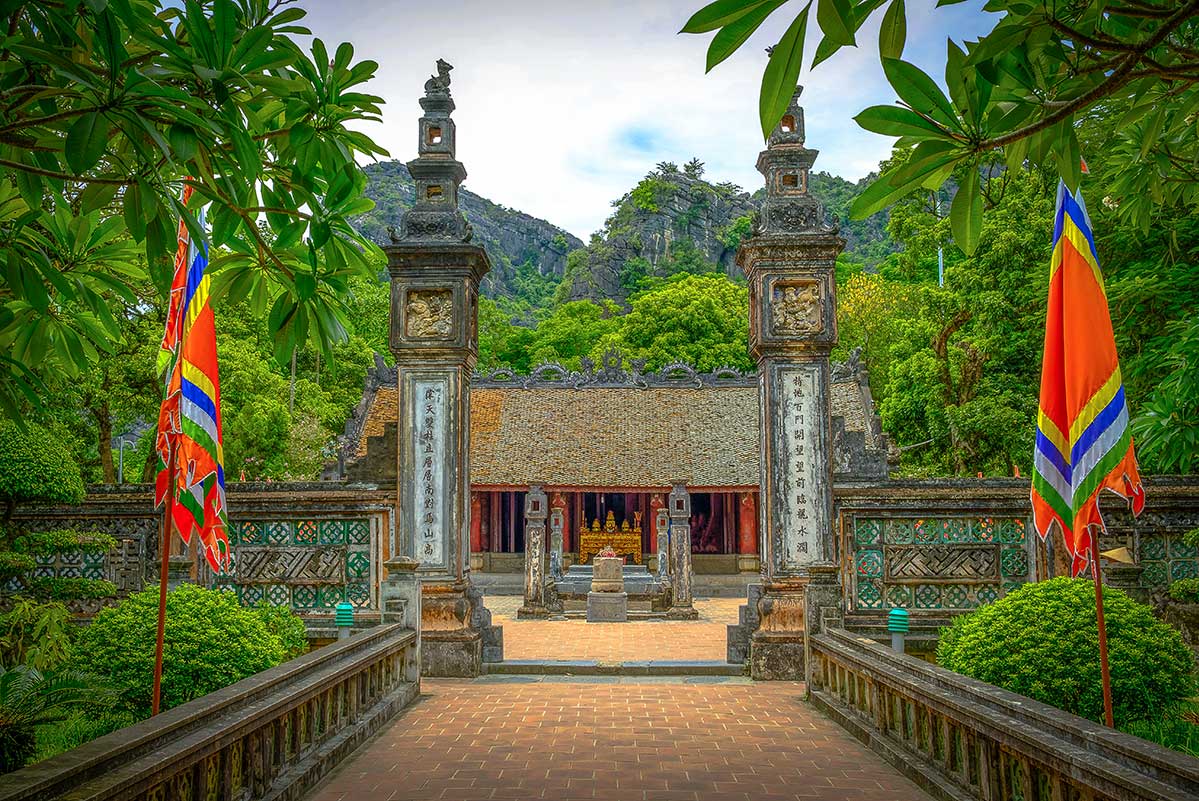
This is the main reason to come. The temple honors the founding emperor, and it stands on the exact spot where his royal palace once sat. What you see today was built in the 17th century, but the location is the original heart of the ancient capital. You enter through a stone gate into a series of courtyards and halls, laid out with the mountain behind and water in front, following old Vietnamese principles of harmony between building and landscape.
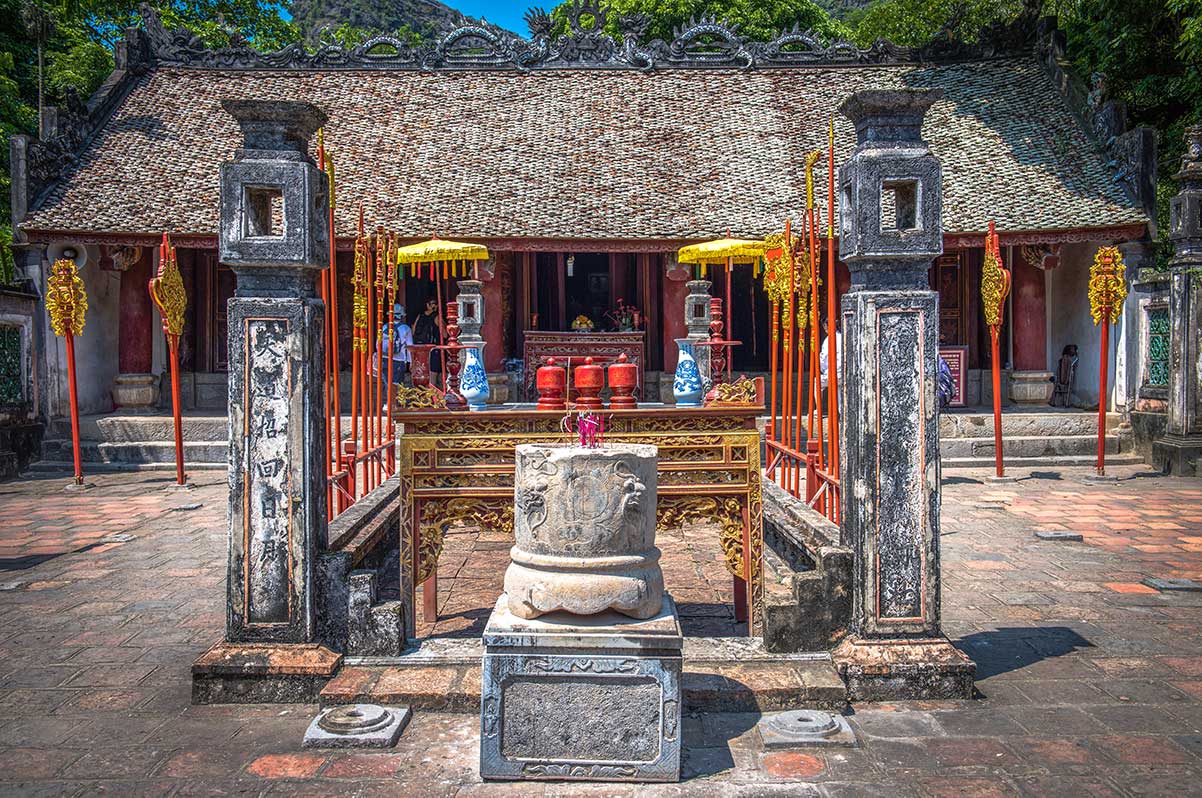
Inside, the carving is the highlight. Look for the stone “dragon bed,” a carved throne base flanked by dragons, worn smooth with age. The main hall holds a statue of Dinh Tien Hoang seated with his sons. The wooden beams and pillars are covered in dragons, phoenixes and floral patterns, the work of skilled craftsmen honoring an emperor who had been dead for six centuries by the time they carved them.
3. Le Dai Hanh Temple
A short walk north, about 500 meters, brings you to the second temple, honoring the emperor who took over after Dinh Tien Hoang. It is smaller and quieter, with gardens and a small lake that give it a calmer feel. The architecture is similar, but this is where the history from earlier comes to life.
Inside, alongside the statue of Le Dai Hanh, you will find a statue of Empress Duong Van Nga, the woman who was married first to one emperor and then the other. Nearby sits his son Le Long Dinh, remembered in history as a lazy and unpopular ruler. Seeing all three together makes the tangled story of the two dynasties suddenly feel real.
4. Ma Yen Mountain viewpoint
Behind the Dinh temple, a stone staircase climbs Ma Yen Mountain, named for its horse-saddle shape. It is around 265 steps to the top, a short but steep climb. The two emperors bookend the climb: Le Dai Hanh’s tomb sits at the foot of the mountain, and Dinh Tien Hoang’s rests at the summit.
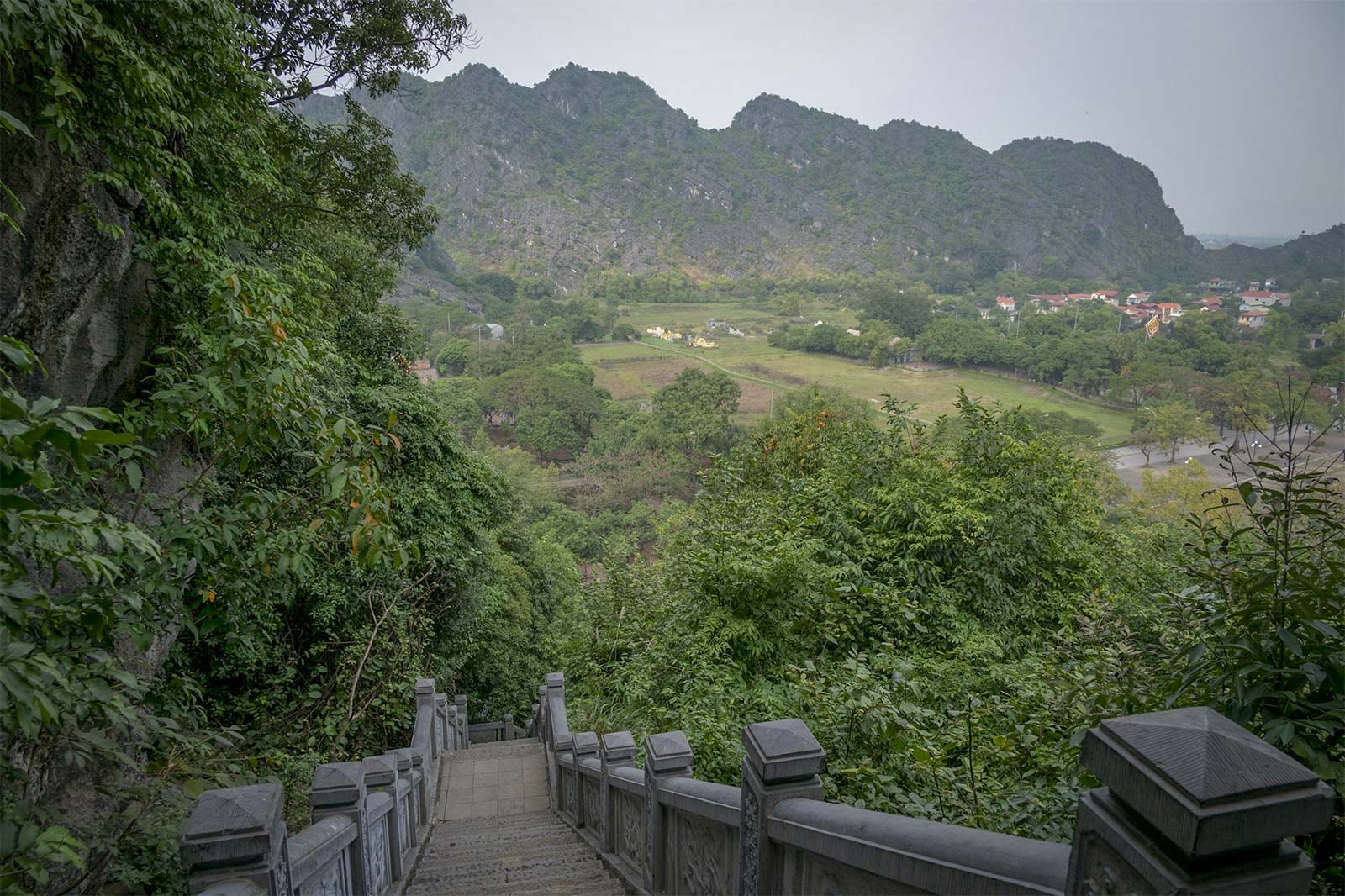
At the top, the view is the real reward: the whole valley of the old capital spread out below, the ceremonial square and bridge small beneath you, and the Hoang Long River winding between the karst peaks. If you have the legs for it, this is the best view of the site and worth the effort.
Location and getting there
Where is Hoa Lu Ancient Capital
Hoa Lu sits about 12 kilometers from Ninh Binh city, in the heart of the karst landscape that the region is famous for. From Hanoi it is roughly 90 to 100 kilometers south, or a 2 to 2.5 hour drive. The best part of its location is what surrounds it: some of Ninh Binh’s top sights are only minutes away, which makes Hoa Lu easy to combine with a fuller day out.
How to get there
From Ninh Binh or Tam Coc, you have a few options. A Grab or taxi is the simplest and cheapest over these short distances. Renting a motorbike works well too, as the roads here are flat and easy. Many people also visit on a guided day trip, either from Ninh Binh or direct from Hanoi, which usually pairs Hoa Lu with a boat ride and one or two other sights.
If you are coming from Hanoi without your own transport, the common route is a train or bus to Ninh Binh, then a taxi or rented bike for the last stretch. But the easiest way to see Hoa Lu, especially if your time is limited, is as part of an organized tour that handles the logistics for you.
Nearby to combine a visit
Hoa Lu is a short stop on its own, so almost everyone pairs it with something close by. These are the best options.
- Trang An — Just 1.7 kilometers away, this is the natural pairing. A slow boat takes you through a chain of caves and past temples, weaving between towering limestone cliffs. It is the most popular thing to do in the whole region, and being this close to Hoa Lu makes the two an obvious half-day combination.
- Tuyet Tinh Coc (Am Tien Cave) — About 1.8 kilometers from Hoa Lu, this is a quiet valley with a jade-green lake ringed by cliffs, reached through a cave. It was once a royal site and later a prison. It sees fewer crowds than the boat tours and makes a peaceful, quick add-on.
- Tam Coc — Around 11 kilometers away on the other side, Tam Coc offers another famous boat ride, this one through flooded rice fields. It is a little further, but the ride between Tam Coc and Hoa Lu is a highlight in itself. On a bicycle, taking the quiet back roads rather than the route the cars use, it is one of the nicest things to do in Ninh Binh, not just a way to get from A to B.
- Bai Dinh Pagoda — A short drive away, Bai Dinh is the largest Buddhist complex in Vietnam, a huge and modern site of vast halls and long corridors lined with statues. It is the complete opposite of Hoa Lu in scale and feel, which is part of why the two go well together.
Visiting information and practical tips
Entry and opening hours
The entrance fee is 20,000 VND for adults, 10,000 VND for children aged 8 to 18, and free for younger kids. Bring cash in Vietnamese dong, as cards are not accepted and there is no ATM on site. The complex is open daily from around 7am, closing in the late afternoon, roughly 5pm, though it can close earlier in the quieter months. Mornings are the calmest time to visit, before the tour groups arrive.
How long to spend and getting around
Most people spend one to two hours here, longer if you climb Ma Yen Mountain or take your time in the grounds. You do not need a bicycle to see the site. The two temples are close together and easily walked, despite what the people renting bikes at the gate will tell you. A bike is only worth it if you plan to ride the wider countryside around Hoa Lu, which is a pleasant thing to do in its own right but not necessary for the temples themselves.
Watch out for scams at the gate
This is the one real downside of visiting, and it is worth knowing before you arrive. The area around the entrance has a persistent problem with touts, and it catches a lot of visitors out. A few things to be aware of.
People near the gate may tell you that you cannot bring your bicycle or motorbike inside, and that you must park with them. This is false. You can take your own bike in after scanning your ticket, and park in the designated areas by the temples.
Be very careful with the motorbike-taxi drivers offering to show you around. A common trick is to agree a price, then demand much more once you are already out on the site, often taking you far from the main temples first so you have little choice but to pay. If you use one, agree the full price clearly upfront and carry small change. Honestly, the simplest way to avoid all of this is to walk. The site is small enough that you do not need a ride at all.
Facilities and what to bring
There is a small snack bar near the grounds selling drinks, ice cream and basic food, along with toilets. One of the exhibition rooms has air conditioning, which is a welcome escape on a hot day. Much of the site is open and exposed, so bring water, sun protection and a hat in summer. To enter the temple halls you need to cover your shoulders and knees. If you are not dressed for it, shawls are usually available for free at the entrance.
Consider a guide
There is very little English signage, and without some background the temples are just old buildings. The history is what makes Hoa Lu worth visiting, so a good guide, whether on a tour or hired locally, makes a real difference to how much you get out of it. If you would rather go independently, reading up on the history beforehand does much the same job.
Is Hoa Lu Ancient Capital worth visiting?
It depends on what you come for. If you have any interest in history, yes, Hoa Lu is worth it. This is where Vietnam began as an independent country, and standing in the spot where the first emperor ruled, with his tomb on the mountain above, carries real weight once you know the story. The temples are well kept, the carvings are beautiful, and the setting among the limestone peaks is genuinely lovely. For history lovers, it is an easy recommendation.
But be honest with yourself about the scale. This is not a grand ancient city. The citadel is gone, the site is small, and you are looking at two modest temples and open grounds, not the ruins of an empire. Some visitors arrive expecting something bigger and older-feeling, and leave a little underwhelmed. With hardly any signage to explain what you are seeing, it can feel flat if history is not your thing. More than one person has come away feeling the scenery around the site was more memorable than the site itself.
So who should go? If you are already exploring Ninh Binh, the answer is simple: yes, because it sits right next to Trang An and takes only an hour or two. It slots into a day perfectly. If you are deciding whether to make a special trip just for Hoa Lu, be more careful. On its own it may not justify the journey, but paired with a boat ride and the countryside around it, it rounds out a day in Ninh Binh nicely. Go for the history and the calm, keep your expectations grounded, and it delivers.