


Why choose train travel in Vietnam?
Train travel in Vietnam is a reliable and comfortable way to move between major cities, especially if you prefer a more relaxed journey over domestic flights or traveling by bus in Vietnam. While it’s not the fastest option, it offers a good balance between convenience, scenery, and experience.
- Safe: Trains are generally one of the safest transport options in Vietnam, with fewer sudden stops or risky driving compared to buses.
- Scenic: Many routes, especially along the coast, offer views of rice fields, mountains, and sea stretches you won’t see from the road or plane.
- Comfort: Sleeper cabins allow you to lie flat on overnight journeys, making long distances more manageable.
- Spacious: More legroom and the ability to walk around make trains more comfortable than buses, especially for taller travelers.
- Experience: Traveling by train gives you a more local feel, sharing cabins with Vietnamese passengers and seeing daily life pass by outside your window.
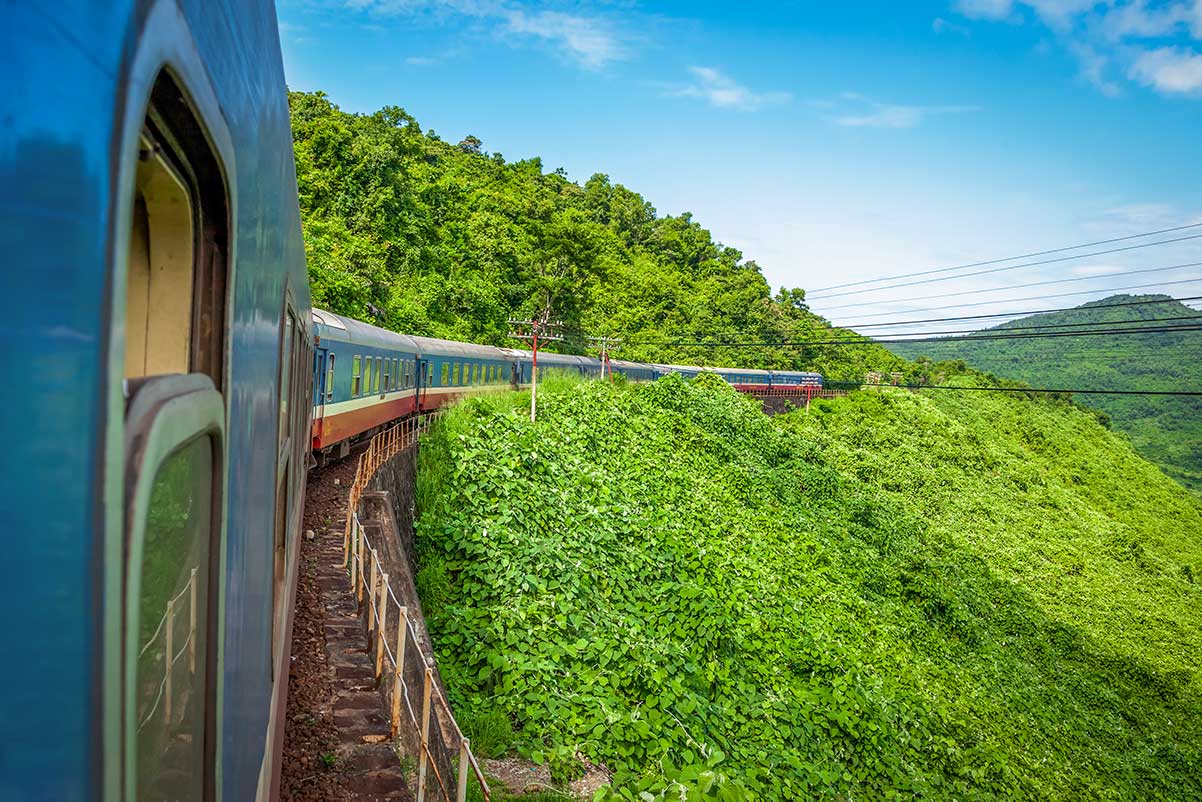
That said, train travel in Vietnam is not always the best option. The railway follows an old track, journeys can be slow and sometimes noisy, and there are no high-speed trains. For shorter distances or tight schedules, flights or buses are often more practical.
Traveling Vietnam by train: what to expect
Traveling by train in Vietnam is quite different from what you might be used to in Europe or Japan. It’s more relaxed, a bit less polished, but overall a comfortable and interesting way to move through the country.
Train schedules and timing
Train travel in Vietnam does not run on very frequent schedules. On major routes like Hanoi to Da Nang or Ho Chi Minh City, you can expect several trains per day, usually around 4 to 6. Smaller stations may only have one or two trains stopping daily.
In general, Vietnam train services are fairly punctual. Delays can happen, especially on longer routes, but it’s usually not extreme. Still, it’s good to keep some flexibility in your plans, especially if you have a tight connection afterward.
Day trains vs overnight journeys
You can travel Vietnam by train during the day or overnight, depending on the route and your preference.
Day trains are great if you want to enjoy the scenery and don’t mind spending several hours on the train. Overnight trains are more practical for long distances, as you save a night in a hotel and arrive early the next day.
Sleeping on the train is usually fine, but don’t expect perfect silence or hotel-level comfort. It’s more about convenience than luxury.
Scenic views along the route
One of the main reasons people choose Vietnam by train is the scenery. Some sections of the railway are genuinely beautiful.
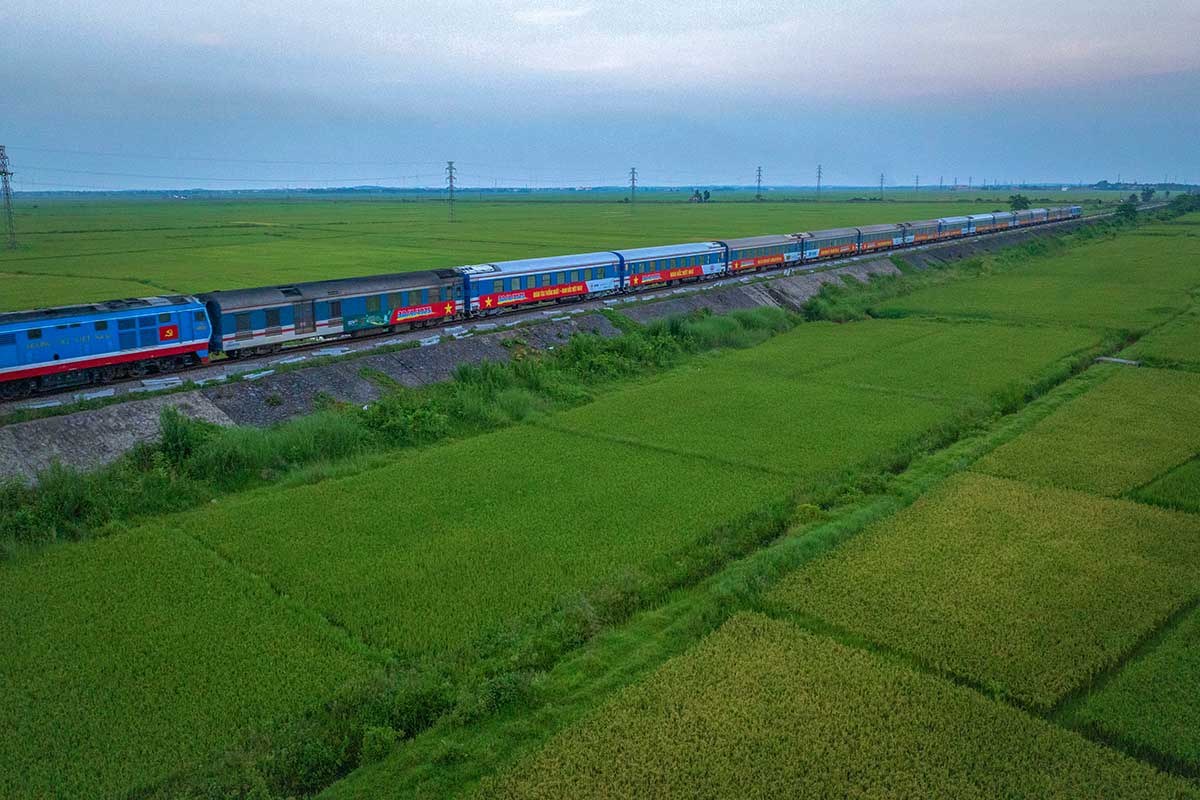
The most famous stretch is between Hue and Da Nang, where the train runs along the coast with views over the sea and mountains. Other parts pass rice fields, small villages, and rural landscapes you won’t see from a plane.

That said, not every part of the journey is equally scenic. Some sections are more industrial or less interesting, so expectations should be realistic.
Getting on and off the train
Boarding a Vietnam train can feel a bit more basic compared to modern systems.
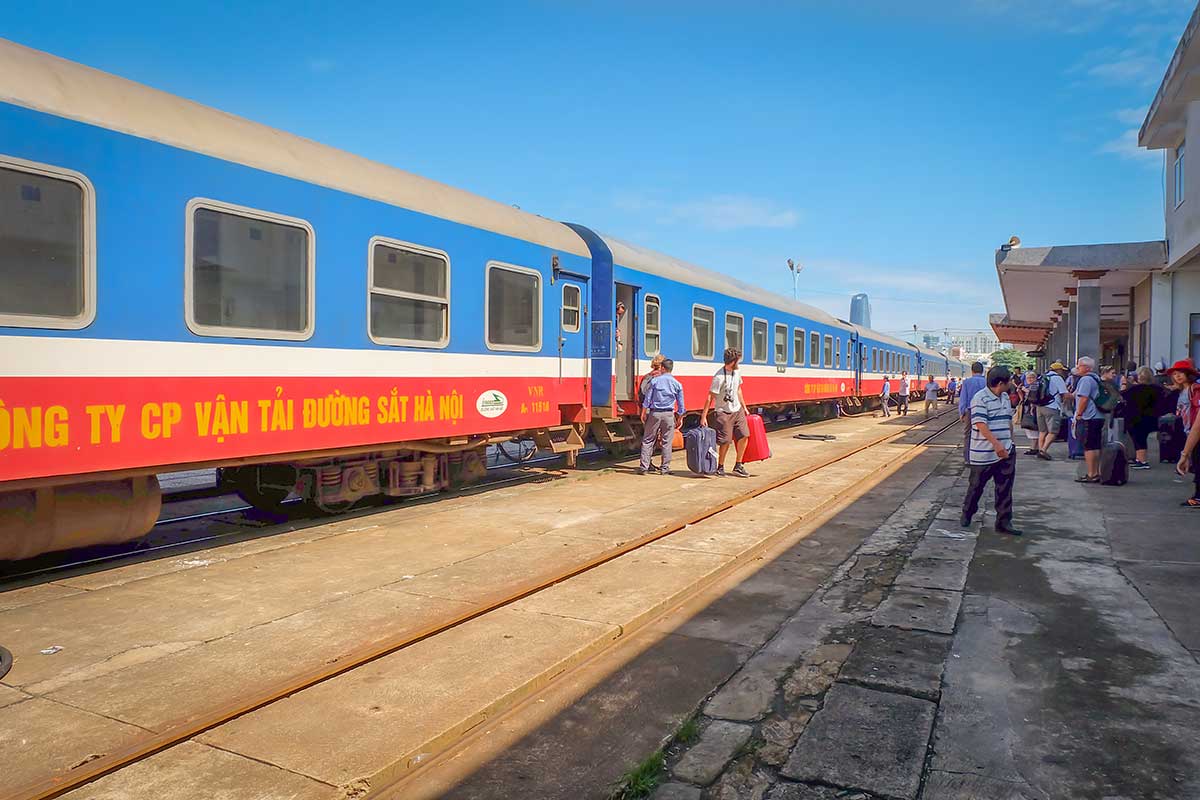
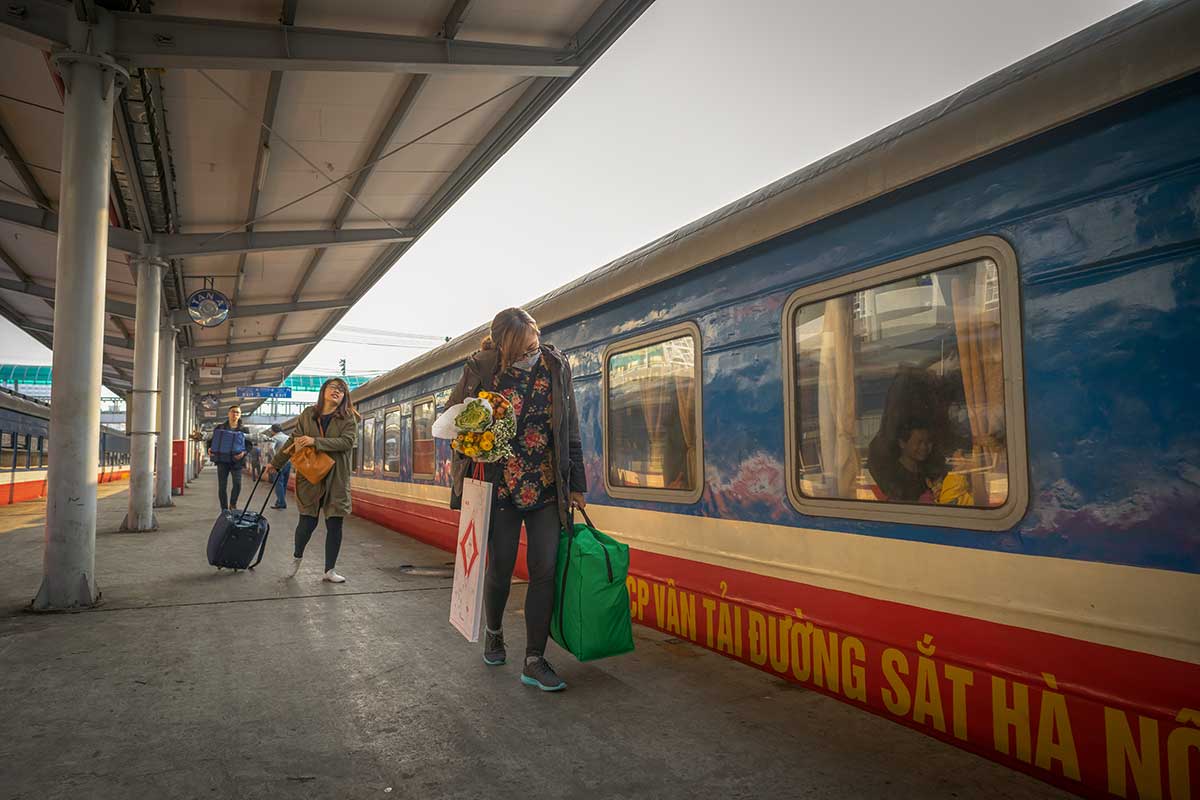
Platforms are not always at the same height as the train, so you often need to step up using small metal steps. This can be a bit challenging if you have heavy luggage or limited mobility.
Train staff are usually nearby and often help with lifting bags or guiding you to your carriage, which makes the process easier.
Luggage on the train
There are no strict airline-style luggage limits, and you can generally bring what you need.
In sleeper cabins, bags are often placed under the lower berths or in the small walkway area. There is also storage above the door, but lifting heavy suitcases there is not very practical.
On trains with seats, you can use overhead racks or store larger bags at the ends of the carriage. Keep valuables close to you, especially on overnight journeys.
Toilets on Vietnam trains
Toilets are available on almost all trains, and most carriages have at least one.
They are standard Western-style toilets, not just a hole in the floor. Toilet paper is often available, and staff regularly check and restock.
Cleanliness can vary depending on the train and time of day. At the start of the journey, toilets are usually clean, but on long routes they can become less tidy over time.
Food and onboard facilities
Facilities on Vietnam trains are simple but cover the basics.
Some long-distance trains have a dining carriage (restaurant car), where you can buy Vietnamese meals. The choice is limited and mostly local dishes, but it’s a decent option if you don’t bring your own food.
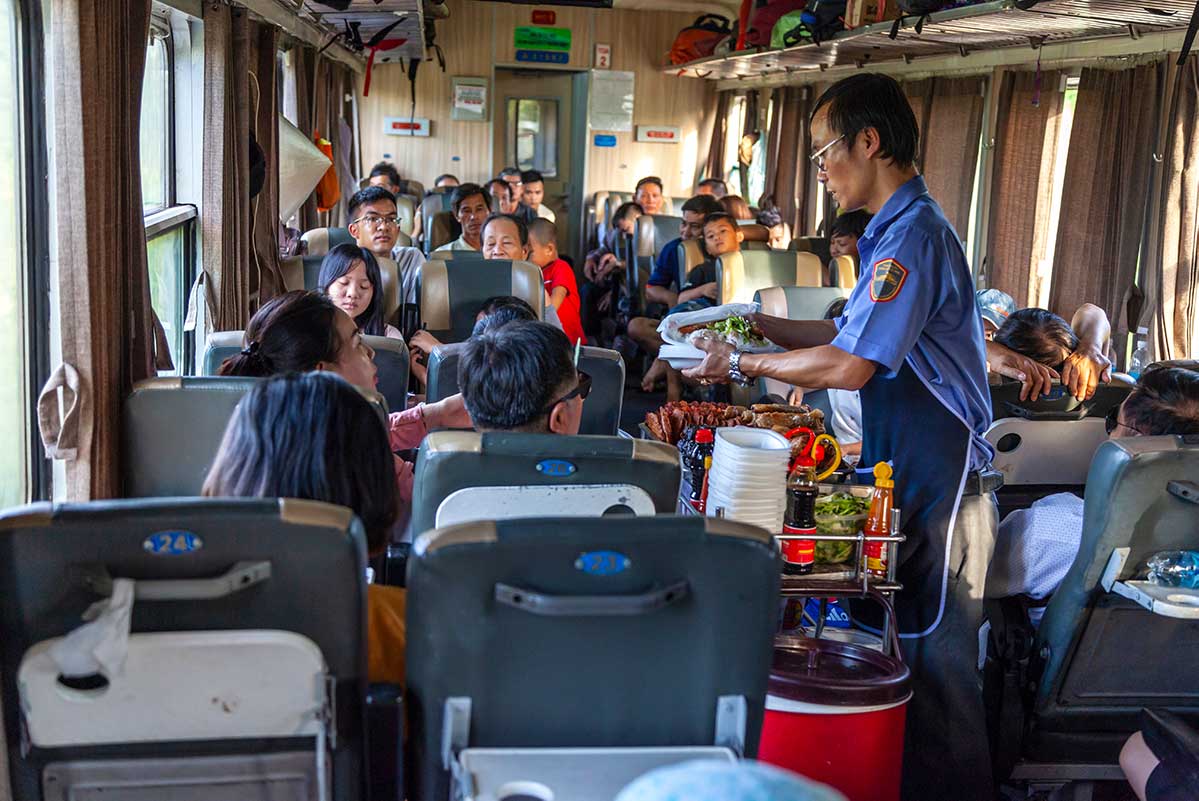
On all trains, staff move through the carriages with carts selling drinks, snacks, instant noodles, coffee, and water. It’s easy to buy something during the journey, but bringing your own snacks is still a good idea.
Power sockets and charging
Most sleeper cabins have power sockets, often one per berth in 4-berth cabins. This is useful for charging phones and small devices.
In soft seat carriages, sockets are not always available or may be limited, so you should not fully rely on them.
Internet and mobile connection
There is no WiFi on Vietnam trains.
Mobile data works on many parts of the route, but there are also sections, especially in rural or mountainous areas, where the signal drops completely. If you need to stay connected, it’s good to prepare for gaps.
Train staff and service
Train staff are generally professional and helpful.
Some staff speak basic English, especially on popular tourist routes. They can assist with finding your seat or cabin, lifting luggage, or answering simple questions.
The service is not overly formal, but it’s efficient and friendly enough for most travelers.
Cleanliness and bedding
A common question about traveling by train in Vietnam is how clean the beds are.
On major routes, bedding is usually prepared at the starting stations like Hanoi, Da Nang, or Ho Chi Minh City. If you board at one of these stations, your berth is often freshly made.
If you get on later along the route, there is a chance the bed has already been used. In that case, you can ask staff for clean sheets, which are usually available.
Noise and comfort
Train travel in Vietnam can be a bit noisy.
The railway system is old, and you will hear the sound of the tracks, especially at night. On top of that, other passengers moving around, talking, or using their phones can add to the noise.
If you are a light sleeper, earplugs can make a big difference.
Smoking on the train
Smoking is officially not allowed anywhere on the train.
In practice, some passengers may smoke between carriages. If this bothers you, you can inform the train staff, as it is not permitted.
Overall, traveling by train in Vietnam is comfortable enough and often more relaxed than buses, but it comes with small inconveniences. Knowing what to expect helps you decide when it’s the right choice for your trip.
Types of trains in Vietnam
When you travel by train in Vietnam, you are not choosing between completely different railway systems, but rather between different types of trains and carriages on the same network. The overall experience is similar, but some trains are more modern or more comfortable than others.
Reunification Express
The Reunification Express is the main Vietnam train service that runs along the north–south railway between Hanoi and Ho Chi Minh City.
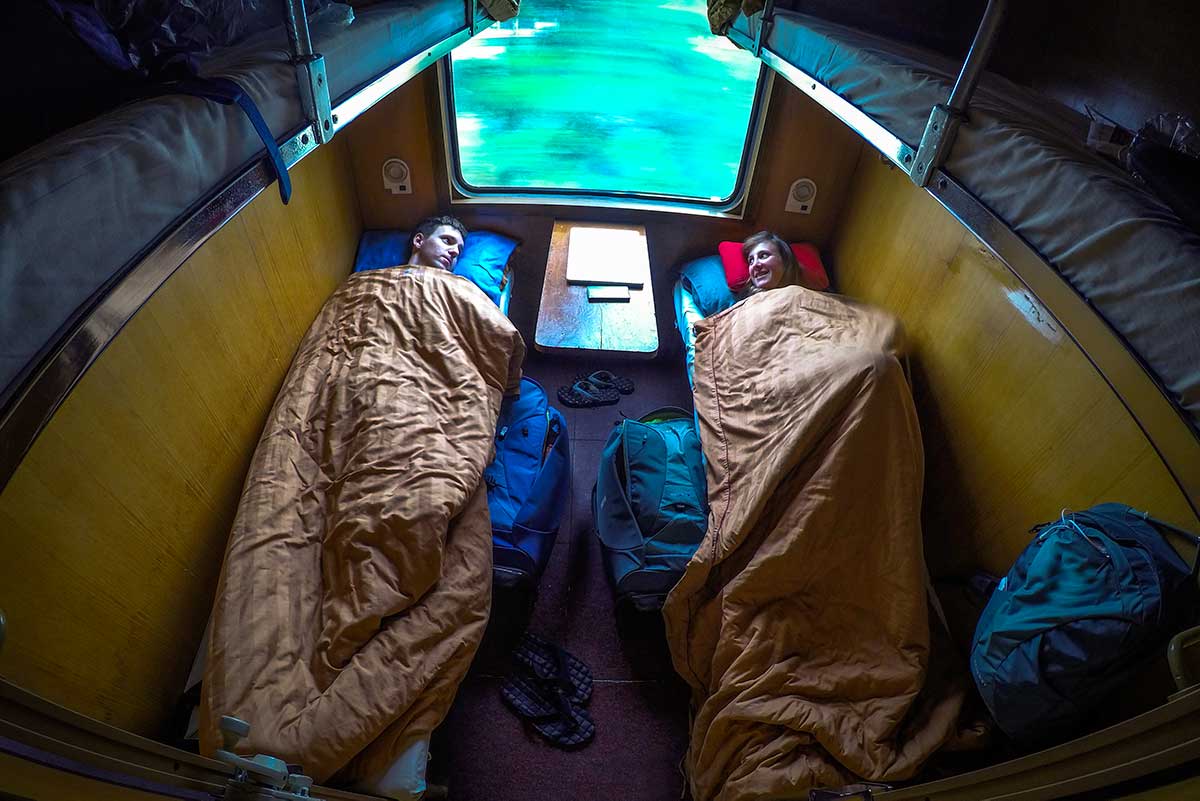
Despite the name, it is not one single train, but a group of trains with different numbers (like SE1, SE2, SE3, etc.) that all operate on the same route. These trains stop at major cities along the coast and form the backbone of train travel in Vietnam.
In general, the SE trains (especially SE1–SE4) are considered slightly faster and better in quality than others. They usually have a mix of seat carriages and sleeper cabins, and are the most commonly used trains for long-distance travel.
For most routes, if you are traveling Vietnam by train, you will end up on one of these Reunification Express services.
Tourist trains
Tourist trains in Vietnam are not separate trains with their own tracks or schedules. They are private or semi-private carriages attached to regular Vietnam train services, usually on popular routes.
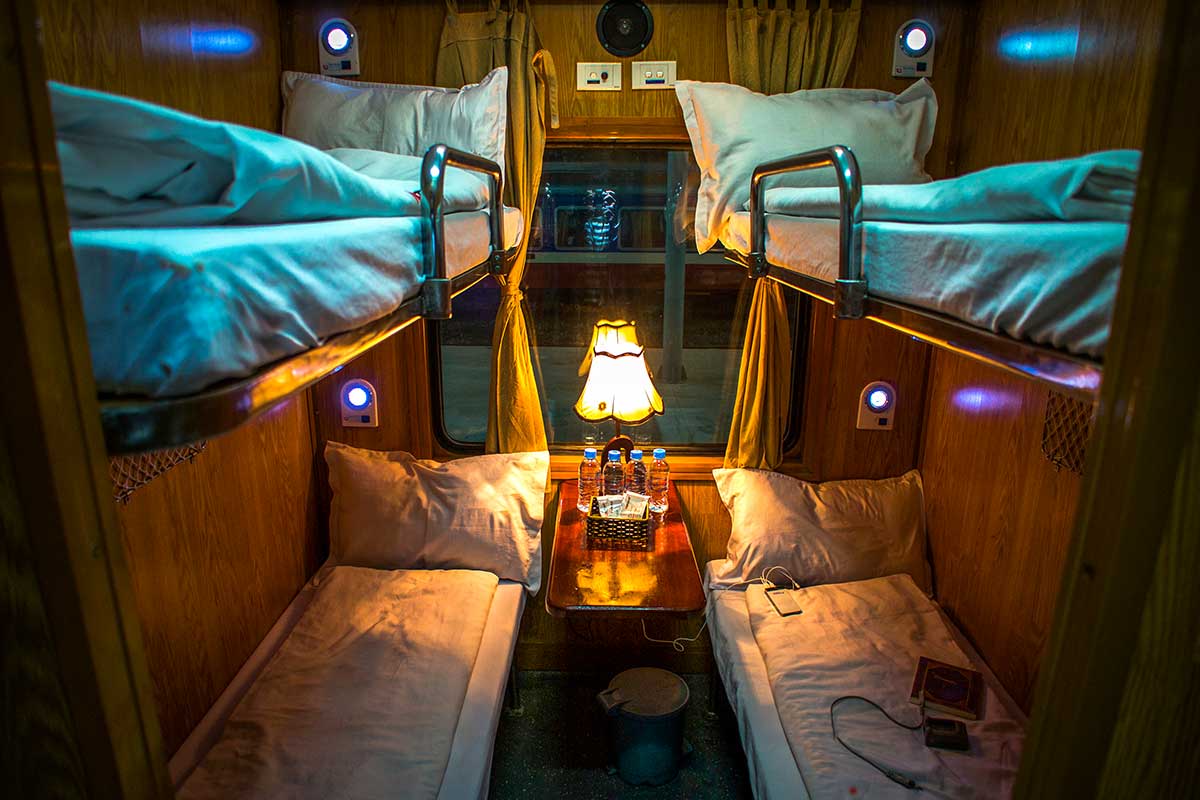
This means they run at the same time as the normal trains, but offer a slightly upgraded experience, mainly in sleeper cabins.
On most routes, there are only one or two tourist carriage options available. The main exception is the route between Hanoi and Lao Cai (for Sapa), where several companies operate their own carriages, giving more choice.
Typical differences include better mattresses, cleaner cabins, nicer interiors, and sometimes small extras like snacks or drinks. However, it’s still the same train underneath, so don’t expect a completely luxury experience.
Some well-known tourist train options include:
- Livitrans Express (Hanoi – Lao Cai / Sapa): One of the more established tourist carriage providers with comfortable sleeper cabins and a slightly upgraded interior.
- Fanxipan Express (Hanoi – Lao Cai / Sapa): Popular choice for Sapa travelers, offering clean cabins and good service.
- Sapaly Express (Hanoi – Lao Cai / Sapa): Known for more premium-style cabins, sometimes with better finishes than standard trains.
- King Express (Hanoi – Lao Cai / Sapa): Aimed at tourists looking for a more polished experience, with softer bedding and improved cabin design.
- Chapa Express (Hanoi – Lao Cai / Sapa): One of the more higher-end options, with a focus on comfort and design.
- Violette Train (Hanoi – Lao Cai / Sapa): Smaller-scale tourist carriage with upgraded interiors compared to standard sleepers.
- New Livitrans Express (Hanoi – Da Nang): One of the few tourist-style options on routes outside Sapa, offering improved cabins on the central route.
For most travelers, choosing between standard trains and tourist trains comes down to comfort preference and budget. The journey itself remains the same, but the cabin experience can feel a bit more refined on tourist carriages.
Seat and cabin options on Vietnam trains
When planning train travel in Vietnam, choosing the right seat or cabin makes a big difference to your experience. The trains offer a few standard options, ranging from basic seats to more comfortable sleeper cabins, and the right choice depends mainly on your travel time and budget.
Hard seat (not recommended)
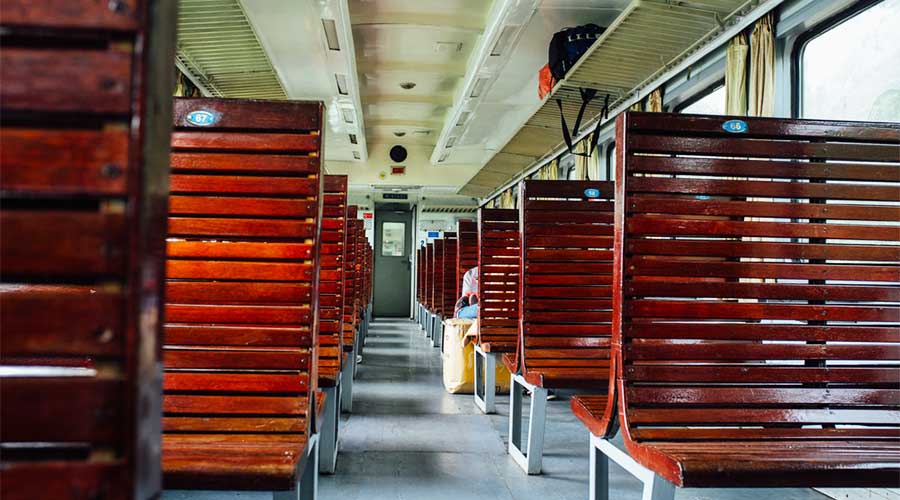
Hard seats are the most basic option on Vietnam trains.
These are simple wooden or very firm bench-style seats, often in open carriages without much space or comfort. They are mainly used by locals for very short distances and are not designed for longer journeys.
In reality, this is not a good option for most travelers. Even for short trips, the lack of comfort makes it hard to enjoy the journey. Unless you are on a very tight budget or just traveling one or two hours, it’s best to skip this option.
Soft seat (best for short distances)
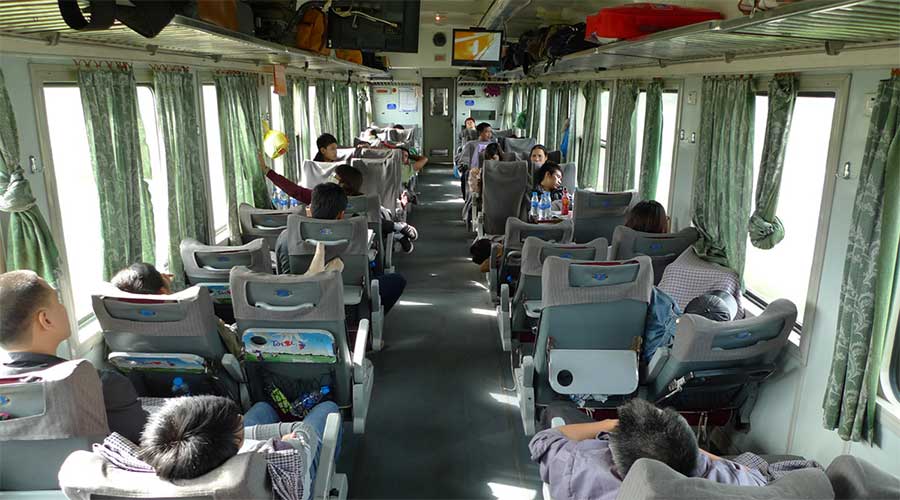
Soft seats are the standard choice for shorter train journeys.
These are cushioned seats, usually arranged like airplane seating, sometimes with reclining options. They are much more comfortable than hard seats and are perfectly fine for trips of a few hours.
If you are traveling Vietnam by train for around 2 to 5 hours, this is usually the most practical and affordable option. You get enough comfort without paying for a sleeper cabin.
For longer journeys, however, sitting for many hours (or overnight) becomes tiring, which is where sleeper options are better.
Hard sleeper (6-berth cabin, budget option)
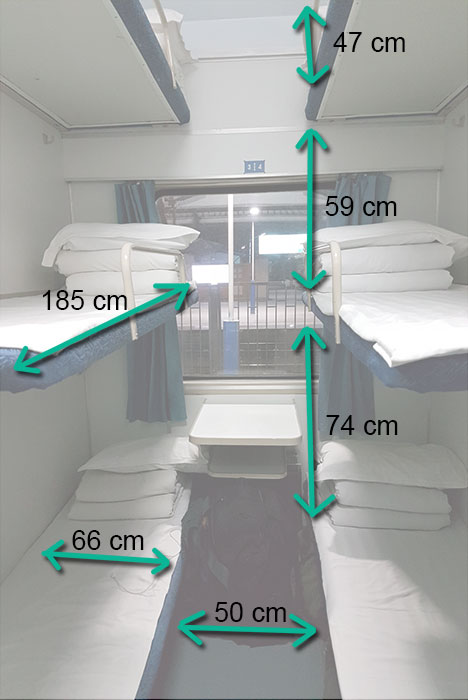
Hard sleeper cabins are the more budget-friendly sleeping option.
These cabins have six beds, arranged as three bunks on each side. The beds themselves are similar in size to soft sleeper beds, but the main difference is the number of people sharing the space.
Because of this, the cabin can feel quite cramped, especially when all berths are occupied. There is less privacy and less space for luggage, and getting into the top bunks can be a bit inconvenient.
For train travel in Vietnam, this option is mainly suitable if you want to save money on overnight journeys. It works, but it’s not the most comfortable experience, especially if you are traveling with luggage or prefer more personal space.
Soft sleeper (4-berth cabin, best for comfort)
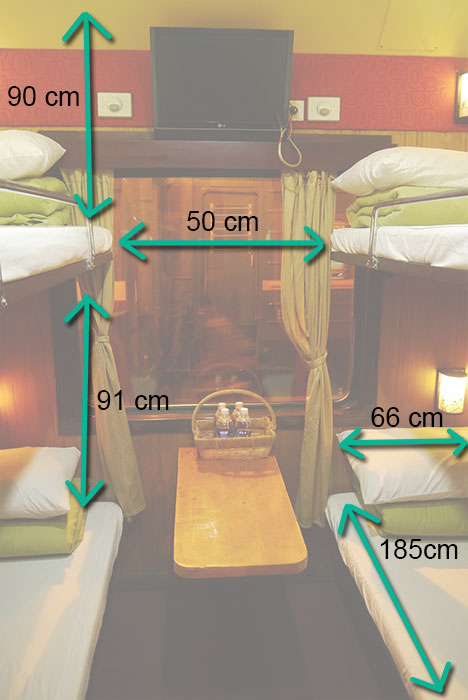
Soft sleeper cabins are the most comfortable and most recommended option for Vietnam train travel.
These cabins have four beds, arranged as two bunks on each side, which gives more space and a more relaxed atmosphere. The beds are softer, and overall the cabin feels less crowded.
For longer journeys, especially overnight trips, this is by far the best choice. You can lie down properly, get some rest, and arrive much more refreshed compared to sitting.
Even for shorter trips of around 3 to 5 hours, some travelers still prefer a soft sleeper for the extra comfort and privacy. If you are traveling with family or a small group, you can book all four berths and have the cabin to yourselves, which makes the experience much more comfortable.
If your budget allows it, soft sleeper is the option most people are happiest with when traveling by train in Vietnam.
Booking your train ticket in Vietnam
Booking train tickets in Vietnam is relatively straightforward, but there are a few different ways to do it. The best option depends on how easy you want the process to be, whether you want access to tourist trains, and how flexible your travel plans are.
Official railway website
The official website for booking Vietnam train tickets is dsvn.vn.
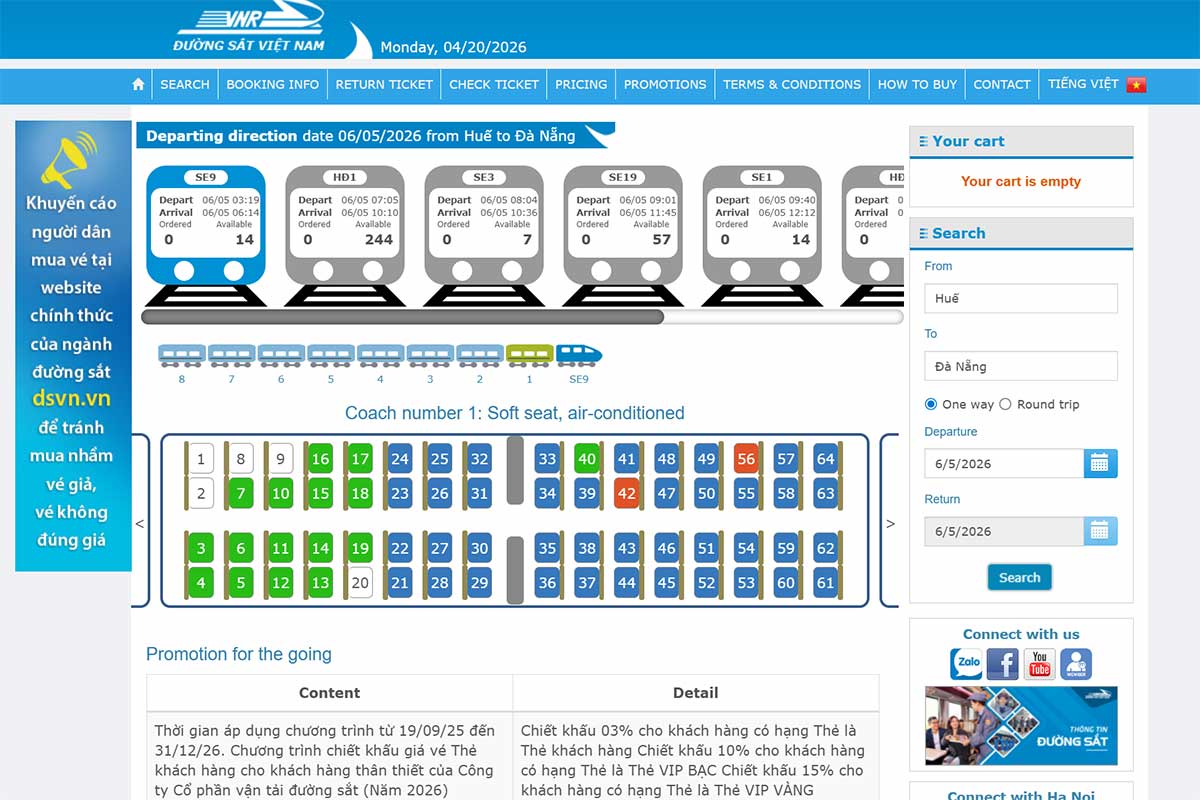
It has an English version, but the interface is not always very clear, especially for first-time users. Payment can also be a bit tricky for foreign cards, which is one of the main downsides.
The advantage is that this is usually the cheapest way to book train tickets, as you are booking directly with the railway company. However, it only includes standard trains (Reunification Express), not tourist train cabins.
Booking platforms
Booking platforms are the easiest and most popular way for travelers to book train tickets in Vietnam.
They offer a smoother booking process, clearer information, and easy payment with international cards. Another big advantage is that they include both regular Vietnam train tickets and tourist train options, so you can compare everything in one place.
The two most commonly used platforms are:
- Baolau: One of the best-known platforms for booking train tickets and other transport in Vietnam. Clear interface and reliable service.
- 12go.asia: Very popular across Southeast Asia, offering train tickets, buses, and transfers. Easy to use and good for comparing options.
You will usually pay a bit more compared to booking directly, but for many travelers the convenience is worth it.
Booking directly with tourist train companies
Some tourist train companies allow you to book directly through their own websites.
The experience varies a lot. Some companies have decent booking systems, while others have outdated or unclear websites. In some cases, you may even see booking options via social media, but you should be careful, as there are fake pages and scams.
If you choose this option, always double-check that you are using the official website or a trusted source before making payment.
Booking through a travel agent
Booking Vietnam train tickets through a travel agent is the easiest option if you want everything arranged for you.
Agents usually add a small markup to the ticket price, but in return they can help you choose the best trains, secure better cabin options (like booking a full sleeper cabin), and organize the rest of your trip.
This can be especially useful if you are combining train travel in Vietnam with other transport, accommodation, or activities. Just make sure you book through a trusted company and, if needed, compare prices so you know the markup is reasonable.
Buying tickets at the train station
You can also buy train tickets directly at the station.
Prices are the same as on the official website, so it’s one of the cheapest ways to book. The main downside is availability. If you book on the day of travel, especially on popular routes, you might not get the seat or cabin you want.
For solo travelers or flexible plans, this can work fine. But if you are traveling in a group or want a specific option like a private sleeper cabin, it’s better to book your Vietnam train tickets in advance.
Vietnam railway routes and stations
Train travel in Vietnam mainly follows one long north–south railway line connecting Ho Chi Minh City and Hanoi. This line runs largely along the coast and passes through many of the country’s major cities, which is why traveling by train in Vietnam works well for classic travel routes.
It’s important to know that the railway network is limited. There are a few branch lines in the north, such as to Lao Cai (for Sapa) and Hai Phong, but these are separate connections and not directly part of the main north–south route. Large parts of the country, especially the Central Highlands (like Dalat, Pleiku, and Buon Ma Thuot), have no train access at all.
Because of this, Vietnam by train is best used for traveling between major cities along the coast, often combined with other transport options to reach more remote areas.
Popular train stations in North Vietnam
In the north, several key stations are used by travelers, but the station names are not always obvious if you don’t know the geography.
- Hanoi Railway Station (Hanoi): Main hub for northern Vietnam and the starting point of the north–south line. Also connects to Lao Cai (for Sapa) and Hai Phong.
- Lao Cai Station (for Sapa): Final stop on the branch line from Hanoi. From here, it’s about a 1-hour drive to Sapa town.
- Hai Phong Station (for Cat Ba Island & Halong area): Connected to Hanoi by train. From Hai Phong, you can continue by ferry or road to Cat Ba Island or parts of Halong Bay.
- Ninh Binh Station (for Tam Coc & Trang An): Main access point for Ninh Binh province, including Tam Coc, Trang An, and Hoa Lu.
- Thanh Hoa Station (for Sam Son Beach): Less used by international travelers, but serves Thanh Hoa city and nearby coastal areas.
Popular train stations in Central Vietnam
Central Vietnam is well connected along the main railway, but again, station names don’t always match the destination travelers have in mind.
- Vinh Station (for Nghe An region): A regional stop, sometimes used for access to less-visited parts of north-central Vietnam.
- Dong Hoi Station (for Phong Nha): Important stop for Phong Nha–Ke Bang National Park, located about 45 minutes by car from the station.
- Hue Station (Hue): Located close to the city center, convenient for visiting Hue’s historical sites.
- Da Nang Station (for Da Nang & Hoi An): Major station serving both Da Nang and Hoi An. Hoi An itself has no train station and is about 45–60 minutes away by car.
- Tam Ky Station (for southern Quang Nam): Less commonly used, but can be relevant depending on your route.
- Dieu Tri Station (for Quy Nhon): Main station for Quy Nhon, located about 20–30 minutes from the city center.
- Nha Trang Station (Nha Trang): Central station located in the city, easy access to hotels and beaches.
Popular train stations in South Vietnam
The south has fewer train options compared to the north and central regions, but still connects key coastal cities.
- Thap Cham Station (for Phan Rang): Used to access Phan Rang and nearby coastal areas.
- Binh Thuan Station (for Mui Ne & Phan Thiet): The main stop for Mui Ne, although it’s still about a 30–40 minute drive to the beach area.
- Long Khanh / Bien Hoa Stations (near Ho Chi Minh City): Occasionally used for shorter regional travel, but not very relevant for most travelers.
- Saigon Railway Station (Ho Chi Minh City): Southern end of the north–south railway line. Located slightly outside the city center, but well connected by taxi or Grab.
For most travelers, the key takeaway is simple: Vietnam train travel works best between major cities along the coast. For destinations in the mountains, islands, or the Central Highlands, you will almost always need to combine the train with buses, cars, or flights.
Popular train routes in Vietnam
If you want to experience the highlights of train travel in Vietnam, there are a few routes that stand out for scenery or practicality. Below are some of the most popular ones.
- Hanoi to Lao Cai (for Sapa): One of the most well-known Vietnam train routes, mainly used by travelers heading to Sapa. The journey is usually done overnight, making it a practical and comfortable way to cover the distance.
- Hue to Da Nang: Often considered the most scenic section of the entire railway. The train passes along the coast and over the Hai Van Pass, with great views of the sea and mountains.
- Nha Trang to Quy Nhon (Dieu Tri): A quieter but very pleasant route with coastal scenery and fewer crowds. It’s a good way to travel between two beach destinations while seeing more of central Vietnam.
For a full overview and more options, see our complete guide about best train routes in Vietnam.
Tips for traveling Vietnam by train
Traveling by train in Vietnam is quite straightforward, but a bit of preparation makes the experience much smoother. These practical tips help you avoid common mistakes and get the most out of your journey.
Book Vietnam train tickets in advance
Don’t wait until you arrive at the station to book your Vietnam train tickets.
Popular routes and better cabins (especially soft sleepers) sell out quickly. If you are traveling in a small group and want to sit or sleep together, booking in advance is strongly recommended.
Book a full cabin for more comfort
Even if you are traveling with 2 or 3 people, you can book all 4 berths in a soft sleeper cabin.
This gives you full privacy, more space for luggage, and a much more relaxed experience. It’s completely normal and many travelers choose this option, especially families.
Arrive at the station on time
Train stations in Vietnam can be a bit chaotic, especially the larger ones like Hanoi or Ho Chi Minh City.
For smaller stations, arriving about 20 minutes before departure is usually enough. For larger stations, it’s better to be there 30 to 45 minutes in advance. Also consider traffic if you are coming from your hotel.
Check your carriage and seat carefully
This is where many people make mistakes.
Your ticket shows both a carriage number and a seat or berth number. Each carriage has the same seat/bed numbering system, so if you enter the wrong carriage, you might sit in the correct number but still be in the wrong place.
Some stations have platform signs showing where each carriage will stop. If not, ask staff before boarding. Once inside, check your seat or berth number carefully.
Pick the right side for the best views
On scenic routes, your seat location matters.
For example, on the Hue to Da Nang route over the Hai Van Pass, you want to sit on the coastal side for the best views. It’s a small detail, but it can make a big difference. (See our guide about Hai Van Pass by train for more details.)
What to bring on the train
Bring a few practical items to make your Vietnam train journey more comfortable:
- Snacks and drinks: Food is available, but options are limited and basic.
- Cash money: Useful for buying drinks, snacks, or small items on the train.
- Earplugs or noise-canceling headphones: Trains can be noisy, especially at night.
- Small backpack: Keep essentials like your phone, charger, and toiletries within reach.
- Light towel or personal sheet: Adds comfort if you are unsure about bedding.
- Wet wipes and hand sanitizer: Toilets are usually stocked, but not always.
Prepare to be offline
There is no WiFi on Vietnam trains, and mobile signal is not reliable everywhere.
To be prepared:
- Download movies or series (for example via Netflix)
- Download music or podcasts
- Save maps or travel information offline
A local SIM or eSIM helps, but even then, expect periods without connection.
Getting from the station to your hotel
Most train stations have taxis waiting, even late at night.
Make sure to use reliable taxi companies or book through a ride-hailing app like Grab. To avoid issues, it’s worth reading our guide about taxis in Vietnam so you know what to look out for. You can also ask your hotel to arrange a pickup in advance.
Be prepared for air conditioning
Air conditioning on Vietnam trains can be quite cold, especially in sleeper cabins.
In private cabins, you can usually adjust or turn off the ceiling blower. If you are sharing, you may need to ask others. Bringing a light sweater or long-sleeve shirt is a simple way to stay comfortable.
Don’t miss your stop
On overnight journeys, train staff often wake you up when your stop is approaching.
There are also announcements over the speakers, but they are not always very clear or in English. As a backup, it’s a good idea to set an alarm on your phone.
Keep your valuables close
Train travel in Vietnam is generally safe, but basic precautions are always smart.
Keep your passport, wallet, and phone close to you, especially when sleeping. A small bag near your pillow or under your blanket works well.
Vietnam by train with kids
Traveling Vietnam by train with kids is often one of the best options.
It’s safer than buses, there is no motion sickness from winding roads, and kids can move around more freely. They can enjoy the views, take naps, and you can walk around when needed.
If possible, book a private sleeper cabin so you have your own space. Bringing snacks, games, or downloaded movies helps a lot on longer journeys.
Keep expectations realistic
Train travel in Vietnam works well, but it’s not a modern high-speed system.
Trains can be noisy, a bit old, and service is simple. If you go in with the right expectations, it’s actually a comfortable and enjoyable way to travel through the country.