
Do you need a SIM card in Vietnam?
You can survive on wifi. It is in almost every hotel, cafe, and restaurant. But it drops the moment you leave the building, and that is exactly when you need it most: on the road, in the countryside, halfway up a mountain pass. For any trip longer than a day or two, a SIM card in Vietnam pays for itself on the first Grab ride.

Here is what you will actually use it for:
- Grab. Book cheap taxis and motorbike rides in-app instead of arguing with airport taxi touts. A Grab from the airport is a fraction of the “fixed” taxi price.
- Maps. Google Maps to find your way, and offline maps for when the signal drops.
- Translate. Google Translate does a lot of heavy lifting. English is limited once you leave the main tourist areas.
- Messaging and calls. Reaching hotels, drivers, and tour operators, who mostly reply on WhatsApp or Zalo rather than email.
- Booking on the move. Sorting a room, a bus, or a table when plans change.
- Money. Checking exchange rates and paying by QR code, which is everywhere now.
None of this needs much data. But without it, you are relying on public wifi that is fine in the lobby and useless in a rice field.
eSIM or a physical SIM card?
An eSIM is a digital SIM. No plastic, no swapping. You buy it online, get a QR code by email, scan it, and you are set up. It works on most phones from the last few years (iPhone XR and newer, recent Samsung, Pixel, and others). A physical SIM is the classic plastic card you slot into your phone.
Which one is right depends on what you value.
An eSIM wins on convenience. You buy it before you fly and you are connected the second the plane lands, with no passport, no queue, and no shop to find. Most travel eSIMs are data-only, though some include a local number. They cost a little more than a local physical SIM, but the difference is small.
A physical SIM card wins on price and data volume. You buy it on arrival, it is cheaper for large amounts of data, and it is easy to top up. The trade-off is that you need your passport to register it, and you have to swap out your home SIM to use it.
There is a third option that beats both if your phone supports it. An eSIM phone can run your home SIM and a Vietnamese eSIM at the same time. That means your home number stays live for bank codes and calls, while cheap Vietnamese data handles everything else. For most modern phones, that is the cleanest setup there is.
For the full comparison, current plans, and which providers to buy from, read the dedicated guide to the best eSIM for Vietnam.
How buying a SIM card works in Vietnam
Every SIM in Vietnam has to be registered to a real person. This has been the rule since 2016, when the government cancelled millions of unregistered cards. For a physical SIM, that means showing your passport at the point of sale. At an official store or airport counter, staff scan it, sometimes take a quick photo, and the card is active within a few minutes. An eSIM bought online from a travel provider skips this: no passport, no registration.
Where you buy changes what you get.
Official sellers are airport counters, provider stores, and the big electronics chains. The card is registered properly in your name, staff set it up for you, and pricing is fair to slightly high.
Unofficial sellers are street stalls, corner shops, and many hostels. These cards are often pre-activated and registered in someone else’s name. They are cheaper and involve no paperwork, and honestly they work fine nine times out of ten. But be clear on the downsides: you do not always get the exact plan you think you are paying for, topping up can be awkward, and because the card is not in your name it can in theory be switched off at any time. For a two or three week trip, that is unlikely to ever bite you. For a longer stay, register your own.
Where to buy a SIM card in Vietnam
You can buy a SIM card in Vietnam the moment you land or later in town. Here are the options, from fastest to cheapest.
At the airport
The fastest option. You will find counters at all of Vietnam’s international airports, including Hanoi, Ho Chi Minh City, Da Nang, Cam Ranh (for Nha Trang), and Phu Quoc.
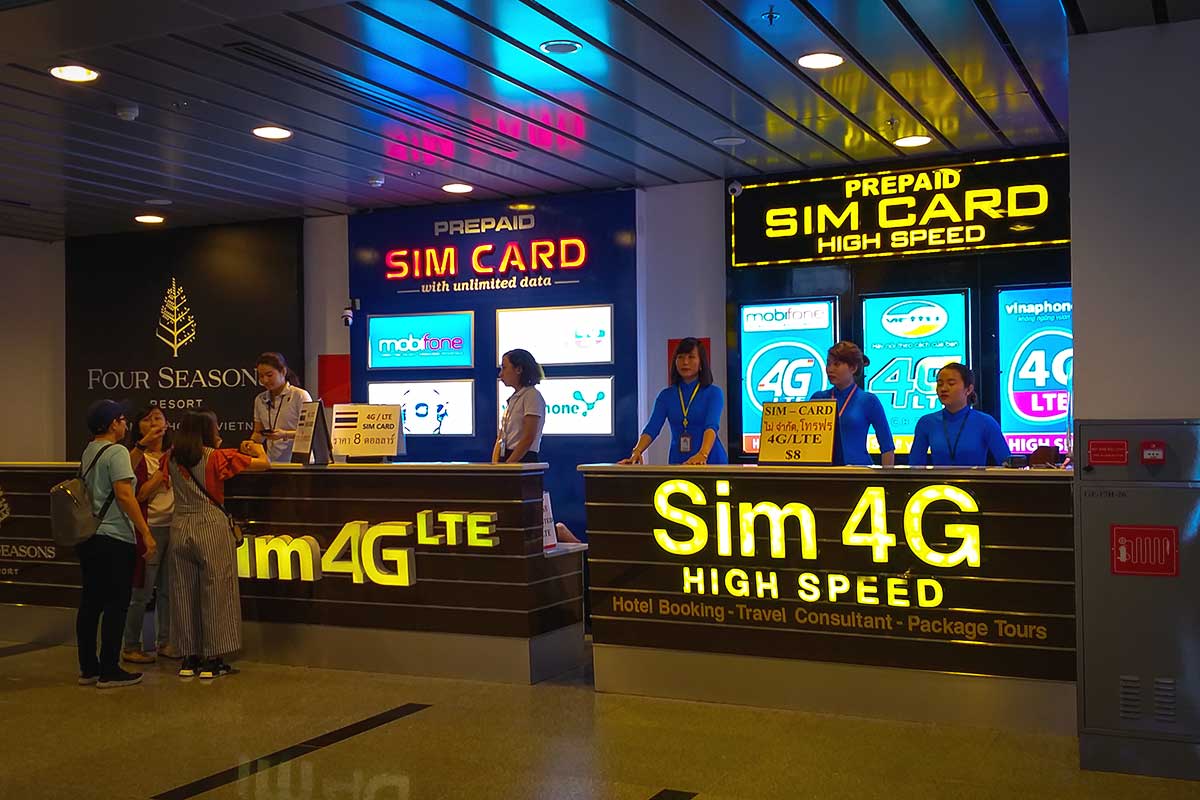
Staff speak English, register and install the SIM for you, and you walk out already online. That last part matters: it means you can order a Grab straight to your hotel instead of dealing with the taxi mafia. Prices are a little higher than in town, but still cheap. Do not leave the counter until you can see you have signal and are actually online.
At an official store
An official store means the SIM card is registered properly in your name, staff set it up and check it works, and the price is fixed and fair. Bring your passport.
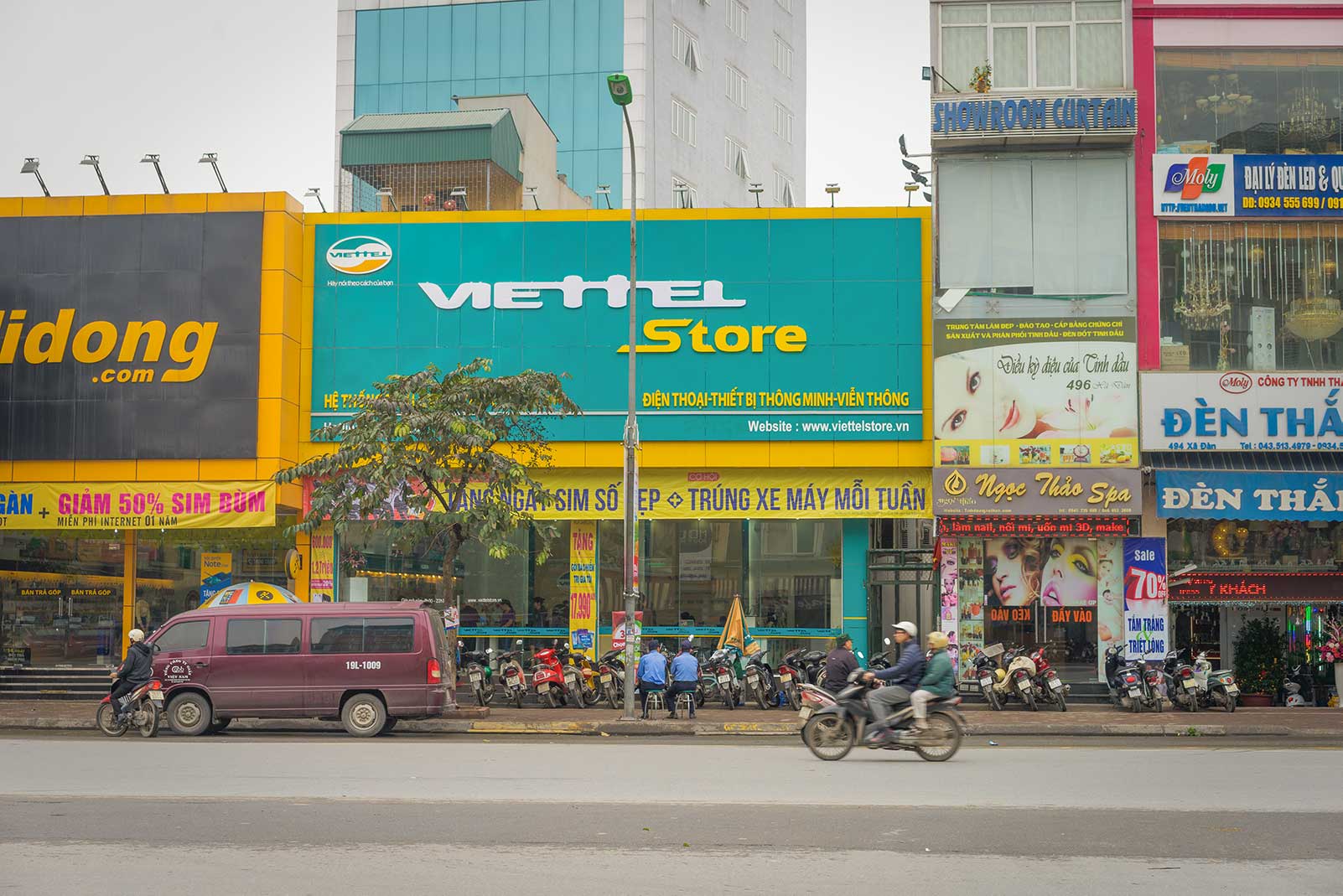
These are the main places selling official SIM cards, with branches across Vietnam:
- Viettel stores — the provider’s own shops, in every city and most towns. Best for the full range of Viettel plans and the most reliable registration. Viettel store locator
- Vinaphone (VNPT) stores — official Vinaphone outlets, widely available in cities and provincial centers. Vinaphone store locator
- Mobifone stores — official Mobifone shops around the country, plus the Hi Vietnam app if you would rather set up online. Mobifone store locator
- thegioididong (Mobile World) — the bright yellow phone chain with over a thousand branches nationwide, on nearly every main street. Sells SIMs from all the major networks. thegioididong store locator
- FPT Shop — another large phone and electronics chain with stores in most towns and cities, also selling SIMs from the main providers. FPT Shop store locator
If you want the widest choice of plans and the lowest official price, a provider store or one of the big chains is the place to go.
Unofficial sellers
Street stalls, convenience stores like Circle K and VinMart, and plenty of hostels also sell SIMs. Convenient and cheap, with the caveats covered above. They are perfectly fine for topping up. For your main SIM, just be a little more careful about what you are actually buying.
How much does a SIM card cost in Vietnam?
Data is genuinely cheap. A SIM card in Vietnam has two costs: the card itself and the data plan you load onto it.
- The physical SIM card: roughly 10,000 to 60,000 VND (about $0.50 to $2.50) for the plastic.
- A tourist data plan: roughly 60,000 to 200,000 VND (about $2.50 to $8) for 7 to 30 days.
- A common sweet spot: a plan with 3 to 5 GB per day, valid for a month, runs around 150,000 to 200,000 VND (about $6 to $8) at an official store.
How much data do you need? For almost everyone, 3 to 5 GB a day is plenty. That covers constant maps, messaging, social media, and some streaming without a second thought. Only heavy streamers or people running a hotspot need more.
“Tourist plans” are simply data bundles aimed at short stays. Some are data-only, some include call minutes. Prices and packages change constantly and vary from seller to seller, so treat the numbers above as a guide, not a quote. Either way, you will never pay much. Even the priciest tourist plan costs less than a single day of roaming from home.
Best SIM card provider in Vietnam
For most travelers, the best SIM card in Vietnam comes down to one network. Here is how the four providers stack up, ranked.
Viettel: the best choice for most travelers
Viettel has the largest network and by far the best coverage in the mountains and countryside, exactly where you want signal once you leave the cities. Riding the Ha Giang Loop, trekking around Sapa, exploring the caves at Phong Nha, or heading to a remote island: Viettel is the one that still has a signal when the others drop to nothing. It also runs the fastest 5G in the cities. If your trip goes anywhere off the main route, this is the network to buy. Viettel has also offered free roaming in Laos and Cambodia, handy if you cross borders, though the terms have changed before, so confirm when you buy.
Vinaphone: a solid second
Vinaphone matches Viettel for speed in the cities but weakens in remote and mountainous areas. Its tourist plan often includes a local phone number and call minutes, which helps if you specifically need a Vietnamese number for calls or verification codes.
Mobifone: fine for the cities
Mobifone works well in the cities but fades in remote provinces. It runs a tourist app called Hi Vietnam that bundles an eSIM, some free data to start, and card payment, useful if you want to set up before you arrive without visiting a shop.
Vietnamobile: skip it
Cheap, but its coverage falls apart outside the big cities. There is no real reason to choose it over the others.
Calling and staying in touch in Vietnam
Do you actually need calling? For most travelers, no. Two separate questions sit underneath this: whether you need to make normal phone calls, and how you message people day to day.
On calls, it depends on your plan. Some tourist plans are data-only, others include local and sometimes international minutes. If you want to phone hotels, Grab drivers, or tour operators from a Vietnamese number, choose a plan that includes minutes or one that comes with a local number. eSIMs are often data-only, so check before buying if calling matters to you.
But the honest reality is that you will barely dial a real phone number. Vietnam runs on apps.
Zalo and WhatsApp
You do not strictly need either app, but you will want at least one, and it helps to know which is used where.
WhatsApp is more common in Vietnam than most guides admit. Almost every business that deals with foreign travelers uses it: hotels, tour operators, travel agencies, dive shops, and drivers who work with tourists. If you are booking through the usual tourism channels, a WhatsApp message will usually get you a reply.
Zalo is Vietnam’s own app, and it is everywhere locals are. The more local the operator, the more likely they use only Zalo: many small bus companies, family-run homestays, rural guides, and drivers off the main tourist track. Book a homestay on the Ha Giang Loop or confirm a pickup in a small town, and the reply often comes on Zalo, not WhatsApp or email. Both apps do free calls, video, and messages over data or wifi.
So the practical setup is simple. Keep WhatsApp for the tourism side, and install Zalo too if you are heading anywhere off the beaten path. You can register Zalo with your home number, though verifying a foreign number is occasionally fussy. For reaching people back home, see the guide on calling into and out of Vietnam.
Keeping your number when you swap SIMs
The common worry: put in a Vietnamese SIM, and do you lose WhatsApp? No. WhatsApp, Telegram, Signal, and the like are tied to the number you first registered with and run over data. They keep working on your home number no matter which SIM is in the phone. The same goes for your Apple ID and iMessage.
The one real catch is SMS. Text-message codes, like bank logins and two-factor codes, are sent to your home number. If your home SIM is out of the phone, those texts will not arrive.
There are two clean fixes. Use an eSIM, so your home SIM stays in and active for texts while a Vietnamese eSIM handles the data. Or, if you are swapping a single physical SIM, sort out any app that relies on SMS codes before you travel, keep your home SIM somewhere safe, and bring a paperclip or ejector pin to make the swap.
How to top up your SIM
Topping up is easy and possible almost anywhere.
- At a provider store or a Mobile World shop, staff do it for you on the spot.
- At convenience stores and phone stalls, you buy a top-up voucher, and the vendor will usually load it for you even with almost no shared language.
- In the provider’s own app, you can pay by card and add data yourself, once the app is set up.
For a properly registered SIM, this is all straightforward. For an unregistered card from an unofficial seller, topping up can be hit and miss, which is one more reason to buy your main SIM from an official seller if you are staying a while. You can add credit manually with a code from the voucher, but letting the shop or vendor handle it is simply easier.
Good to know before you go
Coverage in the mountains and countryside
Vietnam’s 4G and 5G reach much further than people expect, including most of the Ha Giang Loop and the area around Sapa. There are still dead spots on the highest passes and deep in the valleys, so download offline Google Maps before you set off. Viettel gives you the best odds of holding a signal out there.
Do you need a VPN?
Vietnam blocks very little, so most travelers do not need one just to get online. A VPN is still worth having for two reasons: security on public wifi, and reaching home services that block you when they see a Vietnamese connection.
Useful apps to install first
Set these up on home wifi before you fly: Grab for transport and food, Google Maps and Translate, WhatsApp, Zalo, your provider’s app, and your booking apps. The full list is in the guide to the best apps for a Vietnam trip.
A few quick answers
Can I buy a SIM card before I arrive? Only as an eSIM. An eSIM bought online is the only way to be connected the moment you land. Physical SIM cards are bought on arrival.
Will my phone work? Any unlocked phone works with a physical SIM. An eSIM needs a reasonably recent phone. Either way, make sure your phone is unlocked before you travel, or a Vietnamese SIM will not work in it.
How much data do I really need? For nearly everyone, 3 to 5 GB per day is more than enough.
Can I use my Vietnamese SIM in Laos or Cambodia? Viettel has offered free roaming there. Confirm the current terms when you buy.