


Halong Bay: a seascape of limestone islands
Halong Bay sits about 3.5 hours east of Hanoi, a vast spread of jagged limestone islands, hidden lagoons, caves and floating villages in a sheltered bay off the northern coast. It’s the classic image of Vietnam, drawing huge numbers of visitors, and the standard way to see it is from the water on an overnight cruise. Quang Ninh province, which Halong belongs to, kept its name in the 2025 reforms, so nothing changes there for travelers.

It’s worth being honest about what Halong is and isn’t. The scenery is genuinely special, but the bay is busy and heavily touristed, and the quality of the experience depends almost entirely on which cruise you pick. The two neighbouring bays — Lan Ha and Bai Tu Long — offer the same landscapes with fewer boats, which is why they’re worth knowing about. A day trip is possible from Hanoi, but one or two nights on a cruise is far better.
Best things to do in Halong Bay
The single most important thing to understand: nearly all the best things to do in Halong Bay happen as part of a cruise, not as separate outings you arrange yourself. The kayaking, caves, floating villages, viewpoints, swimming and onboard activities below are almost all included in cruise itineraries, so the cruise you choose effectively decides what you’ll do. The list runs through them so you know what to look for when booking.
1. Take a Halong Bay cruise
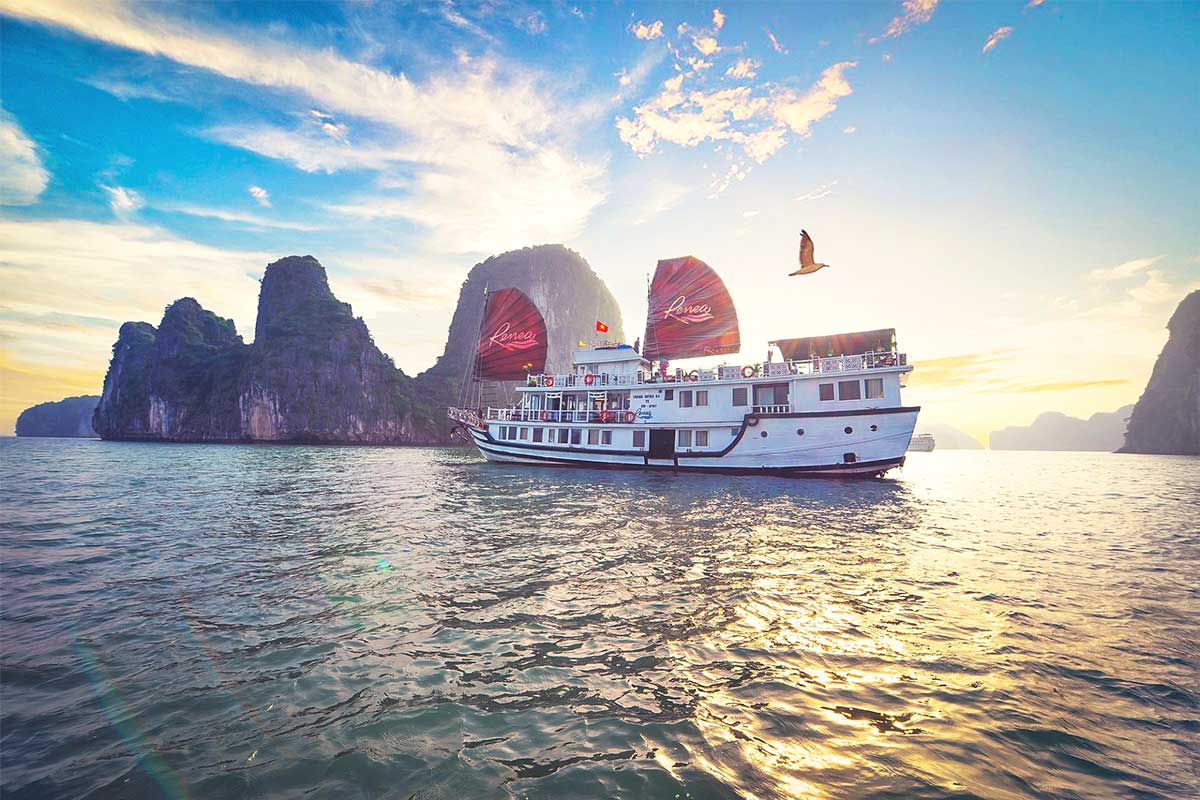
A cruise is the heart of any visit and by far the best thing to do in Halong Bay — there’s really no other way to properly see it. The water is calm and sheltered, so seasickness isn’t a worry, and gliding between the karst islands, away from the crowds at the harbour, is the experience people come for. There’s a huge range of boats, and the choice matters more here than almost anywhere, so it’s worth understanding the options.
Day cruise or overnight
A day cruise gives you a taste — a few hours on the water, a cave and a kayak — and works if you’re tight on time. But the bay is at its best in the early morning and evening light, after the day boats have gone, so an overnight cruise (one or two nights) is the better experience by a clear margin.
Budget to luxury
Boats run from cheap, basic backpacker cruises to genuinely luxurious ones with private balconies, spas and fine dining. Halong has had its share of poorly run and unsafe boats over the years, so this isn’t the place to book purely on price — the cheapest options are where corners get cut. Reading recent reviews carefully pays off.
Which bay it cruises
Crucially, “Halong Bay” cruises may actually sail in Halong, Lan Ha or Bai Tu Long Bay. The latter two are quieter and just as beautiful, so check which route a cruise takes before booking. With so many boats out there, our roundup of the best Halong Bay cruises, grouped by type and budget, is the place to start narrowing it down.
2. Take a scenic seaplane flight
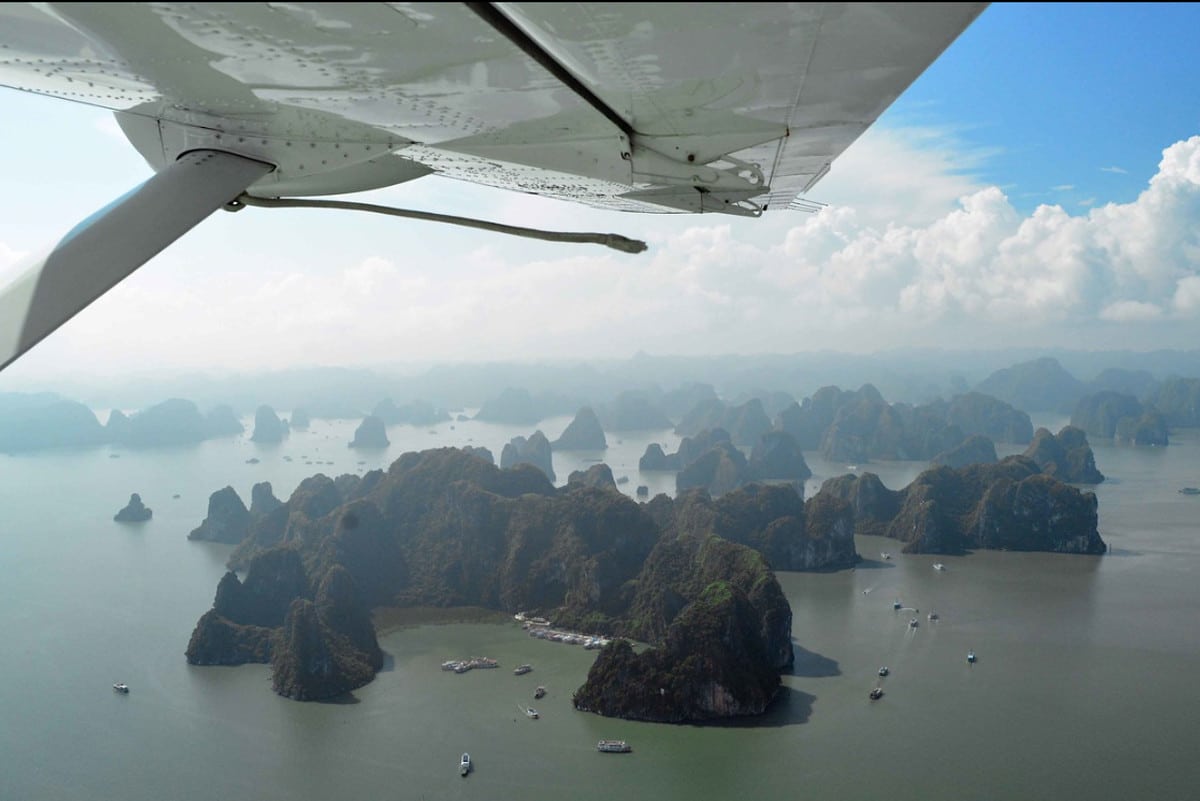
For a completely different perspective, a seaplane flight over the bay is the most spectacular way to grasp its scale — seeing the thousands of islands scattered across the water from above. The flights last around 25 minutes and take off from the water near Halong City, so the water landing and take-off are part of the thrill. It’s a splurge, but a memorable one, and you can photograph the whole way; some travelers combine a short flight with a cruise to get both the aerial and the on-the-water view.
3. Explore Cat Ba Island

Cat Ba is the largest island in the area and one of the few you can actually stay on, which makes it a popular base for exploring the bay independently rather than only by cruise. It sits on the edge of beautiful Lan Ha Bay (technically in Hai Phong rather than Quang Ninh), and it has its own national park with jungle treks, viewpoints and wildlife, plus beaches, kayaking, climbing and boat trips out into the bay. There’s far more to do here than a single guide entry can hold, so for the full picture — the park, the beaches, getting there and where to stay — see our dedicated guide to things to do on Cat Ba Island.
4. Go kayaking

Kayaking is one of the best things to do in Halong Bay, because it takes you where the big boats can’t — through low rock arches into hidden lagoons ringed by cliffs, and along quiet shorelines and beaches. The water is flat and current-free, so even complete beginners manage easily, and paddling under your own power, away from the engines, is a genuinely peaceful contrast to the cruise. Most cruises include a kayaking stop, with the option to take a small rowed boat instead if you’d rather be paddled, and it’s easy to skip if it’s raining or you don’t fancy it.
5. Visit the caves

The same limestone that forms the islands is riddled with caves, and visiting one is part of almost every cruise itinerary. They range from vast chambers to small grottoes, and several are lit (sometimes a little gaudily) in coloured light. The best known:
- Sung Sot Cave (Surprise Cave) — the biggest and most famous, a huge two-chamber cavern on Bo Hon Island, and the busiest.
- Thien Cung Cave (Heavenly Palace) — elaborate stalactite formations, one of the most beautiful and popular.
- Luon Cave — a low water tunnel you pass through by kayak or bamboo boat into an enclosed lagoon, more an experience than a walk-through.
There are many more across the bays. For the full set and which cruises visit them, see our guide to the caves of Halong Bay.
6. See the floating fishing villages
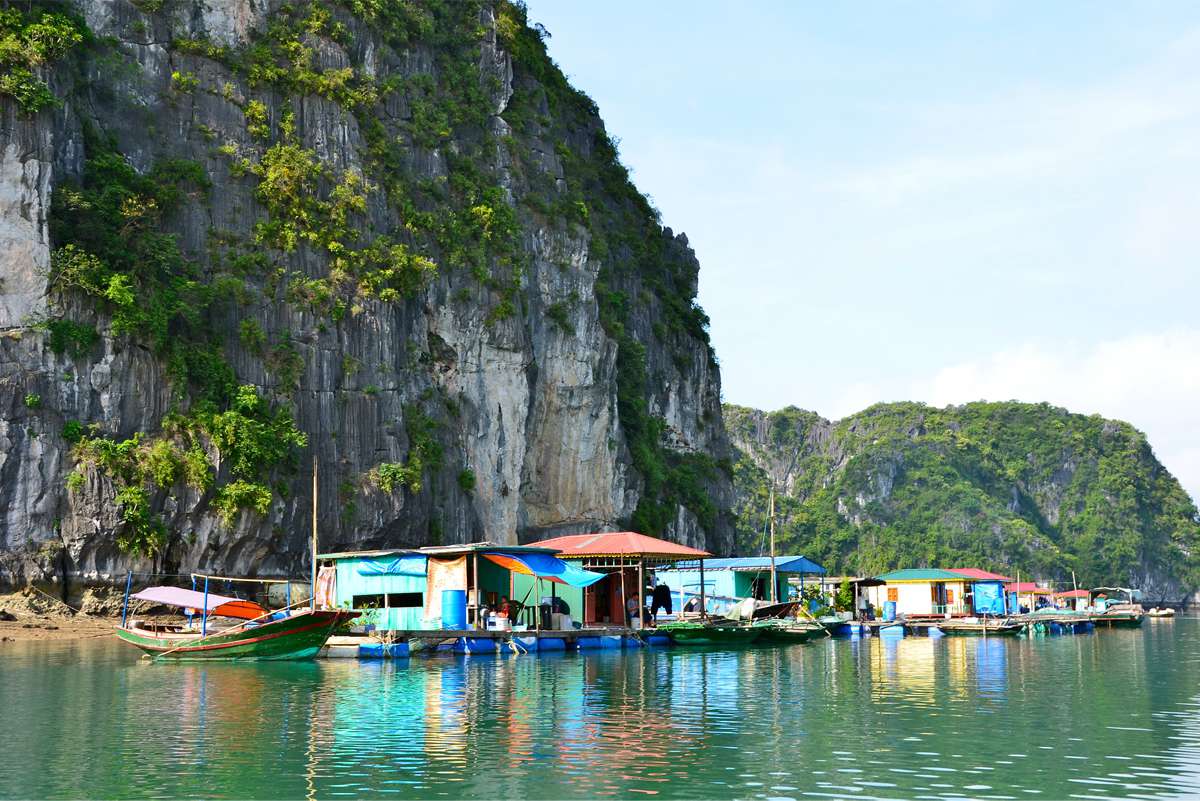
Halong’s calm waters are home to floating fishing villages — clusters of houses, fish farms and boats where families have long lived and worked on the water. Most have had their permanent populations reduced or relocated ashore in recent years for conservation reasons, so they’re quieter than they once were, but they remain working places rather than pure tourist set-ups, and visiting by rowboat is a genuine glimpse of bay life. The main ones:
- Cua Van — the largest and best known, in a sheltered spot in Halong Bay, with a small cultural centre.
- Vung Vieng — over in quieter Bai Tu Long Bay, visited by rowboat and far less crowded.
- Ba Hang — a small village near the Halong mainland, close to many cruise routes.
For more, see our guide to the floating villages of Halong Bay.
Continuing with 7 through the mainland section.
7. Relax on the beaches
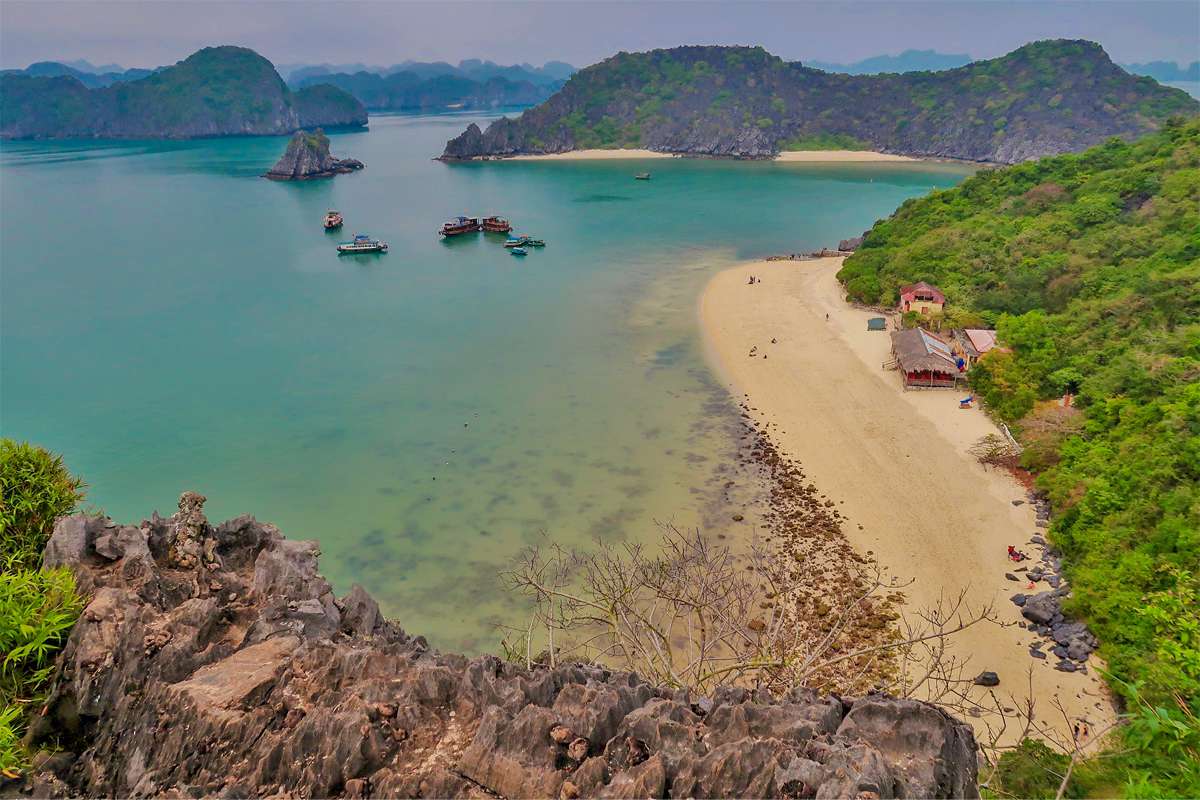
It’s worth setting expectations here: Halong Bay isn’t a beach destination in the usual sense. Most of the islands have no beach at all, and the ones that do tend to be small coves you can only reach by boat as part of a cruise — which is exactly what makes landing on one feel special. On a cruise you’ll often get a stop to swim off the boat or on a little island beach like Soi Sim or Ti Top, lovely in the warmer months. If you want proper beaches you can come and go from on your own, base yourself on Cat Ba Island instead, which has several you can reach by road.
8. Take in the viewpoints
The bay looks dramatic from the water, but the views from above are better still, and a few climbs deliver the postcard panorama over the islands. The best of them:

- Ti Top Island — a short, steep flight of steps in the middle of the bay leads to the classic viewpoint over the karsts; a very popular cruise stop, with a small beach at the bottom.
- Bai Tho Mountain — rising right behind Halong City, this gives a sweeping view over the bay and town, though access has been on and off over the years, so check it’s open before setting out.
- Cat Ba — the island has several viewpoints of its own, including the climb to the Cannon Fort, one of the best outlooks over Lan Ha Bay.
For more, see our guide to the best viewpoints in Halong Bay.
9. Enjoy the onboard activities
Beyond the big sights, a lot of what makes a cruise enjoyable is the small stuff laid on between stops — and which you get depends on the boat, so it’s worth checking the itinerary. Common ones include:
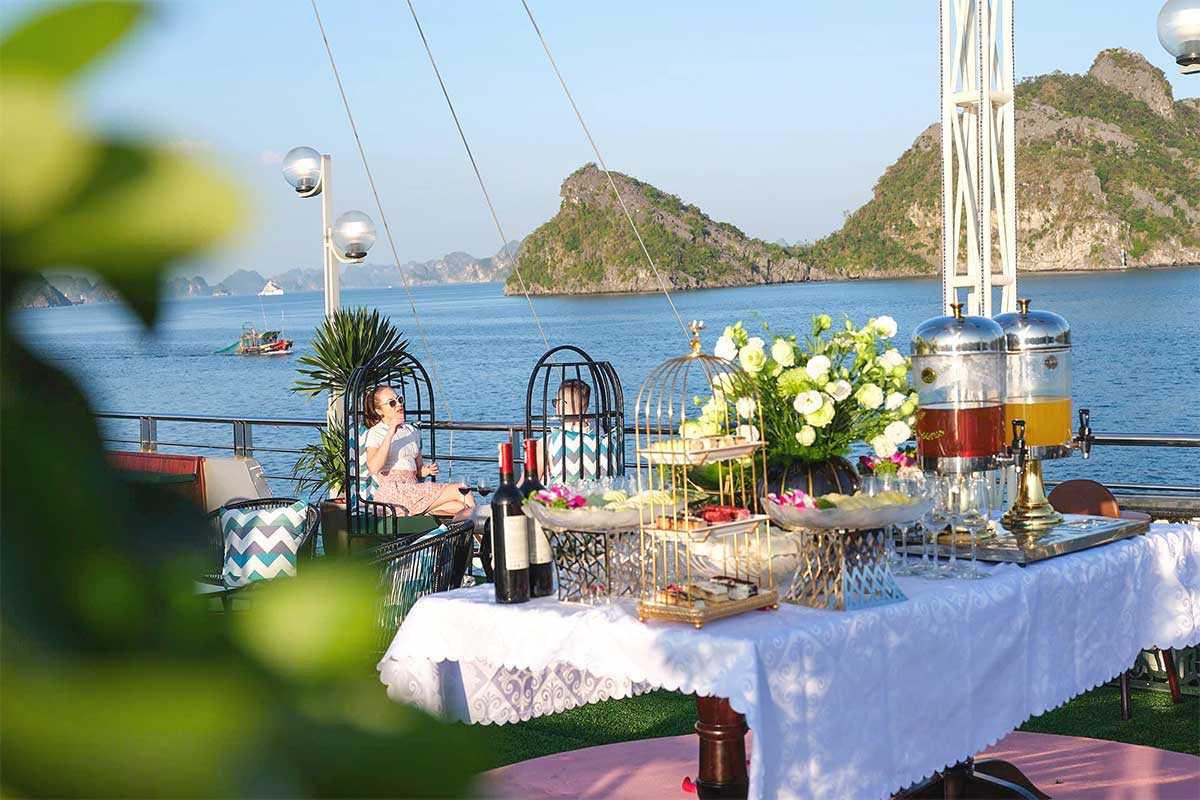
- Sunset on the top deck — drinks and the day’s best light over the islands, often the highlight of the trip.

- Cooking class — a hands-on session making spring rolls or another Vietnamese dish, usually in the afternoon.
- Squid fishing — trying your luck off the back of the boat after dark, a low-key bit of evening fun.
- Morning tai chi — a gentle sunrise session on deck, surprisingly popular.
- Swimming and pearl farms — a dip off the boat, and some cruises stop at a pearl farm to see how they’re cultivated.
None of these alone is a reason to pick a cruise, but together they shape the rhythm of the trip, so a good itinerary makes a real difference.
10. Discover the mainland and Quang Ninh
Most people treat Halong City purely as a place to get on a boat, but the surrounding mainland and wider Quang Ninh province have a few worthwhile things to do, especially if you have a spare half-day before or after a cruise:
- Halong City itself, with its night market, the riverside, and seafood restaurants in the local Hon Gai side.
- The Sun World cable car across the bay, whose record-breaking cabins and giant Ferris wheel give an easy high view over the city and water.
- Yen Tu Mountain, about an hour away, the sacred birthplace of Vietnamese Zen Buddhism, reached by cable car or a long stair climb to its bronze summit pagoda — recently UNESCO-listed and a major pilgrimage site.

- Binh Lieu, a remote, mountainous district near the Chinese border far inland, with green ridge walks and ethnic-minority villages — well off the tourist trail and nothing like the coast.
These suit travelers with extra time rather than a first short visit, but they show there’s more to Quang Ninh than the boat harbour.
Halong Bay vs Lan Ha Bay vs Bai Tu Long Bay
One thing that confuses many first-time visitors: “Halong Bay” is really three connected bays, and which one your cruise sails matters. They share the same landscape of limestone islands and emerald water, but differ in how busy and developed they are.
Halong Bay is the original and most famous, with the biggest islands, the best-known caves and the most dramatic scenery — but also by far the most boats and tourists, especially on the main routes. It’s the easiest to reach from Hanoi.
Lan Ha Bay, to the south off Cat Ba Island, is just as beautiful, with more beaches and far fewer boats. It technically sits in Hai Phong rather than Quang Ninh, and it’s the natural choice if you’re basing yourself on Cat Ba. Our guide to Lan Ha Bay covers it in full.
Bai Tu Long Bay, to the northeast, is the quietest of the three — the same karst scenery with a fraction of the crowds, the trade-off being a slightly longer transfer from Hanoi. It’s the pick if avoiding the masses is your priority, as our guide to Bai Tu Long Bay explains.
In short: choose Halong for the classic, easy-to-reach scenery, Lan Ha for beaches and a Cat Ba base, and Bai Tu Long for peace and quiet. A “Halong Bay cruise” might sail any of the three, so always check the route before booking.
Best time to visit Halong Bay
The best times to visit Halong Bay are spring (March to April) and autumn (September to October), when the weather is cool, clear and pleasant, and the bay is at its most comfortable for cruising. These are the sweet spots either side of the summer.
Summer (May to early September) is warm and sunny, the best time for swimming under blue skies, but it’s also peak domestic season and carries a real risk of storms — typhoons can and do cancel cruises at short notice, so build in some flexibility. Winter (November to March) turns cold, grey and often foggy, especially January and February; the haze can mute the views, and it’s too cold to swim, though a clear winter day still has its own quiet beauty. For a month-by-month look, see our guide to the best time to visit Halong Bay.
Where to stay in Halong Bay
Where you stay depends on whether you want to be on the water, on an island, or on the mainland.
On a cruise
For most people the best option is to sleep on the cruise itself — it’s the whole point of coming, and waking up among the islands at dawn, before the day boats arrive, is the experience you’ll remember. One or two nights is plenty, and it doubles as your accommodation, transport and sightseeing rolled into one.
Cat Ba Island
Cat Ba is the best base if you want to explore on your own rather than only by cruise, with the widest choice of hotels, hostels and resorts, plus the national park, beaches and boat trips into Lan Ha Bay on your doorstep. Good for travelers who want flexibility and a few days in the area.
Halong City and Tuan Chau
Halong City on the mainland has plenty of hotels and is handy for a night before or after a cruise, though it lacks the bay atmosphere. Nearby Tuan Chau Island, connected by road, holds the main cruise harbour and some resorts, but feels manufactured and short on local character.
How to get to Halong Bay
With your cruise
The simplest way, and what most people do: nearly all cruises include road transfer from Hanoi and back, usually a comfortable shuttle or limousine van, around 2.5 to 3.5 hours each way on the expressway. Cruises into Lan Ha or Bai Tu Long Bay sometimes charge extra for transfers, as they leave from ports further out.
By bus or private car
If you’re travelling independently, frequent buses and limousine vans run from Hanoi to Halong City in around 3.5 hours, and a private car gives you the most flexibility. From Halong it’s also possible to arrange transport straight on to Ninh Binh without backtracking to Hanoi.
By seaplane
For a memorable arrival, the seaplane from Hanoi lands at Tuan Chau Island near Halong City — expensive, but it doubles as a scenic flight over the bay.
How to get around Halong Bay
Out on the water, a boat is the only way around, and that’s covered by your cruise. On land, things are simpler: on Cat Ba Island you can rent a scooter or hire a car with driver to reach the beaches, the national park and the viewpoints, and cycling is popular too, with many places renting bikes. To see more of the bay itself, the answer is always a boat trip.
Itinerary: 2 days in Halong Bay
A standard overnight cruise covers the best things to do in Halong Bay, and a typical two-day, one-night itinerary looks like this:
Day 1
- Transfer from Hanoi and board your cruise around midday.
- Lunch on board as you sail out among the islands.
- Kayak or take a rowboat into a lagoon, and visit a cave.
- Swim or relax, then watch the sunset from the top deck with a drink.
Day 2
- Early risers catch the sunrise and a tai chi session on deck.
- Visit a floating village or another cave, or climb a viewpoint.
- Brunch on board as the boat heads back to harbour.
- Disembark around midday and transfer back to Hanoi.
Tips for traveling to Halong Bay
Choose your cruise carefully
It bears repeating because it matters more than anything else: the cruise makes or breaks the trip. Read recent reviews, check exactly which bay and route it sails, and don’t book on price alone — the cheapest boats are where standards slip.
Watch the weather in summer
Storms and typhoons in summer can cancel cruises at no notice. Keep a day’s flexibility in your plans around a Halong trip, and don’t schedule a tight onward flight for the morning you’re due back.
Pack for the boat
Bring layers even in summer, as it’s breezy on the water and cooler in the evenings; in winter, a proper warm jacket. Swimwear, a light rain layer and motion-sickness tablets (just in case, though the water is calm) are all worth having.
Manage expectations
Halong is beautiful but popular, so the main routes get busy and the caves can be crowded. If peace matters more to you than the famous name, choose a cruise into Lan Ha or Bai Tu Long Bay instead.
Traveling with kids
Halong is a great trip with children — swimming, kayaking and the boat itself keep them busy. Look for a cruise with the right facilities and activities, as our notes on a Halong Bay family cruise explain.
What to expect from Halong Bay: an honest verdict
The scenery at Halong Bay never gets old, however many times you see it — the views are extraordinary and the landscape genuinely hard to believe. That much is beyond doubt. The honest steer is about where you cruise rather than whether you go: for many travelers, neighbouring Lan Ha Bay (especially combined with some self-guided island time on Cat Ba) or quieter Bai Tu Long Bay deliver the same breathtaking karst scenery with far fewer boats. Halong itself remains spectacular and the easiest to reach, but going in knowing the alternatives is what turns a good trip into the right one.