What to know before planning a Vietnam holiday
Before diving into destinations and itineraries, it helps to understand what kind of country Vietnam is — and whether it suits the way you travel. This section covers the practical realities that matter before you even start planning.
Safety
Vietnam is one of the safer countries in Southeast Asia for foreign travelers. Violent crime against tourists is rare, and most visitors complete their trip without any serious incident. Petty theft exists in busy areas — bag snatching on motorbikes is the most common issue in Ho Chi Minh City — but it is not widespread enough to be a constant concern.
Scams do occur, mostly around overcharging, unofficial taxi drivers, and pushy vendors in tourist hotspots. None of it is particularly sophisticated, and a little awareness goes a long way. The bigger daily risk is traffic. Vietnamese roads are busy and chaotic by most Western standards, and crossing the street or riding a motorbike takes some adjustment.
Overall, Vietnam is a comfortable and accessible destination for solo travelers, couples, and groups alike.
Traveling with kids
Vietnam is an excellent destination for families. Children tend to be welcomed warmly everywhere, and there is no shortage of things to keep them engaged — boat trips, beaches, open markets, and street food are all naturally interesting for younger travelers.
The country is safe for kids, food options are varied enough to satisfy picky eaters, and the mix of nature and culture means there is something for every age group. Longer travel days between destinations can be tiring, so it is worth building some buffer into a family itinerary. With the right pacing, a Vietnam holiday with kids is one of the most rewarding ways to travel here.
Traveling as a senior
Vietnam suits senior travelers well. The country has a strong culture of respect for older people, service is generally attentive, and door-to-door transport options are widely available at relatively low cost — meaning there is no need to navigate complicated public transport systems.
The main practical challenge is infrastructure. Pavements in cities are often uneven, blocked by parked motorbikes, or simply nonexistent. Some attractions involve stairs or uneven terrain. None of this makes Vietnam off-limits for seniors, but it is worth keeping in mind when selecting destinations and accommodation. Choosing a well-located hotel and arranging private transfers removes most of the friction.
Budget: what does a Vietnam holiday cost?
Vietnam remains an affordable destination by international standards, though prices have risen in recent years — particularly in popular tourist areas.
As a rough guide:
- Budget traveler: $30–50 USD per day. Hostel beds or basic guesthouses, local street food and simple restaurants, public or shared transport.
- Mid-range traveler: $80–150 USD per day. Comfortable hotels, a mix of local and tourist restaurants, private transfers, and paid tours.
- Comfort traveler: $200 USD and above per day. Boutique hotels and resorts, private guides, domestic flights between destinations, and higher-end dining.
Flights and tours are additional costs on top of daily spend. Vietnam is genuinely good value at every level, but budget travelers who expect rock-bottom prices in popular spots like Hoi An or Phu Quoc may find things more expensive than expected.
How easy is it to travel in Vietnam?
Vietnam is easier to travel than many first-time visitors expect. Tourist infrastructure is well developed along the main route from Hanoi in the north to Ho Chi Minh City in the south, with plenty of accommodation options at every price point, reliable transport connections, and a well-worn path that independent travelers have followed for decades.
English is spoken in most hotels, tour operators, and restaurants in tourist areas. Outside of those areas, communication can be harder — but gestures, translation apps, and the general willingness of Vietnamese people to help make it manageable. The country is not without its frustrations, but difficulty navigating it is rarely one of them.
Best time for a Vietnam holiday
Vietnam’s climate does not follow a simple wet and dry season. The country stretches over 1,600 kilometers from north to south, crosses multiple climate zones, and has mountain regions that behave differently from the coast. The result is that there is no single best time for a Vietnam holiday — the right month depends on where you are going.
Best time for North Vietnam
North Vietnam has four distinct seasons, which is part of what makes it so appealing. The best time to visit is autumn (September to November) and spring (March to May). Temperatures are comfortable, skies are clearer, and the landscapes — particularly in Ha Giang and Sapa — are at their most dramatic.
Summer (June to August) is warm and sees more rainfall, though it is still a popular travel period. Winter (December to February) brings cold temperatures to the mountains, occasionally dropping close to zero at higher elevations. It can be atmospheric, but pack layers.
The Tet holiday period (late January to late February, depending on the year) sees domestic travel spike sharply. Some businesses close, transport fills up quickly, and popular spots get busy. Worth knowing before you book.
Best time for Central Vietnam
Central Vietnam — covering Hue, Da Nang, Hoi An, and the surrounding coastline — has a climate that runs roughly opposite to the north and south. The dry season runs from February to August, making this the most reliable window for a visit.
September to January brings the wet season, with October and November seeing the heaviest rainfall. Flooding in Hoi An during this period is common and can disrupt travel. The beaches along the central coast are best enjoyed between April and August, when conditions are consistently sunny and calm.
Best time for South Vietnam
The south — including Ho Chi Minh City, the Mekong Delta, and Phu Quoc — has a cleaner two-season pattern. The dry season runs from November to April and is the most comfortable time to visit. Humidity is lower, rain is rare, and beach conditions on Phu Quoc are at their best.
The wet season (May to October) brings daily rainfall, typically in short afternoon bursts rather than all-day downpours. Travel is still very possible during this period, and prices are lower. The Mekong Delta is actually more interesting during the wet season, when water levels are high and the floating markets are more active.
Best time for all of Vietnam
If the plan is to travel through multiple regions in one trip, February to April is the closest thing to a universally good window. The north is coming out of winter with improving conditions, central Vietnam is in its dry season, and the south is still comfortably dry. It is not perfect everywhere simultaneously — nowhere in Vietnam ever is — but it is the most reliable overlap for a north-to-south Vietnam holiday.
Biggest highlights of a Vietnam holiday
The best things to do during a Vietnam holiday range from motorbike routes through remote mountain landscapes to boat trips on calm bays, ancient town streets, and some of the most rewarding beaches in Southeast Asia. The list below covers the experiences that genuinely stand out — not everything worth seeing, but the highlights that most travelers look back on as the best parts of their trip. They are not ranked. What belongs at the top of your list depends entirely on the kind of traveler you are.
1. Drive the Ha Giang Loop
The Ha Giang Loop is the most spectacular motorbike route in Vietnam, and for many travelers the single best experience the country has to offer. The route winds through the rocky plateau of Ha Giang in the far north, passing dramatic limestone karst formations, deep river valleys, and remote Hmong and Dao villages that see far fewer tourists than anywhere else on the typical Vietnam circuit.
Most travelers do the loop over three to four days, either self-driving or on the back of a motorbike with a local driver. The roads are winding and the elevation changes are significant — this is not a relaxing ride, but the scenery at every turn makes it one of the most memorable stretches of road in Southeast Asia.
Ha Giang is still relatively untouched compared to other northern destinations, which is a big part of its appeal. That is slowly changing, but it remains the kind of place that rewards travelers who make the effort to get there.
2. Trekking in Sapa
Sapa is Vietnam’s most established trekking destination, set in the Hoang Lien Son mountains close to the Chinese border. The landscape is defined by stepped rice terraces that cascade down hillsides, and the area is home to several ethnic minority groups — most visibly the Black Hmong and Red Dao — whose villages are accessible on foot.
Trekking in Sapa ranges from easy half-day walks to multi-day routes that involve homestays in remote villages. The experience is most rewarding when done with a local guide, preferably from one of the minority communities themselves. The town of Sapa has become heavily developed and commercialized in recent years, but the surrounding valleys remain genuinely beautiful.
The best trekking conditions are in spring (March to May) and autumn (September to November). During winter, cloud and mist can obscure the views entirely.
3. Explore Hoi An ancient town
Hoi An ancient town is one of the best-preserved trading ports in Southeast Asia and a UNESCO World Heritage Site. The old town core is compact and walkable, lined with wooden merchant houses, Chinese assembly halls, tailor shops, and more restaurants per square meter than almost anywhere in Vietnam.
It is undeniably touristy — Hoi An ancient town draws large crowds, particularly in the evenings when lanterns are lit along the river — but it has earned its reputation. The architecture is genuinely impressive, the food scene is excellent, and the surrounding area offers cycling routes through rice fields and access to a long stretch of beach a few kilometers away.
The key is managing expectations. Come for the atmosphere and the food, not for an off-the-beaten-track experience.
4. Cruise in Halong Bay
A cruise in Halong Bay remains one of the most iconic experiences on any Vietnam holiday. The bay is home to thousands of limestone karsts rising from calm green water, and seeing it from the deck of a boat — particularly at dawn or dusk — is genuinely impressive.
The main challenge with Halong Bay is the volume of visitors and the wide variation in cruise quality. Budget boats can feel rushed and crowded. A mid-range or higher-end cruise makes a significant difference to the experience. It is also worth considering Lan Ha Bay or Bai Tu Long Bay as alternatives — both share the same landscape, with fewer boats and a quieter atmosphere.
A two-day, one-night cruise is the minimum worth doing. Three days gives more time to kayak, swim, and explore caves at a slower pace.
5. Floating markets in the Mekong Delta
The Mekong Delta is a vast network of rivers, canals, and rice paddies in southern Vietnam, and the floating markets are its most distinctive feature. Traders sell fruit, vegetables, and goods directly from boats, with the largest and most active markets found around Can Tho.
The floating markets in the Mekong Delta are best visited early — most activity happens between 5am and 8am, after which things wind down quickly. A boat tour from Can Tho is the standard way to visit, and it is worth combining with time in the delta’s quieter canal villages, where daily life feels genuinely removed from the tourist trail.
6. Boat trip in Ninh Binh
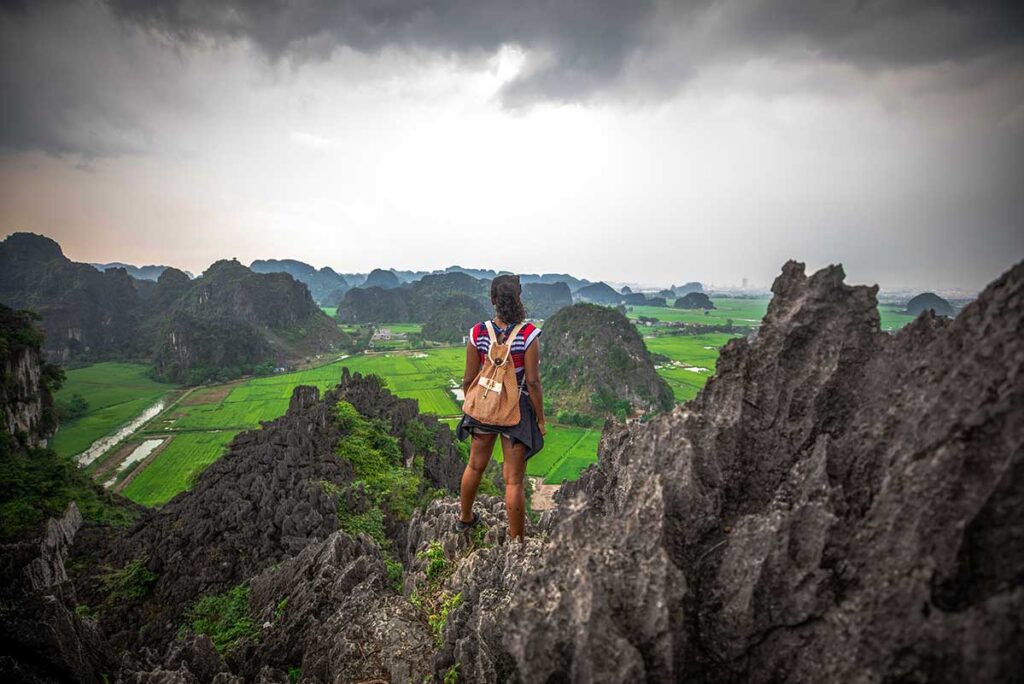
Ninh Binh is often called Halong Bay on land, and the comparison is fair. The landscape is similar — limestone karsts rising sharply from flat ground — but here the water is freshwater, and the surrounding rice paddies add a different kind of beauty to the scene.
The two main boat trip routes are Tam Coc and Trang An. Both involve rowing through a series of caves and past dramatic cliff faces. Trang An is the more expansive route and a UNESCO World Heritage Site. Tam Coc is shorter and more accessible, but also busier. Either makes for a worthwhile half-day.
Ninh Binh is easily visited from Hanoi as a day trip or short overnight, which makes it one of the most accessible highlights on a Vietnam holiday.
7. Hue Imperial Citadel
Hue was Vietnam’s imperial capital for most of the 19th and early 20th centuries, and the Hue Imperial Citadel is the physical heart of that history. The complex is modeled loosely on the Forbidden City in Beijing, with a series of gates, palaces, courtyards, and ceremonial halls enclosed within thick walls and a moat.
Much of the citadel was damaged during the Vietnam War and has been partially restored. Some sections are still in ruins, which adds a certain atmosphere but also means it requires some imagination to fully appreciate. A good guide makes a real difference here — the history is layered and the site is large enough to feel overwhelming without context.
Hue is also worth exploring beyond the citadel. The royal tombs scattered outside the city, the Thien Mu Pagoda, and the city’s distinct food culture all add depth to a visit.
8. Beaches of Phu Quoc
Phu Quoc is Vietnam’s largest island and its most developed beach destination. Phu Quoc beaches range from the busy, bar-lined Long Beach on the west coast to quieter stretches in the north and the increasingly developed Sao Beach in the south.
The water is clear, the sunsets on the west coast are reliably beautiful, and the island has a range of accommodation that suits every budget. It has grown quickly over the past decade, and parts of it feel more like a resort complex than a tropical island. The north and east remain quieter, and a boat trip to the surrounding islands offers some of the best snorkeling in Vietnam.
Phu Quoc is at its best between November and April, when the sea is calm and rainfall is low.
9. Diving in Con Dao
Con Dao is an archipelago of 16 islands off the southern coast, and the best destination in Vietnam for serious divers. The marine national park surrounding the islands has some of the healthiest coral reefs in the country, with strong visibility and relatively few boats compared to more popular dive sites elsewhere in Southeast Asia.
Diving in Con Dao is best between February and July. The islands are also home to one of Vietnam’s most significant sea turtle nesting sites, and night dives during nesting season are a highlight for those who time it right.
Con Dao has a dark history — the prison complex used during the French colonial period and the Vietnam War is one of the most sobering historical sites in the country. Most visitors combine diving with a visit to the prison, which adds a layer of depth to the trip that purely beach-focused islands lack.
10. Trekking in Pu Luong
Pu Luong is a nature reserve in Thanh Hoa province that offers some of the best trekking in northern Vietnam without the crowds of Sapa. The landscape is defined by terraced rice fields, forested hills, and traditional Thai and Muong villages connected by narrow paths and suspension bridges.
Trekking in Pu Luong suits travelers looking for a quieter, more off-the-beaten-track alternative to the more famous northern destinations. Trails are generally moderate, and most visits involve one or two nights in a homestay, which are typically simple but welcoming. The best time to visit is September to November, when the rice terraces turn gold before harvest.
11. Street food in the Hanoi Old Quarter
The Hanoi Old Quarter is one of the most atmospheric urban neighborhoods in Southeast Asia — a dense grid of narrow streets, each historically associated with a particular trade, now filled with guesthouses, coffee shops, and an extraordinary concentration of street food.
Eating your way through the Hanoi Old Quarter is one of the great pleasures of a Vietnam holiday. Pho, bun cha, banh mi, cha ca, egg coffee — the classics are all here, often served from tiny plastic stools on the pavement, steps from where they have been made for generations. A street food tour with a knowledgeable local guide is one of the best ways to get beneath the surface of what is on offer.
The Old Quarter is also worth exploring on foot at different times of day. Early mornings are quiet and atmospheric. Evenings around Hoan Kiem Lake draw locals and visitors alike.
12. History in Ho Chi Minh City
Ho Chi Minh City is Vietnam’s largest and most energetic city, and while it is not a place most visitors come to slow down, it offers some of the most important historical experiences on any Vietnam holiday.
The Cu Chi Tunnels, located about 40 kilometers from the city center, are an extraordinary reminder of what Vietnamese forces endured during the war — an underground network of tunnels stretching for hundreds of kilometers, used for shelter, supply lines, and surprise attacks. The War Remnants Museum in the city center is one of the most powerful war museums in the world, with a photographic collection that is difficult to forget.
Beyond the history, Ho Chi Minh City rewards time spent simply walking. The French colonial buildings around Dong Khoi, the chaotic energy of District 1, and the quieter streets of older neighborhoods like District 3 all offer a different side of the city.
13. Off the beaten track in Cao Bang
Cao Bang is one of the least-visited provinces in Vietnam, tucked into the far northeast close to the Chinese border. For travelers who have already covered the main highlights and are looking for something genuinely different, it delivers.
Ban Gioc Waterfall is the headline attraction — one of the largest waterfalls in Southeast Asia, set on the border with China and far more impressive in scale than most waterfalls in the region. The surrounding area holds other rewards: the Phong Nam Valley offers a quiet, rural landscape of karst peaks and rice paddies, Angel Eye Mountain provides a panoramic viewpoint that few travelers reach, and the Me Pia Pass is a winding mountain road with views that rival anything on the Ha Giang Loop.
Cao Bang requires more planning and more time than a typical stop on the tourist trail, but that is exactly what makes it worth it.
14. Adventure in Dalat
Dalat is Vietnam’s adventure capital, a highland city in the southern mountains that has built a strong reputation for outdoor activities. Canyoning in Dalat is the most popular draw — a full-day descent through waterfalls, natural slides, and rappels that suits both beginners and experienced adventurers.
Beyond canyoning, the area offers trekking through pine forests and coffee plantations, mountain biking on trails that range from gentle to technical, and the Dalat easy rider — a motorbike tour with local guides that is one of the most enjoyable ways to explore the surrounding countryside at a relaxed pace.
Dalat also has a distinct character shaped by its French colonial past, its cool highland climate, and a growing food and coffee scene. It is a place that works equally well as an adventure base and as a destination to simply slow down.
15. Beaches of the central coast
Vietnam’s central coast has a long stretch of beaches that offer a quieter and often more affordable alternative to Phu Quoc. Da Nang is the largest city on the coast and the main gateway, with a wide beach, good infrastructure, and easy access to both Hoi An and the Marble Mountains.
Nha Trang is the most developed beach resort on the central coast — busy, lively, and well set up for water sports and island hopping. Quy Nhon is significantly quieter, with a beautiful bay and a relaxed atmosphere that attracts travelers looking to escape the more crowded spots. Phu Yen, just north of Nha Trang, remains largely undiscovered and offers some of the most dramatic coastal scenery in Vietnam — rocky headlands, empty beaches, and a pace of life that feels entirely unhurried.
Booking flights for your Vietnam holiday
Vietnam has two main international airports: Noi Bai International Airport in Hanoi and Tan Son Nhat International Airport in Ho Chi Minh City. Which one to fly into depends on your itinerary. If the plan is to start in the north and work south, Hanoi is the natural entry point. For trips focused on the south or central regions, Ho Chi Minh City makes more sense. It is also worth considering flying into one city and out of the other to avoid backtracking.
Direct flights to Vietnam
The number of direct flight options to Vietnam has grown significantly in recent years. Below is an overview of the main direct connections currently available for a Vietnam holiday:
- United Kingdom (London Heathrow) – Vietnam Airlines, approximately 11–12 hours
- France (Paris) – Vietnam Airlines, approximately 11 hours
- Germany (Frankfurt) – Vietnam Airlines, approximately 11 hours
- Netherlands (Amsterdam) – No direct flights currently available; connections typically via the Middle East, Southeast Asia, or East Asia
- Australia (Sydney, Melbourne, Brisbane, Perth) – Vietnam Airlines, Qantas, Jetstar, approximately 8–10 hours
- United States (Los Angeles, San Francisco) – No direct flights currently available; connections typically via East or Southeast Asia
- Japan (Tokyo, Osaka) – Vietnam Airlines, ANA, JAL, approximately 5–6 hours
- South Korea (Seoul) – Vietnam Airlines, Korean Air, Asiana, approximately 4–5 hours
- Singapore – Vietnam Airlines, Singapore Airlines, Scoot, approximately 2 hours
- Thailand (Bangkok) – Multiple carriers, approximately 1.5–2 hours
- China (multiple cities) – Multiple carriers, approximately 2–4 hours depending on origin
Direct flight availability changes. Always check current routes when booking.
When to book flights
For travel during peak season — roughly November to April, when conditions are best across most of Vietnam — booking flights three to six months in advance is advisable, particularly for travel over Christmas, New Year, and the Tet holiday period. Last-minute availability during these windows is limited and prices rise sharply.
For shoulder season travel, one to three months in advance is usually sufficient to find good fares. Flexibility on travel dates by even a day or two can make a noticeable difference to the price, and flying midweek is generally cheaper than weekends.
Next. make sure to use main keyword 1 or 2 times in the text naturally.
Planning your Vietnam holiday itinerary
The planning stage is where most travelers either set themselves up for a great trip or quietly set themselves up for disappointment. Vietnam is a long country with a lot to offer, and the most common mistake is trying to cover too much. A well-planned Vietnam holiday is not about ticking off the most destinations — it is about giving each place enough time to actually enjoy it.
Picking the right destinations
The right destinations depend entirely on what kind of traveler you are. A family with young kids needs a different itinerary than a couple looking for trekking and adventure. Someone on their first Vietnam holiday will prioritize differently than a repeat visitor looking to go deeper.
For more inspiration based on travel style, the guides below are a good starting point:
- Best things to do with kids in Vietnam
- Best nature destinations in Vietnam
- Most beautiful beaches in Vietnam
- Unique cultural experiences in Vietnam
- Best places for trekking in Vietnam
- More Vietnam travel inspiration
How long to spend in Vietnam
Two weeks is the most common length for a Vietnam holiday, and it is a workable amount of time — but only if the itinerary is focused. Two weeks is enough to cover the north or the south in reasonable depth, or to do a highlights route from Hanoi to Ho Chi Minh City with a handful of stops.
Three weeks or more opens things up considerably. It allows for slower travel, detours off the main route, and time to actually settle into a place rather than passing through it.
One week is tight but manageable for a single region. Trying to see the whole country in seven days results in a trip that feels more like a series of transfers than an actual holiday.
As a general rule, fewer destinations with more time at each is almost always more satisfying than the alternative.
Booking accommodations
Vietnam has accommodation options at every price point, from basic guesthouses to internationally branded resorts. For budget and mid-range stays, booking a few days in advance is usually fine outside of peak season. In popular destinations like Hoi An, Sapa, and Phu Quoc, and during the November to April high season, booking further ahead is strongly recommended — good mid-range hotels fill up quickly.
Booking.com is the most widely used platform and generally has the best selection. Reading recent reviews carefully pays off — quality can vary significantly even within the same price bracket, and location matters more in some towns than others.
Getting between destinations
Vietnam’s main transport options each have their strengths depending on the distance and the type of traveler.
Domestic flights
Domestic flights are the fastest and often most practical way to cover long distances — Hanoi to Ho Chi Minh City by air takes two hours compared to 30-plus hours by train. Vietnam Airlines, Vietjet, and Bamboo Airways cover all major routes, and fares can be very affordable when booked in advance. For any journey over 500 kilometers, flying is usually worth considering.
Train travel
The Reunification Express runs the length of Vietnam from Hanoi to Ho Chi Minh City, with stops at all major destinations along the way. Train travel is slower than flying but considerably more scenic, and the overnight sleeper trains between cities like Hanoi and Da Nang or Da Nang and Ho Chi Minh City are a comfortable and practical option. Soft sleeper berths are worth the small price difference over hard sleeper.
Bus travel
Open bus tickets connecting the main tourist destinations are widely available and inexpensive. The journey quality varies — some operators run modern, comfortable coaches while others do not. For shorter distances between nearby destinations, buses are often the most convenient option. For longer routes, flying or the train is usually a better experience.
Booking tours and activities
Some activities are worth booking in advance, particularly anything with limited capacity — cruises in Halong Bay, canyoning in Dalat, and trekking tours in Sapa fill up during peak season. For most day tours and city activities, booking a day or two ahead on arrival is fine.
Working with a local specialist rather than booking through international platforms often results in better guides, more flexibility, and a more genuine experience. It also means having someone to call if things change.
Before you leave for your Vietnam holiday
A little preparation before departure goes a long way. None of what follows is complicated, but sorting these things in advance means arriving in Vietnam ready to travel rather than scrambling to catch up.
Visa
Most travelers need either a visa exemption or an e-visa to enter Vietnam. The rules depend on nationality.
Visa-free entry
Vietnam has expanded its visa-free agreements significantly in recent years. Citizens of many European countries, the United Kingdom, South Korea, Japan, and several others can enter without a visa for stays ranging from 14 to 45 days depending on nationality. Always check the current rules for your specific passport before booking, as exemption periods and eligible nationalities are updated periodically.
E-visa
For nationalities that are not visa-exempt, or for travelers who want a longer stay, the Vietnamese e-visa is the standard option. It is straightforward to apply for online through the official Vietnamese immigration portal, costs around $25 USD, and is typically processed within three working days. The e-visa allows a single or multiple entry stay of up to 90 days, which is more than sufficient for most Vietnam holidays. Avoid third-party websites that charge significantly more for the same service.
Vaccinations
No vaccinations are legally required to enter Vietnam, but several are recommended. Hepatitis A and B, typhoid, and tetanus are the most commonly advised. Rabies is worth discussing with a travel health professional if the itinerary includes remote areas or significant time outdoors. Malaria risk exists in some rural and forested regions, though it is low in the main tourist destinations.
The best approach is to consult a travel clinic or GP at least four to six weeks before departure, as some vaccinations require multiple doses over time.
Travel insurance
Travel insurance is not something to skip for a Vietnam holiday. Medical care in major cities is adequate, but facilities in remote areas are limited, and medical evacuation can be extremely costly without coverage. A standard travel policy covers most situations, but read the fine print — motorbike riding is excluded from many standard policies and requires a specific add-on. Given how many travelers rent motorbikes in Vietnam, this is worth checking before you go.
What to pack
Vietnam covers a wide range of climates, so packing depends partly on the regions and time of year. A few practical pointers:
- Light, breathable clothing suits most of the country for most of the year. The northern mountains in winter require warm layers.
- Comfortable walking shoes matter more than people expect — cities involve a lot of pavement, and trekking destinations require proper footwear.
- A light rain jacket is useful year-round, particularly in the central and northern regions.
- Sunscreen, insect repellent, and a basic first aid kit are worth bringing from home — available in Vietnam but often cheaper and more reliable from a familiar brand.
- A power adapter is not needed — Vietnam uses Type A, B, and C plugs, and most modern chargers handle the local voltage without issue.
During your Vietnam holiday
The practical side of daily life in Vietnam is straightforward once you know how it works. The tips below cover the things that make a real difference on the ground — from staying connected to getting around, eating well, and looking after your health.
Getting a Vietnamese SIM card
Buying a local SIM card is one of the first things worth doing after landing. Mobile data in Vietnam is fast, reliable in most areas, and extremely affordable — a SIM with several gigabytes of data costs just a few dollars and is available at the airport, convenience stores, and phone shops everywhere. Viettel and Vinaphone have the best coverage across the country, including in more remote areas. Having a working data connection makes navigation, ordering Grab, and translating menus significantly easier throughout a Vietnam holiday.
Cash and ATMs
Vietnam is still largely a cash economy. While larger hotels, restaurants, and shops in tourist areas accept cards, smaller local restaurants, street food stalls, market vendors, and rural guesthouses typically do not. Vietnamese dong is the only currency accepted for day-to-day transactions — US dollars and other foreign currencies are not usable for regular purchases despite what some outdated guides suggest.
ATMs are widely available in cities and tourist towns. Most machines have a withdrawal limit of around two to three million dong per transaction, and fees apply on top — both from the local bank and often from the cardholder’s home bank. Withdrawing larger amounts less frequently keeps fees manageable. Agribank and Vietcombank ATMs tend to have higher limits and lower fees than some of the smaller local banks.
Getting around cities and towns
Public transport in Vietnamese cities is limited and difficult to navigate for most foreign travelers. Buses exist in Hanoi and Ho Chi Minh City but routes are hard to follow without Vietnamese language skills. The practical options for getting around are below.
Grab and taxis
Grab — Southeast Asia’s equivalent of Uber — is the easiest and most reliable way to get around any Vietnamese city. Fares are fixed, shown in the app before booking, and paid cashlessly or in cash. It removes the risk of overcharging that comes with flagging down unmarked taxis. For metered taxis, Mai Linh and Vinasun are the two reputable companies to look for.
Walking
Many of Vietnam’s most interesting neighborhoods are best explored on foot. The Hanoi Old Quarter, Hoi An ancient town, and the backstreets of Ho Chi Minh City’s older districts all reward slow walking in a way that no vehicle allows. Comfortable shoes and a willingness to go without a fixed plan make a big difference.
Renting a motorbike
Renting a motorbike gives a level of freedom that no other transport option matches, and it is a normal part of traveling in Vietnam for many visitors. That said, it comes with real risks. Traffic in cities is intense and chaotic, road conditions outside urban areas vary, and accidents involving foreign travelers are common. Anyone considering renting a motorbike should have prior riding experience, always wear a helmet, and check that their travel insurance covers it.
Where and what to eat
Food is one of the great highlights of any Vietnam holiday, and knowing where to eat matters as much as knowing what to order.
Street food is where Vietnam’s food culture is at its most authentic and most affordable. Plastic stools, open-air kitchens, and a single dish done perfectly — this is how most Vietnamese people eat, and it is almost always the best option for pho, bun cha, banh mi, and other classics.
Local restaurants step up slightly in comfort without losing authenticity. These are the family-run spots with handwritten menus and no English signage that reward a little curiosity and a willingness to point at what the next table is having.
Tourist restaurants are more comfortable, have English menus, and are reliably consistent. They are a reasonable choice when energy is low, but the food rarely matches what is available from street stalls and local spots at a fraction of the price.
Western food is widely available in cities and tourist centers. The quality has improved considerably in recent years, and there are genuinely good options in Hanoi, Ho Chi Minh City, Hoi An, and Dalat. After two weeks of Vietnamese food, a decent pizza or burger is not something to feel guilty about.
Staying healthy
Most travelers complete a Vietnam holiday without any health issues beyond mild stomach upset during the first few days as the body adjusts to new food and bacteria. A few simple habits reduce the risk considerably.
Drink bottled or filtered water — tap water is not safe to drink anywhere in the country. Be cautious with ice in very local settings, though ice in tourist restaurants is generally produced from filtered water. Eat at busy places where food is freshly cooked and turnover is high. Wash hands regularly, carry a small bottle of hand sanitizer, and apply insect repellent in the evenings, particularly in greener or more rural areas.
Culture and etiquette
A few basic points of awareness go a long way in Vietnam. Dress modestly when visiting temples, pagodas, and other religious sites — shoulders and knees covered is the standard expectation. Remove shoes when entering a temple or someone’s home. Bargaining is normal in markets but should be kept light-hearted — aggressive haggling over small amounts creates more discomfort than it saves money.
Public displays of frustration rarely achieve anything and tend to make situations worse. A calm, patient approach is almost always more effective, and Vietnamese people generally respond warmly to travelers who make even a small effort to engage respectfully.