
What makes the rice terraces of north Vietnam different
Rice grows everywhere in Vietnam. Terraced rice does not. The difference comes down to geography: the north is the only part of the country where large numbers of people live high in steep mountains and still need to grow a wet crop. That single problem shaped the landscape you came to photograph.
Flat paddies versus terraces
Wet rice needs standing water. On flat land that is easy, which is why the deltas around Hanoi and in the south are covered in square, level fields. On a mountainside it is impossible, unless you make the slope flat yourself.
So that is what people here did. They cut the hill into steps, each one level, each one walled with packed earth to hold water. Streams higher up the mountain are diverted into channels, the top field fills, and when it is full the water spills into the field below, then the next, all the way down the slope. No pumps, no engines. Gravity does all of it, and the system has worked for centuries.
That is also why terraces look the way they do. The curves are not designed for beauty. They follow the natural contour of the hill because that is the only line where a field stays level.
The people who built them
The terraces are the work of ethnic minority groups, not of the Kinh majority who live mostly in the lowlands. Roughly speaking, altitude decides who farms where.
The Hmong live highest, and the most dramatic terraces you see in Mu Cang Chai, Sapa and Ha Giang are largely theirs. The Dao farm the mid slopes, and Hoang Su Phi is mostly Dao country. Lower down, in the wide valleys, the Thai and Muong grow rice in Mai Chau and Pu Luong, and the Tay do the same across Cao Bang, Ba Be and Bac Kan. Around Y Ty, near the Chinese border, the terraces belong to the Ha Nhi.
This matters more than it sounds. The clothing, houses, festivals and food change as you climb, and the terraces change with them.
How a terrace is actually made
Nobody built these fields in one go. A family clears a strip of hillside, digs it flat by hand, and builds a low earth wall along the outer edge to hold the water. That is one field. The next year they add another below or beside it. Over generations, a family’s small patches join up with the neighbours’ and the whole mountain ends up terraced.
The tools are basic: a hoe, a buffalo, and a lot of time. There is no laser level. The water does the levelling, because a field that is not flat drains to one side and shows the mistake immediately.
The earth walls are the weak point. They erode, they leak, and they need repairing every single year before the water comes. When you see somebody up to their knees in mud in April, that is what they are doing.
One harvest or two, and what happens the rest of the year
Here is the fact that decides your whole trip. High in the mountains there is only one rice crop a year. Down in the valleys and the lowlands there are two.
The reason is water and cold. Terraces high up depend on rain and mountain streams, and winter at 1,500 metres is genuinely cold, so a second crop will not ripen. Lowland fields have reliable irrigation and a milder winter, so farmers squeeze in two.
That is why Sapa and Mu Cang Chai are gold once, in September, while Ninh Binh and Mai Chau turn gold twice, in late May and again in autumn.
The rest of the year the terraces are not empty, just not photogenic. Fields sit dry and brown, buffalo graze on the stubble, and families plant corn, cassava, mustard greens or, in Ha Giang, buckwheat that flowers pink in late autumn. Life on the hillside continues. The rice simply is not there.
Best time to see the rice terraces in north Vietnam
Most guides give one answer to this question, usually September, and that answer is only half right. North Vietnam runs on two completely separate rice calendars, and which one applies depends on how high you are going. Get this wrong and you can arrive in a famous destination during the exact weeks the fields are bare.
Highland terraces: Sapa, Mu Cang Chai, Hoang Su Phi
One crop a year. That is it.
The cycle starts in May, when the farmers open the water channels and flood the terraces. For a few weeks the fields are pure water, and the hillsides turn into thousands of mirrors reflecting the sky. This is the second best sight of the year and almost nobody plans for it.
Planting follows through late May and June, so early summer looks patchy and thin. July fills in, August is deep green and genuinely beautiful, and by late August the earliest fields in Sapa start turning yellow. September is the harvest, and that is the postcard.
By mid October it is over in most places. From November to April the terraces are brown, dry and, honestly, not worth a long trip on their own. The trekking conditions in those months are excellent, but the landscape is not what you saw online.
Lowland and valley fields: Ninh Binh, Mai Chau, Pu Luong
Two crops, so two chances.
Preparation and planting start in February. The fields green up through March and April, and by mid to late May the first crop is gold. That is when Ninh Binh is at its best, with the Tam Coc boat ride running between yellow fields and limestone cliffs, and it is a month when the mountains have nothing to show yet.
The second crop goes in around late June and July, grows green through August, and ripens again from late September into October. Pu Luong and Mai Chau usually run slightly later than Ninh Binh here, which is useful, because it means a trip in late September can catch the highland harvest and the lowland harvest in the same two weeks.
So the short version: come in May for water in the mountains and gold in the valleys, or come in late September for gold nearly everywhere. Skip November to March if the terraces are the reason you are travelling.
North Vietnam rice terraces month by month
The fields change every few weeks, and a place that looks empty in April can be the best view of your trip in September. Below is what the terraces actually look like in each month of the year, based on how the seasons normally run rather than on a fixed calendar. If you are still choosing dates for the wider trip, weather matters too, and the best time to visit north Vietnam covers that side of it.
January
January is the coldest month in the northern mountains, with fog on the passes and frost on the highest peaks. So what is happening in the fields?
Nothing. The terraces are bare, brown and dry, and there is no rice anywhere in the north. Even the lowlands have not started yet. Come in January for markets, villages and mountain scenery, but not for rice.
February
February is Tet month, when the villages are at their most colourful and every family is celebrating. And the fields?
The highlands are still empty. But down in the lowlands, work begins. Around Ninh Binh, Mai Chau and Pu Luong the fields are ploughed and flooded, and the first seedlings go in. You will see farmers bent over in the water and buffalo working the mud. It is not a landscape you travel for, but it is the most interesting fieldwork of the year to watch.
March
March brings the first warm, dry days after winter and some of the best hiking weather of the year. Is there anything to see yet?
In the mountains, no. Sapa, Mu Cang Chai and Hoang Su Phi are still bare. In the lowlands the February planting is coming up, so early in the month you get thin green shoots poking out of the water, and by late March the fields are properly green. Pleasant, but not the postcard.
April
April is when the north wakes up, warm but not yet hot, and the mountain roads are dry. What about the terraces?
The high terraces are still empty, though this is when repair work starts: walls patched, channels cleared, fields ploughed ready for water. Down in Ninh Binh, Mai Chau and Pu Luong the first crop is now full, tall and deep green. The whole month is good there, and the later you go the better it looks.
May
May is one of the two best months of the year, and the most underrated. Why?
Because two things happen at once. High in the mountains the water arrives. Terraces in Sapa, Mu Cang Chai and Hoang Su Phi are flooded and reflect the sky, turning entire hillsides into stacked mirrors, best in the early morning and late afternoon. At the same time the lowland fields turn gold, and by late May the first harvest begins. Tam Coc by boat, cycling in Mai Chau, trekking in Pu Luong. Fewer travellers, and two completely different landscapes in one trip.
June
June is hot, humid and the start of proper rain, but there is a short window worth catching. What is left in the fields?
In the first days of the month the lowland harvest may still be running, with gold fields in Pu Luong and Mai Chau. By mid June most of it is cut and the fields are being turned over for the second crop. Up in the mountains, planting is finished or nearly so, and the terraces show small green shoots standing in water. Some areas still hold the mirror effect. A quiet in-between month.
July
July is the wettest month in the north and the least popular time to travel, which also means empty trails. Is the rice growing yet?
Yes. Everything planted in May and June is now coming up across Sapa, Mu Cang Chai, Hoang Su Phi, Y Ty and Ngoc Chien. Early July still looks thin, but by the end of the month the terraces are filling in nicely and the greens are strong. Expect rain, mud and the occasional landslide on mountain roads.
August
August is the greenest month in north Vietnam, and for many people it beats September. What do the terraces look like?
Full, thick and deep green from top to bottom, across every highland destination. The rain is still around but usually in short heavy bursts rather than all day. And in the last week or so of the month, the earliest fields around Sapa can already start turning yellow, which catches a lot of travellers by surprise.
September
September is the month everybody comes for, and it earns it. Where is the harvest?
Everywhere, but not all at once. Sapa is usually first, often gold from very late August through the first two weeks. Mu Cang Chai and Hoang Su Phi tend to run later, generally mid to late September. Pu Luong, Mai Chau and the Ninh Binh area ripen again toward the end of the month. Pick the destination first, then the dates, because a week in either direction changes what you see. The September weather in north Vietnam is also close to ideal for walking.
October
October is the last chance of the year, and the odds drop with every week. What is still standing?
Sapa is usually finished by early October. Mu Cang Chai and Hoang Su Phi run later, so the first half of the month can still be gold, and the lowland fields around Pu Luong and Ninh Binh can hold on too. Arrive after roughly the 20th and you should expect cut fields, stubble and buffalo. Beautiful weather, though.
November
November has the best walking conditions of the entire year: dry, clear, cool and no crowds. So why not go for the rice?
Because it is gone. The terraces were harvested in September and early October, and what is left is bare earth and dry stalks. If your priority is trekking, mountain views, markets and villages, November is excellent. If your priority is the terraces, it is the wrong month.
December
December is cold, quiet and often grey in the mountains, with mist sitting in the valleys for days. Anything in the fields?
No rice. The terraces are empty and the ground is dry, and in some areas the buckwheat and mustard flowers are the only colour left. It is a fine month for culture and quiet travel, and a poor one for the landscape you came to photograph.
Best places to see the rice terraces in north Vietnam
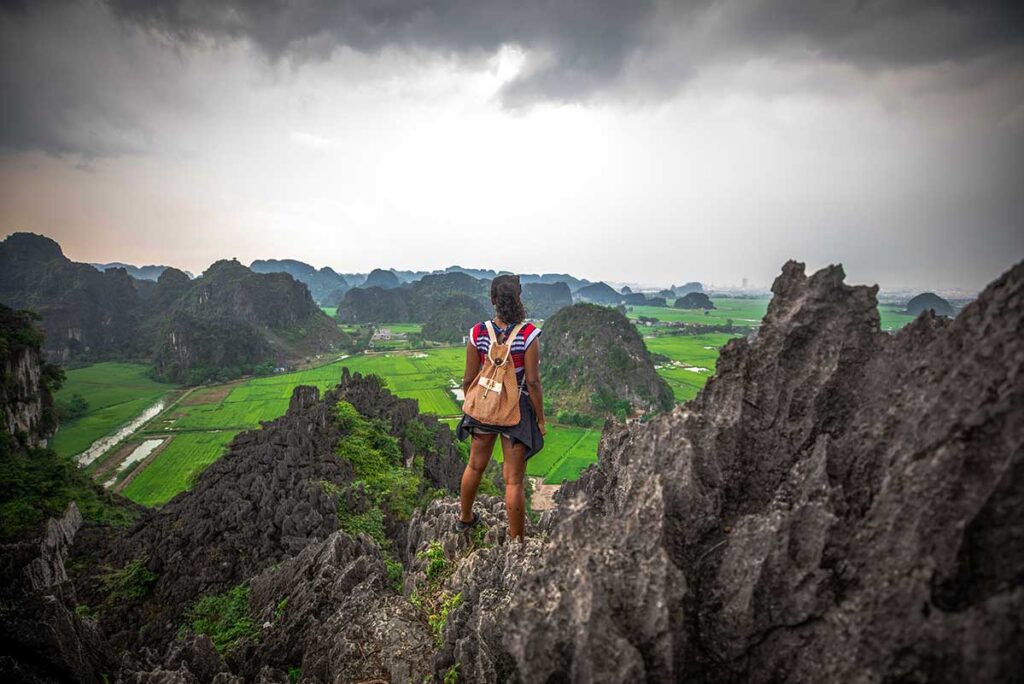
Before the list, one honest point. Two of the most recommended “rice terrace” destinations in north Vietnam do not have terraces at all. Ninh Binh and Mai Chau are flat valley fields, beautiful in their own way but a completely different landscape from a carved mountainside. They are in this list because they are worth going to and because they are gold when the mountains are not, so you should know exactly what you are getting.
The first six are the famous ones. The last four see almost no foreign visitors and, in a couple of cases, look just as good.
1. Sapa, Lao Cai
The most accessible terraces in the country and still, for many people, the best. The Muong Hoa valley below Sapa drops in wide steps from the town all the way to the river, with Hmong and Dao villages spread through it, and you can walk right into it on foot from your hotel.
The trade-off is crowds. Sapa town itself is overbuilt, noisy and, honestly, unattractive. But the town is not the point. Walk twenty minutes past the last hotel and it changes completely. Sapa also runs earlier than most guides claim, so late August to mid September is your window, not October. There is more detail in the Sapa rice fields guide.
2. Mu Cang Chai, Yen Bai
If you want the single most dramatic terraces in Vietnam, this is it. The valley between Mu Cang Chai and Tu Le is carved into thousands of steps that stack up whole mountainsides, some of them curving into shapes that look almost like pyramids. The famous Raspberry Hill is here.
It is harder to reach than Sapa and there is far less to do besides looking at the landscape, which is fine, because the landscape is the reason. Harvest runs later than Sapa, usually mid to late September, and in those weeks the main viewpoints along the Khau Pha pass get busy with photographers. Turn onto any side road and it empties out immediately.
3. Hoang Su Phi, Ha Giang
The wildest of the big three. Hoang Su Phi sits in western Ha Giang (now part of Tuyen Quang province), below Tay Con Linh mountain, and the terraces here climb higher and steeper than anywhere else, often disappearing into cloud.
Getting there is slow, the roads are rough, and accommodation is basic homestays rather than hotels. That filters out most travellers, which is exactly why it is worth it. Harvest is usually late September. Note that this is a separate trip from the classic Ha Giang loop, which runs through the drier limestone country further north where there is very little rice.
4. Pu Luong, Thanh Hoa
The best combination of terraces and comfort in the north. Pu Luong is a nature reserve of limestone hills with Thai and Muong villages, water wheels turning in the streams, and terraces cascading down the valley sides. It is around four hours from Hanoi, so it works even on a short trip.
Two crops means two harvests, late May and again late September into October, which gives you more chances than the highland destinations. Accommodation here is genuinely good, from cheap homestays to hillside lodges with pools looking straight over the fields.
5. Mai Chau, Hoa Binh
A wide flat valley of Thai stilt houses ringed by limestone cliffs, about three hours from Hanoi. The fields in Mai Chau are not terraced, they are level paddies, and the pleasure is cycling through them on small lanes between villages rather than climbing for viewpoints.
It is easy, gentle and good for families or anyone short on time. It is also well established on the tour circuit, so parts of it feel commercial. Best in late May and again in autumn, and it pairs naturally with Pu Luong just down the road.
6. Ninh Binh
Not terraces, but arguably the most striking rice landscape in the north anyway. In Ninh Binh the fields sit between vertical limestone karsts and the Ngo Dong river, and you float through them by rowing boat at Tam Coc or look down on the whole valley from the steps at Mua Cave.
The timing here is unusually strict. Tam Coc has one main crop, sown in winter and cut around the end of May, so late May is the week everybody aims for. Outside that window the water is still lovely but the fields are green or bare. It is also the busiest place on this list, being two hours from Hanoi.
7. Y Ty and Bat Xat, Lao Cai
Same province as Sapa, entirely different experience. Y Ty sits high on the Chinese border in a valley of Ha Nhi villages with distinctive thick-walled mud houses, and the terraces run down toward the Red river below. The village of Lao Chai in this area, and the road through Ngai Thau and A Lu, gives views on the level of Mu Cang Chai with a fraction of the visitors.
The catch is access and cloud. Roads are narrow and rough, and Y Ty sits in fog for long stretches, which is beautiful when it breaks and frustrating when it does not. Harvest is usually early to mid September. Stay in a homestay and give it two nights, because one night is a gamble with the weather.
8. Ngoc Chien, Son La
A long valley of Thai and Hmong villages in Son La, sitting between Mu Cang Chai and Muong La, and almost nobody routes through it. The terraces line both sides of the valley, there are old wooden stilt houses that are still lived in rather than rebuilt for tourists, and there are natural hot springs in the village.
It is genuinely rural. English is rare, accommodation is a handful of homestays, and the road in from the Mu Cang Chai side is slow. If you are driving between Mu Cang Chai and Mai Chau or Dien Bien, it is the best detour on the route. Harvest around mid to late September.
9. Hong Thai and Na Hang, Tuyen Quang
High on a plateau in northern Tuyen Quang, Hong Thai is a Dao Tien commune with terraces stepping down around the village and, in spring, hillsides of pear and plum blossom. It is cool year round and completely off the standard tourist route.
Combine it with the Na Hang lake area below, where a boat trip runs between forested limestone cliffs. Accommodation is homestay only and the road up is steep. Harvest is generally mid to late September, in line with the rest of the northeast.
10. Binh Lieu, Quang Ninh
The northeast’s best terraces, in a province almost everyone associates with Halong Bay instead. Binh Lieu is Tay and Dao country, with terraces along the valleys around Luc Hon and Huc Dong, waterfalls, and a genuinely remote feel about four to five hours from Hanoi.
One practical warning. Binh Lieu sits on the Chinese border, and the famous grass-covered ridge walk along the border markers is in a controlled border zone where foreigners officially need a permit, arranged through local authorities or your accommodation. The terraces in the valleys are not affected, but do not assume you can just drive up to the ridge. Sort it in advance or plan around it.
Practical tips for visiting the rice terraces of Northern Vietnam
The timing is never the same twice
The single biggest planning mistake is treating harvest dates as fixed. They are not. Farmers cut when the rice is ready, and that depends on when the rain came, how warm the summer was, and how high the village sits. Two valleys an hour apart can be a week or more out of step.
There is also a pattern most guides get wrong. Sapa runs early, often gold from very late August into the first half of September, not late September or October as you will read elsewhere. Mu Cang Chai and Hoang Su Phi run later, generally mid to late September. Pu Luong and Ninh Binh have their own calendar entirely.
So do not plan around photos from last year. Build a few days of flexibility into your dates, and if you can, ask locally a week or two before you travel. Homestays and local operators know exactly what the fields are doing.
Respect the fields and the people
These are working farms, not a viewpoint. A few things matter more than anything else:
- Never step into a terrace for a photo. The earth walls are fragile and the crop is somebody’s income for the year. If a wall breaks, the water drains and the field below suffers too.
- Ask before photographing people. Distant shots of somebody working are fine. Close-up portraits are not, unless you ask. Most farmers do not speak English, so hold up your camera and wait for a nod or a shake of the head.
- Do not walk into homes or courtyards uninvited. In many villages you will be welcomed if you ask, and refused if you do not.
- Do not give money or sweets to children. It encourages begging and keeps kids away from school. If you want to help, spend your money in the village: stay, eat and hire a guide locally.
- Stay on paths and respect closed gates. A gate across a track usually means livestock, not scenery.
How to get around and see them properly
Walking is the best way to see terraces, and it is not close. From a road you see a wall of green from one angle. On foot you walk between the fields, along the irrigation channels, past the houses, and you end up talking to people. Most of the good trails are not marked, they are farm paths that change with the seasons, so a local guide is not a luxury here. A guide also gets you into villages where you would otherwise be a stranger walking through somebody’s yard. Trekking in Sapa and trekking in Pu Luong are the two best organised options in the north. For the flat fields of Ninh Binh and Mai Chau, swap the boots for a bicycle.
Tip: Trek the terraces with Local Vietnam
Our Sapa trekking tours and Pu Luong trekking tours run with local guides who live in these valleys and know which fields are ready. Routes are adjusted to your pace and to what the harvest is actually doing that week.
For a wider trip covering several rice terrace regions, you have two realistic options. The first is a motorbike. Driving yourself is the most flexible way to travel here, but the north is not the place to learn: mountain passes, blind corners, fog, trucks and gravel. If you are not already experienced, ride on the back with a guide instead, which in Vietnam is usually called an Easy Rider. The second is a private car with driver, which is more comfortable, works in rain, and suits families and anyone carrying luggage between destinations. One thing to understand: a driver is not a guide. He will take you where you ask and stop where you ask, but he will not know which viewpoint is worth the detour. Either book a guide alongside him, or have the itinerary and stops planned in advance.
Tip: Travel the north by private car with Local Vietnam
Our private car with driver service covers the whole north, with routes and stops planned around the harvest instead of the fastest road. You get the comfort of a car and an itinerary that actually knows where to pull over.
Harvest season is also rainy season
The months with the best fields are also the wettest months of the year, and there is no way around it. The good news is that rain in north Vietnam usually does not last all day. It comes in heavy bursts, often in the afternoon or overnight, and mornings are frequently clear. Early starts are your friend.
What rain really affects is the roads. Mountain routes to places like Hoang Su Phi, Y Ty and Ngoc Chien can wash out or get blocked by small landslides, and gravel sections turn to mud. Add buffer time between destinations and do not plan a flight out for the same evening you finish a mountain drive.
Temperatures in July, August and September sit around 25 to 32 degrees in the valleys and noticeably cooler up high, where evenings can drop to 15 or below. Cloud is the other factor. High destinations can sit inside a cloud for two days straight, which is why one night in a place like Y Ty is a gamble. More detail on what to expect is in the north Vietnam rainy season guide.
Pack for wet: quick-dry clothes, shoes with real grip, and a rain jacket rather than an umbrella. Terrace paths get slippery, and the mud between fields is deeper than it looks.
Book early for harvest season
Late August through September is the busiest window of the year in Sapa, Mu Cang Chai and Pu Luong, and it is also when Vietnamese photographers travel. The good homestays and lodges in the valleys are small, often only a handful of rooms, and they sell out months ahead. If your dates are fixed around the harvest, book accommodation as early as you can and leave the flexible days for the driving.
The rest of Vietnam grows far more rice than the north
Worth knowing, if only for perspective. The great majority of Vietnam’s rice does not come from these mountains at all. It comes from the Mekong Delta in the south and the flat coastal plains of the centre, where the country grows two or three crops a year on land that stretches to the horizon. The Red River Delta around Hanoi produces far more rice than every terrace in the north combined.
Those fields are just flat. They are green, they are gold, they are enormous, and they photograph like farmland everywhere. The terraces are famous not because they feed the country, but because somebody carved them into a mountain by hand and the result happens to be one of the finest landscapes in Asia. If you want the full picture of where and when rice grows across the country, read more about the rice fields of Vietnam.