
How paying works in Ho Chi Minh City
Before you think about where to change your money, it helps to know how paying actually works here. Ho Chi Minh City is more modern than most of Vietnam, and you can get through a day in District 1 on card alone if you stick to hotels and nicer restaurants. But step slightly outside that and you are back to cash, and you will need dong from the moment you land.
Foreign currency is not accepted
Do not arrive expecting to spend dollars. Under Vietnamese law, prices and payments inside the country have to be in dong, and a business needs a licence to handle foreign currency. Almost nobody has one, and almost nobody wants your euros.
There are a few exceptions. Some travel agencies and hotels will take US dollars, and occasionally a tour operator will quote you in them. But it is never something you can count on, and when it does happen you pay for the convenience with a rate set in their favour, not yours. Treat any dollar payment as a fallback, not a plan. Bring foreign cash to exchange, not to spend. For more background on the money itself, see our guide to the Vietnamese currency.
Cash is still king
Card payment is growing fast, and in the centre it is genuinely easy. Hotels, malls, chain cafes, and most mid-range restaurants in District 1 take cards without a problem, and QR payment is everywhere among locals.
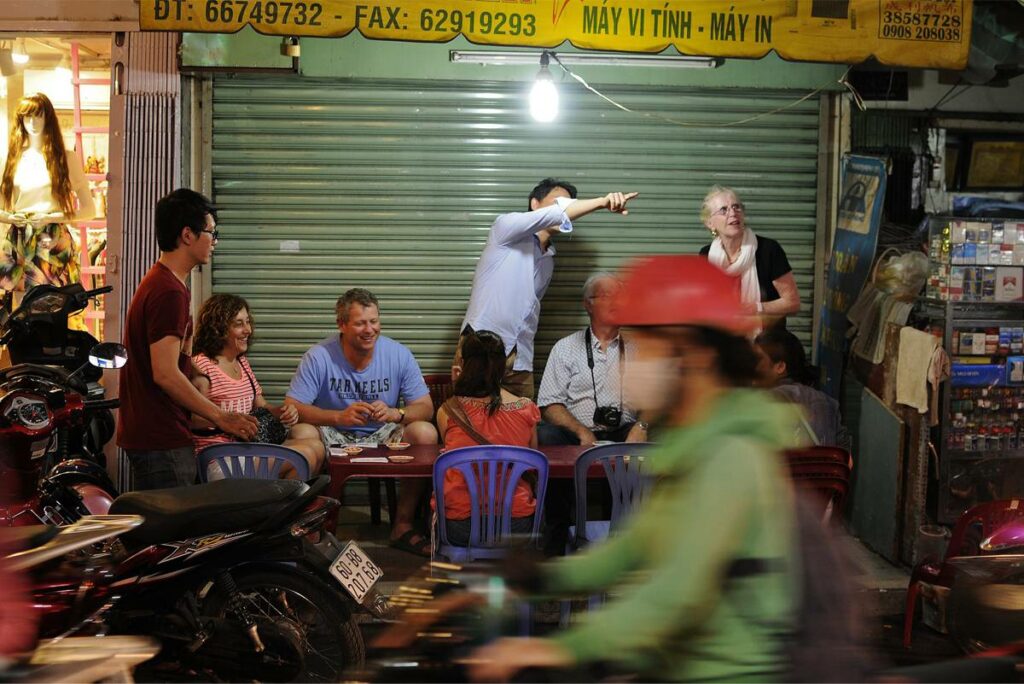
But cash still runs this city. Street food stalls, cyclos, small local restaurants, and every market you will want to visit are cash only. That includes Ben Thanh Market, Binh Tay Market over in Chinatown, and the street food that is half the reason to come here in the first place. A card will not get you a bowl of pho at a plastic stool.
So the practical answer is simple. Carry cash, keep small notes on you, and use your card where it is convenient rather than relying on it.
Know the real rate before you change anything
This is the base for everything else in this guide. Before you walk into any shop, bank, or airport counter, look up the mid-market rate on XE or Google. It takes five seconds. Without that number you have no way of telling a good rate from a bad one, and every poor deal in this city depends on you not knowing it.
Ignore the “no commission” and “zero fee” signs. There is no such thing as free money exchange in Ho Chi Minh City, or anywhere else. If a place is not charging you a fee, it is making its money inside the rate instead, and a bad rate with no commission will cost you far more than a fair rate with a small one. The rate is the only number that matters. Once you know what your money is actually worth, everything below becomes easy.
Where to exchange money in Ho Chi Minh City
There are five places you can realistically change your money in this city, and the difference between the best and the worst is not small. It can easily be five or ten percent of whatever you hand over, which on a few hundred dollars is a decent dinner or two. Money exchange in Ho Chi Minh City is not complicated, but it does reward knowing where to walk. Here is how the options actually compare, before we get to the specific places worth going to.
1. Gold and jewellery shops
The best rates in the city, and it has been that way for years. Gold shops handle large volumes of foreign cash every day, they work on thin margins, and the good ones sit within a fraction of the mid-market rate. That is why they are always packed.
The trade-off is the experience. Expect a queue, a crowd, no privacy at all, and staff who are efficient rather than friendly. They are also strict about the condition of your notes. If you want the best rate and do not mind a bit of chaos, this is where you go.
2. Licensed exchange counters
These are dedicated money changers, usually backed by a bank. Rates are a touch below the gold shops but still far better than a bank branch, and the experience is completely different: indoor, air-conditioned, a numbered ticket, a printed receipt, staff who speak English, and a security camera over the counter.
For most travellers this is the sweet spot. You give up a tiny amount on the rate and get a calm, transparent transaction in return. If you are exchanging a large sum, or you are simply not comfortable counting a fat stack of cash in a crowded doorway, take the counter.
3. Banks
Safe, legal, and slow. Banks give you a worse rate than either of the options above, and they will usually want your passport and some paperwork. Where they earn their place is with unusual currencies, larger sums, or if you want a formal receipt for any reason.
Otherwise there is no real argument for them. You are paying for a level of formality you do not need.
4. The airport
The worst rates you will find anywhere in the city, by a wide margin. The exchange booths at Tan Son Nhat exist because you have just landed and have no dong at all, and they price accordingly. Travellers regularly get a rate here that is thousands of dong per dollar below what the same money is worth in District 1.
Use it for what it is: a way to get just enough cash to reach your hotel, and nothing more.
5. Hotels
Some hotels will change money for you, and a few do it at a fair rate. Most do not. It is convenient, it saves you a walk, and you pay for both.
Treat it as a last resort, for when everything else is shut and you need cash tonight.
Best gold and jewellery shops for money exchange
Gold shops are where locals and long-term expats change their money, and they are the reason money exchange in Ho Chi Minh City has a reputation for good rates. Two of them sit within a minute of each other by Ben Thanh Market, which makes comparing them easy. Most people only ever visit one of the two, and that is a mistake.
Ha Tam Jewelry
Address: 2 Nguyen An Ninh, District 1, directly opposite Ben Thanh Market. Open from around 8am to 8:30pm.
This is the best-known exchange spot in the city and, on most days, the best rate you will get. It is usually within a fraction of the mid-market rate, comfortably better than any bank, and better than the airport by a margin that is almost rude. That reputation is earned, and it shows: the place is constantly packed, with locals changing serious sums alongside tourists with a couple of hundred dollars.
Understand what you are walking into, though. The queue can run fifteen to thirty minutes, and longer around holidays. There is no rate board on the wall, so they check your cash and then write or show you the number. Privacy does not exist here. People waiting behind you can see exactly what you are handing over and exactly what you get back, and if that makes you uneasy, it is worth knowing before you arrive with a thick envelope. The staff are quick and professional, but nobody is going to smile at you.
They are also strict about note condition, which catches out more travellers than anything else. Old, marked, torn, or even slightly scruffy foreign notes get rejected outright or knocked down in rate. Bring new, clean, large notes and you get their best price. Bring a creased twenty with a bank stamp on it and you may be turned away at the counter.
How to get the best out of it
Go early. They open around eight, and the queue builds through the day, so the first hour is the calmest. They can also run out of dong when it is busy, in which case the shop right next door will do the job.
Ask the rate before you hand anything over, and check the number against what you looked up on your phone. Once they have counted your money and handed back the dong, count it yourself and look at every note before you walk away. Damaged dong notes do occasionally slip through, and a torn 500,000 note is a nuisance to spend once you are back on the street.
Mai Van
Address: right beside Ha Tam on Nguyen An Ninh, District 1.
This is the shop almost everyone walks past, because Ha Tam’s queue makes it look like the obvious choice. It is worth two minutes of your time.
Mai Van is quieter, the staff will actually answer questions, and they will tell you the rate before you commit rather than expecting you to hand over your cash first. For larger amounts, around a thousand dollars and up, they can beat Ha Tam outright. They also handle less common currencies at better rates than the big shop next door.
The honest position is this: you are standing next to both. Ask both. It costs you nothing, the shops are a few steps apart, and on a decent sum the difference is real money. The idea that the busiest shop must have the best rate is an assumption, not a fact.
How to get the best out of it
Same rules as anywhere. Know the mid-market rate before you arrive, ask for their number, then walk next door and ask for theirs. Take whichever is better. Bring clean, high-denomination notes, because the condition rule applies here too.
Best licensed exchange counters for money exchange
If the gold shops sound like too much chaos, this is where you go. Licensed exchange counters are dedicated money changers, usually backed by a bank, and they solve almost every complaint people have about money exchange in Ho Chi Minh City. You sit down, you get a ticket, you get a receipt, and nobody is breathing on your shoulder while you count your cash. The rate is a fraction below the best gold shop, and for most travellers that is a fair trade.
Hung Long Money Exchange
Address: 86 Mac Thi Buoi, District 1, a short walk from Nguyen Hue walking street. Open roughly 8am to 8pm daily.
This is the one to pick if you only want to go to one place. Hung Long is the most tourist-friendly exchange in the city and it does not make you pay much for that comfort. It is indoor and air-conditioned, backed by Eximbank, and the whole transaction is transparent from start to finish: you show your cash, they show you the rate on a calculator, and only if you agree do they take the money and hand you a numbered token. You sit down, wait a few minutes, they call your number, and the cash is counted in front of you by machine with a receipt to match. There are security cameras over the counter. Nothing about it is improvised.
The rates are genuinely good. Not always the single best number in the city, but consistently at or very near the market rate, and far above what any bank will give you. Staff speak English, which is not a given at the gold shops, and they take a wider range of currencies than most places will touch, including pounds, Thai baht, Hong Kong dollars, Australian dollars, and Indian rupees. If you are carrying something other than dollars or euros, start here.
The whole thing usually takes five to ten minutes, even with people ahead of you.
How to get the best out of it
Bring large notes in good condition, as the denomination rule applies here as much as anywhere: bigger notes get a better rate. Ask for the rate before you agree, which they will show you anyway, and check it against the mid-market number on your phone.
It is not always the very best rate in town, so if you are changing a large sum and you are already near Ben Thanh, it costs you nothing to compare with the gold shops first. For everything else, the convenience wins.
VietBank Currency Exchange
Address: in front of Saigon Square, District 1.
Fast, no fee, and strong rates for US dollars, sitting close to what the gold shops offer. It is a small counter rather than a proper office, and the appeal is largely convenience: if you are already shopping at Saigon Square or wandering that part of District 1, it saves you a trip. They will change almost any currency.
Be a little more careful here than at Hung Long, though. The experience is less consistent, and the rate you are offered can vary. Some people get an excellent number; others have walked away with clearly less than the going rate. It is not a place to hand over money on trust.
How to get the best out of it
Ask for the rate first and check it against your phone before you commit to anything. If the number is good, take it, because it often is. If it is noticeably off, walk away. There are better options ten minutes down the road and you lose nothing by leaving.
One to be careful with: Eximbank 59
Address: 135 Dong Khoi, District 1.
This place appears on nearly every money exchange list online, which is exactly why it is worth being honest about. The rate here is not consistent, and the pattern behind that is the problem.
Different staff quote different numbers to different customers. More than one traveller has been given a poor rate simply because they handed over their cash without asking what they would get, then found a colleague behind the same counter offering a noticeably better one when questioned. That is not market fluctuation. There have also been complaints about worn, crumpled dong being handed back and no receipt given, and the rate for changing dong back into dollars can be punishing.
None of this means you will be cheated. Plenty of people use it without incident. But when there are better, calmer, more consistent options within a ten-minute walk, there is no strong reason to pick this one.
How to get the best out of it
If you do use it, the rule that protects you everywhere protects you here, and here it matters more than anywhere: ask for the rate before you hand over a single note, and do not be shy about it. Check the number, count your cash at the counter, and ask for a receipt. If the rate changes when you ask, that tells you everything you need to know about walking out.
Exchanging money at banks in Ho Chi Minh City
Banks are the safest and most formal option for money exchange in Ho Chi Minh City, and also the least rewarding. Everything is official, everything is documented, and you pay for that in the rate. For most travellers there is no good reason to use one, but there are a few situations where a bank is the right call.
How it works
Walk into any major branch, take a ticket, and wait your turn. You will usually need your passport, and you may need to fill in a short form. The teller checks your notes, applies the bank’s published rate, and gives you a receipt. It is slower than anywhere else in this guide, and during the lunch hour it can be slow enough to eat your afternoon.
The banks you will see everywhere in District 1 are Vietcombank, Sacombank, BIDV, Techcombank, and Vietinbank. Vietcombank is the one most used to dealing with foreigners and is usually the smoothest of the bunch. Branches generally open around 8am, close at 4pm or 5pm, and shut for lunch. They are closed on Sunday, and often on Saturday afternoon too.
What it costs you
The rate is the whole story. A bank will consistently give you less than a gold shop or a licensed exchange counter, and the gap is not trivial. On a few hundred dollars you can lose the price of a good meal, purely for the privilege of a receipt and an air-conditioned lobby.
Banks are also the fussiest about note condition. They will refuse anything torn, marked, or from an older series, and they apply that rule more rigidly than the exchange counters do.
When a bank actually makes sense
There are three. If you are changing a large sum and want a formal paper trail, a bank gives you one. If you are carrying an unusual currency that the exchange counters will not touch, a bank may still take it. And if you are somewhere in the city with no gold shop or exchange counter nearby, a bank branch is a safe, boring, entirely reliable fallback.
Outside of those cases, walk the extra ten minutes. You will get a better rate and be out of the door faster.
Money exchange at Ho Chi Minh City airport
The exchange booths at Tan Son Nhat give you the worst rates in the city, and it is not close. This is the one part of money exchange in Ho Chi Minh City where the advice is simple: do as little of it here as you possibly can.
What to expect
You will find exchange counters after immigration and customs in the international arrivals hall, run by banks like Vietinbank and Eximbank. They are easy to find, they are open when your flight lands, and they will happily change your money.
The rate is the problem. Airport counters know exactly what they are: the only option available to a tired person who has just landed with no local cash. The difference between what you get here and what the same notes are worth in District 1 is not a rounding error, it is a substantial cut of your money. Travellers routinely find they were given thousands of dong less per dollar at the airport than a gold shop would have handed them an hour later.
What to actually do
Change nothing, or change very little.
The best option is to skip it entirely. Book a Grab with a card linked to the app and you can get from the airport to your hotel without touching a single dong. Sort an eSIM before you fly and you will have data the moment you land, which is all you need to make that work. Then change your money properly the next morning.
If you would rather have some cash in your pocket, change a small amount and no more. Enough for a taxi, a bottle of water, and a meal. Anything beyond that is money you are handing over for nothing.
There is one exception worth knowing. If you land late at night, everything in town is shut, and you genuinely need cash to function, then take the hit and change what you need. A bad rate on fifty dollars is a minor annoyance. A bad rate on five hundred is not.
For the full picture on getting into town, see our guide on getting from the airport to the city centre.
Withdrawing cash from ATMs in Ho Chi Minh City
For a lot of travellers, the ATM is the better answer. Skip the exchange counters entirely, land with a fee-friendly card, and pull dong straight out of a machine at close to the real rate. It works well. But it only works if you use the right ATM, and most of the advice online about which one that is has been wrong since June 2025.
The three fees you are actually paying
Before the recommendations, understand what you are being charged, because it comes from three separate places and only one of them is shown on the screen.
First, the Vietnamese ATM’s own fee. Most banks here charge a flat 22,000 to 55,000 dong per withdrawal. Second, your home bank’s foreign withdrawal fee, which might be a few pounds, euros, or dollars every time you touch a machine. Third, and the one that catches people, the currency conversion margin, which is buried inside the rate.
The trap is the low withdrawal limits. Most Vietnamese ATMs only let you take out two to five million dong at a time, which is not much. Combine that with a fee on every transaction and you end up paying three or four times over just to get a reasonable amount of cash.
Use VPBank
VPBank is the best ATM in the city for foreign cards, and it is not particularly close. It charges no withdrawal fee at all, and it lets you take out up to ten million dong in a single transaction, which is the highest fee-free limit available anywhere in Vietnam. One withdrawal, no ATM fee, and enough cash to last most people a week.
The machines are green and red, and you will find them across District 1 and the rest of the city. Search VPBank ATM on Google Maps and take the short walk. It is worth the detour.
ACB is the backup. It also waives the fee for foreign cards, but the limit is lower at around three million dong per withdrawal, so you may need to go twice.
Do not use TPBank
This is where nearly every other guide will steer you wrong. For years TPBank was the fee-free ATM everyone recommended, and that advice is still copied across travel blogs today.
It has not been true since June 2025. TPBank now charges for foreign card withdrawals, and depending on the machine that is either a flat fee of around 55,000 dong or roughly 3.3 percent of whatever you take out. On a large withdrawal, the percentage version makes it one of the most expensive ATMs in the country. If you read somewhere that TPBank is free, that page is out of date.
Everything else, including Vietcombank, Vietinbank, Agribank, BIDV, and the international names like HSBC, will charge you. They work fine, they are perfectly safe, and they cost you money on every single withdrawal.
The mistake that costs you money even at a free ATM
When the machine asks whether you want to be charged in dong or in your own currency, always choose dong.
Choosing your own currency sounds helpful, and it is the option the screen nudges you towards. What it actually does is let the ATM apply its own exchange rate, which is a bad one, and quietly take a cut of several percent. This is called dynamic currency conversion, and it will wipe out everything you saved by finding a fee-free machine in the first place.
Dong. Always dong. If the screen offers to “convert” for you, decline it.
Practical rules
Withdraw the maximum in one go rather than making several small pulls, since almost every fee here is charged per transaction rather than per amount.
Use machines attached to a bank branch or inside a mall rather than a lonely one on a quiet street. This is sensible anywhere in the world and Ho Chi Minh City is no exception, though card skimming is not something this city has a particular reputation for and it is not worth losing sleep over.
Check your banking app straight after you withdraw. It takes five seconds and it tells you exactly what you were charged, including anything your home bank added on top. If a machine turns out to be expensive, you will know before you use it a second time.
For more on which cards work, which banks to look for, and how ATMs work across the rest of the country, see our guide to ATMs in Vietnam.
Should you exchange money before your trip?
Mostly, no. But there is one thing you should absolutely sort out before you fly, and it is not what most people think.
Do not buy dong at home
Vietnamese dong is a closed currency, which means it is hard to get hold of outside Vietnam and expensive when you can. Your bank at home will either not stock it or will give you a rate so poor that you have lost money before your plane leaves the ground.
Buy your dong in Vietnam. That is what this whole guide is about, and every option in it beats what you will be offered at home.
Bring cash to exchange, and bring the right cash
This is the part that catches people out, and it matters more than anything else in this section.
Bring US dollars if you can. They get the best and most consistent rate in Ho Chi Minh City, and every exchange in the city will take them. Euros, pounds, and Australian dollars are all fine too, though the licensed counters handle those more happily than the gold shops do.
Now the important bit: the physical condition of your notes decides what you get for them. This is not a small preference, it is a hard rule here, and it surprises almost every first-timer.
- Bring new, crisp, unmarked notes. Any tear, fold damage, ink mark, stain, or scribble and the shop will either refuse the note outright or drop your rate.
- Bring large denominations. A 100 dollar bill gets a noticeably better rate than five 20s. Small notes get the worst rate of all.
- Bring recent series notes. Older-series euros and older-style US bills are frequently rejected, even when they are perfectly legal tender at home.
- Watch what your own bank does to your money. Some banks stamp or mark notes when they hand them over, including ink marks used to check for forgeries. A marked note is a devalued note in Vietnam, so check what you are given before you leave the counter at home.
Ask your bank for new, high-denomination notes specifically. It costs nothing to ask and it can be worth a few percent on your whole exchange.
The better option for most people: sort a card
Honestly, the strongest thing you can do before you fly has nothing to do with cash.
Get a low-fee travel card — Wise and Revolut are the two most people use — and load it before you go. You get close to the real exchange rate, you skip the whole business of carrying a wad of foreign notes through an airport, and you can withdraw dong from a fee-free VPBank ATM when you land. For a lot of travellers this beats carrying cash entirely, and it removes the note-condition problem completely.
Bring some cash as a backup, because Vietnam still runs on it and a card is useless if a machine eats it. But you do not need to arrive with a thousand dollars in an envelope. A few hundred in clean notes, plus a good card, covers you.
Our guide to using Wise in Vietnam explains how it works in practice.
Practical tips for money exchange in Ho Chi Minh City
Most of what follows is common sense, but it is the kind of common sense that only arrives after you have already lost money once. Get these habits right and money exchange in Ho Chi Minh City stops being something you have to think about at all.
Before you exchange
Check the mid-market rate on XE or Google before you walk into anywhere. This is the single habit that protects you from every bad deal in this guide, and it takes five seconds on your phone.
Ignore “no commission” signs, because the profit is inside the rate. And bring the right notes: new, clean, and large. A crisp 100 dollar bill will always outperform a folded, marked one.
At the counter
Ask for the rate before you hand over a single note. This sounds obvious and almost nobody does it, because the natural instinct is to give them your money and let them tell you the number afterwards. That instinct is exactly what a bad exchange counts on. Ask first, every time.
Once you have agreed, watch the count. The good places use a counting machine in front of you and hand you a printed receipt. Then count it again yourself before you leave, and look at the notes as you do it. A torn or damaged dong note is difficult to spend afterwards, and you have no case once you have walked out of the door.
Go early in the day at the popular places. The queues build, and the busiest shops can genuinely run out of dong by the afternoon.
After you exchange
Open your banking app and look. If you used an ATM, this tells you exactly what you were charged, including whatever your home bank quietly added on top. It takes a moment and it means you never make the same expensive withdrawal twice.
Handling cash day to day
Break your big notes early. Nobody at a street food stall or on a cyclo can change a 500,000 dong note, and trying to pay with one is the fastest way to a frustrating conversation. Buy something small at a convenience store and get change, then keep small notes on you.
Cash also gives you leverage at the markets, where the price on the first ask is never the real price. Our guide to bargaining in Vietnam covers how far you can reasonably push.
Paying without cash
Add a card to Grab or Xanh SM and you solve half your cash problems at once. You see the fare before you book, you never argue about change, and you never hand a driver a note he claims he cannot break. You can still pay cash if you prefer, but the app is easier. See how to use Grab for the setup.
Staying safe with your money
One trick is worth knowing, because it is the most common money problem tourists actually run into here. The 500,000 dong note and the 20,000 dong note are both blue and look similar at a glance. Some vendors will “swap” the note you handed over for a smaller one and insist you underpaid, or simply short-change you and hope you walk away before counting.
The defence is the same as everything else in this guide. Learn the notes, say the amount out loud as you pay, and count your change before you leave. For the full picture, see our guide on safety and common scams in Ho Chi Minh City.