The dilemma: Vietnam or the Philippines?
Vietnam and the Philippines both appear on the shortlist of almost every traveler planning a trip to Southeast Asia — and that is exactly what makes the decision difficult. Both are affordable, both are visually stunning, and both offer experiences that are genuinely hard to find elsewhere in the region.
The problem is that most travelers have two to four weeks, not two to four months. That means picking one, not both.
What makes this choice harder than most is that Vietnam and the Philippines are strong in completely different categories. Vietnam wins on culture, history, food, and variety. The Philippines wins on beaches and islands. If you know exactly what you want from a trip, the answer is usually obvious. If you want a bit of everything, the choice is much less straightforward.
This guide breaks the comparison down category by category — nature, culture, beaches, authenticity, infrastructure, and practical factors like budget, safety, and visa — so you can make the right call for your trip.
Why not Vietnam AND the Philippines?
How long do you need for each?
Vietnam and the Philippines are both countries where more time equals a significantly better trip. Neither destination rewards a short visit.
For Vietnam, the minimum that makes sense is two weeks. The country is long — roughly 1,650 kilometers from north to south — and the north, center, and south each feel like a separate destination. Two weeks allows you to cover two regions properly. Three weeks is better. Four weeks lets you travel at a pace where you actually experience the country rather than just pass through it.
For the Philippines, two weeks is also the realistic minimum for a trip that goes beyond one island. Getting between islands requires domestic flights or ferries, and travel days add up quickly. A focused one-island trip — Palawan only, for example — can work in ten days, but the Philippines rewards travelers who have time to slow down and explore more than one area.
That means a combined Vietnam and Philippines trip realistically needs five to six weeks minimum to do both justice. Most travelers do not have that. For anyone with three weeks or less, choosing one destination and doing it properly is a better decision than rushing through both.
Traveling from Vietnam to the Philippines
Vietnam and the Philippines are both in Southeast Asia, but getting between them is less straightforward than the map suggests. There is no overland route and no ferry connection — the only option is flying.
Direct flights operate from Hanoi and Ho Chi Minh City to Manila and Cebu. Flight time is roughly two to three hours depending on the route. Prices vary, but budget carriers including Cebu Pacific and VietJet serve these routes and fares can be reasonable if booked in advance.
The main options for getting between the two countries:
- Direct flight from Ho Chi Minh City to Manila — the most common route, well-served by multiple carriers, shortest travel time
- Direct flight from Ho Chi Minh City to Cebu — useful if the Visayas or southern Philippines is the main destination
- Direct flight from Hanoi to Manila — fewer options than from Ho Chi Minh City, but available
- Via a hub (Bangkok, Kuala Lumpur, Singapore) — sometimes cheaper or better timed than direct routes, but adds significant travel time
Tip: Let Local Vietnam plan your Vietnam itinerary
If Vietnam is part of your trip, Local Vietnam can design a private itinerary that fits your travel style, timeline, and budget. Contact us to get started.
Who has the best nature: Vietnam or the Philippines?
Vietnam
Vietnam’s biggest advantage in this category is variety. Few countries of its size pack in as many different types of landscape as Vietnam does.
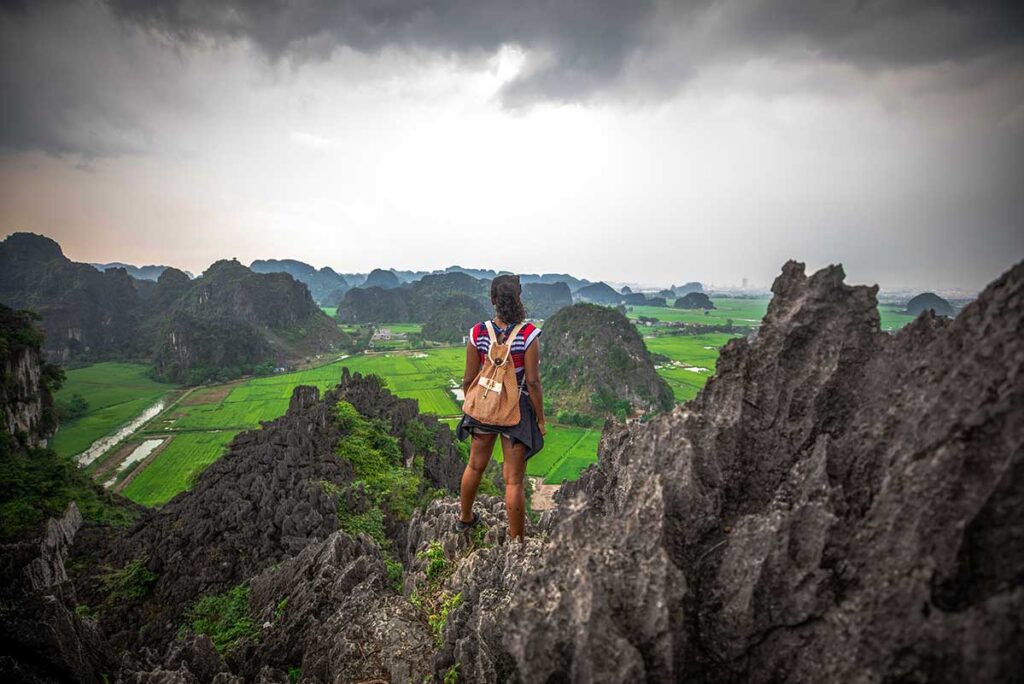
The north offers some of the most dramatic scenery in Southeast Asia — terraced rice fields, karst limestone peaks, and remote mountain valleys home to ethnic minority communities. Ha Giang is the standout, with a loop road through the Dong Van Karst Plateau that ranks among the most visually striking drives on the continent. Sapa and the surrounding area offers a different version of the same region — greener, more accessible, and well set up for trekking.
Moving south, the landscape shifts completely. The central highlands are cooler, forested, and largely off the main tourist trail. The Mekong Delta in the far south is one of the most distinctive river landscapes in Asia — flat, green, and threaded with waterways that have shaped the way people live and work for centuries.
Vietnam’s coastline stretches for over 3,000 kilometers and includes Halong Bay, one of the most photographed natural landscapes in Southeast Asia. It is worth noting that significant parts of Vietnam’s natural environment have been affected by decades of war, deforestation, and rapid urbanization. But what remains — and what has recovered — is genuinely impressive in its range.
The Philippines
The Philippines has attractive natural scenery spread across its islands. Volcanoes are a defining feature — Mayon near Legazpi is one of the most perfectly conical active volcanoes in the world, and the Chocolate Hills of Bohol are unlike anything else in the region. Waterfalls, jungle, and marine ecosystems are found across the archipelago, and underwater biodiversity is among the richest in the world.
The challenge when comparing the Philippines to Vietnam on pure nature — excluding beaches and islands, which are covered separately — is that the remaining highlights are more scattered and harder to combine into a single efficient trip. Island geography means every natural attraction requires planning around transport, and the experience of nature in the Philippines is often inseparable from the experience of getting to it.
Winner: Vietnam
Vietnam wins this category on variety. The range of landscapes — mountains, delta, highlands, coastline, karst — packed into one continuous mainland destination is genuinely difficult to match. The Philippines has strong natural assets, but with beaches set aside for their own category, it cannot compete with Vietnam’s overall breadth.
Who has the best culture and history: Vietnam or the Philippines?
Vietnam
Vietnam’s cultural depth is the strongest argument for choosing it over almost any other destination in Southeast Asia. What makes it stand out is not one headline attraction but the combination of layers that have built up over centuries.
French colonial architecture is visible across the country — in the grand boulevards of Hanoi, the yellow-walled streets of Hoi An, and the hill station villas of Dalat. Chinese influence shaped Vietnamese language, religion, architecture, and social structures over more than a thousand years of interaction and at times occupation. The Cham civilization left behind a separate strand of history entirely, with ruins and towers scattered across the central coast that most travelers walk past without fully registering what they represent.
The Vietnam War — known in Vietnam as the American War — added a layer of history that is both recent and internationally significant. Sites like the Cu Chi Tunnels near Ho Chi Minh City and the DMZ in the center of the country are genuinely interesting for foreign visitors, not just as memorials but as places where the scale and reality of the conflict becomes tangible.
Beyond the historical sites, Vietnam is home to more than 50 officially recognized ethnic minority groups. In the north especially, these communities have distinct clothing, languages, agricultural traditions, and ways of life that have survived largely intact. Traveling through Ha Giang or the valleys around Sapa means moving through a living cultural landscape, not a preserved one.
The Philippines
The Philippines has an interesting historical backstory — over three centuries of Spanish colonial rule followed by several decades of American administration left visible marks on the country. Intramuros, the walled colonial city in Manila, is the most prominent example of Spanish heritage. American influence is felt in the widespread use of English, the education system, and aspects of pop culture that are unlike anywhere else in Southeast Asia.
The honest assessment, though, is that the visible cultural heritage available to a foreign traveler is relatively limited compared to most other countries in this comparison. Outside of Intramuros and a handful of colonial churches, there are fewer sites where history feels layered and accessible. Indigenous cultures exist across the archipelago but are less integrated into the mainstream travel experience than ethnic minority communities are in Vietnam.
Winner: Vietnam
This is not a close comparison. Vietnam’s combination of colonial architecture, ancient trade history, war legacy, Cham ruins, and 50-plus living ethnic minority cultures gives it a depth that the Philippines cannot match in this category. The Philippines has an interesting history, but for a traveler who puts culture first, Vietnam is the stronger destination by a significant margin.
Who has the best beaches and islands: Vietnam or the Philippines?
Vietnam
Vietnam has a coastline that stretches for over 3,000 kilometers, and there are genuinely good beach destinations along it. Phu Quoc in the far south is a well-developed island with clear water and a range of accommodation options from budget to luxury. Con Dao, further up the coast, is quieter, less developed, and consistently rated among the most beautiful islands in Vietnam. The central coast has long stretches of sandy beach, with Da Nang and the surrounding area being the most accessible and well-equipped for beach tourism.
The honest caveat is that Vietnam’s beach scene has a gap in the middle of the market. Accommodation tends to be either a large resort or a very local setup. The relaxed mid-range atmosphere — beach bars, casual bungalows, laid-back beach clubs — that many travelers associate with a good beach holiday is harder to find in Vietnam than in Thailand or the Philippines.
The Philippines
The Philippines is one of the best beach and island destinations in Southeast Asia, and this is where it makes its strongest case against Vietnam. Palawan — particularly El Nido and Coron — consistently ranks among the most beautiful island scenery in the world. The combination of limestone karst cliffs, turquoise lagoons, and white sand beaches is genuinely exceptional. Boracay, once overdeveloped and briefly closed for rehabilitation, has recovered and remains one of the most well-known beach destinations in the region. The Visayas — Cebu, Bohol, Siargao — add further variety, from diving and island-hopping to surf breaks and quieter stretches of coast.
The Philippines also has the mid-range beach atmosphere that Vietnam largely lacks. Island resorts, beach bars, and relaxed bungalow setups at reasonable prices are widely available, and the overall experience of a beach holiday feels more complete.
Winner: The Philippines
This is the category where the Philippines pulls clearly ahead. The island scenery around Palawan and the Visayas is among the best in Southeast Asia, and the overall beach experience — scenery, atmosphere, accommodation variety — is stronger than what Vietnam offers. For travelers whose main reason for visiting Southeast Asia is beaches and islands, the Philippines is the better choice.
Who has the most authentic travel experience: Vietnam or the Philippines?
Vietnam
Vietnam holds up well on authenticity, even as tourism has grown significantly over the past decade. The country is large enough and varied enough that the tourist trail and the real country exist side by side rather than one replacing the other. Popular destinations like Hoi An and Ha Long Bay are heavily visited, but they sit within a country where most places — most towns, most roads, most daily life — remain entirely unfiltered.
The ethnic minority communities of the north are the strongest example of this. In Ha Giang, Cao Bang, and the valleys around Sapa, travelers move through villages where people farm, dress, and live according to traditions that have little to do with tourism. Weekly markets in these areas are genuine trading events, not performances staged for visitors. The contrast between the tourist-facing version of Vietnam and the version that exists just a few kilometers off the main road is real and accessible to anyone willing to look for it.
Even in the cities, daily life has a texture that is hard to miss. Street food culture, neighborhood temples, wet markets, and the rhythms of Vietnamese urban life are visible and easy to engage with. Vietnam does not hide its local character behind a polished tourism surface.
The Philippines
Authentic experiences are available in the Philippines, particularly on lesser-visited islands and in rural areas away from the main tourist hubs. The country has a strong sense of local identity, and Filipino hospitality is genuine and widely noted by travelers.
The challenge is that the most visited destinations in the Philippines are among the most developed and touristed in Southeast Asia. El Nido and Coron have grown rapidly and now operate at a scale where the infrastructure exists almost entirely to serve foreign visitors. Boracay, despite its rehabilitation, remains a resort island first. Siargao has followed a similar trajectory, moving quickly from surf discovery to Instagram destination.
That pattern is not unique to the Philippines — it happens everywhere tourism scales up. But in Vietnam, the sheer size of the country means mass tourism has a smaller footprint relative to what is available beyond it.
Winner: Vietnam
Vietnam wins this category not because the Philippines lacks authentic experiences, but because Vietnam offers more of them, more accessibly, and across a wider range of the country. The combination of ethnic minority culture in the north, unpolished towns throughout the center, and genuine daily life visible in every city gives Vietnam a depth of authentic experience that is harder to find consistently in the Philippines.
Who has the best tourism infrastructure: Vietnam or the Philippines?
Vietnam
Vietnam’s transport network is one of its strongest practical advantages. A train line runs the full length of the country from Hanoi to Ho Chi Minh City, with stops at all major destinations along the way. Buses cover routes the train does not, and the overall network is dense, reliable, and affordable. Getting from one end of the country to the other — or anywhere in between — is straightforward and does not require advance planning beyond booking a seat.
Accommodation supply in Vietnam is extraordinary. Decades of investment in tourism have produced a market where hotels, guesthouses, and hostels far outnumber what demand actually requires. That oversupply keeps prices low and availability high, even in peak season. At every price point, options are plentiful.
The main weakness is English proficiency. Outside of major tourist areas and internationally facing businesses, English is limited. This rarely causes serious problems, but it does mean communication requires more patience than in some neighboring countries.
The Philippines
The Philippines has a clear language advantage — English is an official language and is spoken widely across the country, not just in tourist areas. Communication with locals, reading signs, navigating bureaucracy, and asking for help are all significantly easier than in Vietnam.
Where the Philippines loses ground is geography. An archipelago of over 7,000 islands cannot be navigated the same way a mainland country can. Moving between destinations almost always involves a domestic flight or a ferry, sometimes both. Flights add cost. Ferries add time and, depending on the route and vessel, varying levels of comfort and reliability. A trip covering three or four island destinations can easily consume several full travel days and a meaningful portion of the total budget just in getting around.
Accommodation is decent across the main destinations but does not match Vietnam in volume or value. The Philippines simply has fewer beds at fewer price points, which means less competition and higher average prices.
Winner: Vietnam
The Philippines has the edge on language, and that matters. But Vietnam’s mainland connectivity and the sheer volume and affordability of its accommodation supply outweigh that advantage for most travelers. Getting around Vietnam is easier, cheaper, and more predictable than navigating an island archipelago — and that difference shapes the entire travel experience.
Comparing practical travel factors
Food
Vietnamese food is fresh, relatively light, and built on clean flavors that work for a wide range of palates. It has a strong set of internationally recognized dishes — pho, banh mi, bun bo Hue, cao lau, banh xeo — and the quality of street food is consistently high across the country, not just in the major cities. Travelers who prefer milder, herb-forward food will find Vietnam particularly easy to eat in. The one honest caveat is that travelers who prefer bold, spicy, or heavy flavors may find Vietnamese food too neutral over a longer trip.
Filipino food is less internationally recognized and tends to be heavier — more fried, more pork-based, and less built around fresh herbs and vegetables than Vietnamese cuisine. It has fewer dishes that resonate strongly with foreign travelers, and food is rarely cited as a reason to choose the Philippines over another destination.
Winner: Vietnam
Safety
Both countries are safe for foreign travelers in the main tourist destinations. Vietnam edges ahead in this category. Crime against foreigners is low, and while petty theft exists in busy areas, serious incidents are rare. Traffic is the main practical risk, as it is across most of Southeast Asia.
The Philippines is generally safe in the areas most travelers visit, but faces a higher weather risk. It is one of the most typhoon-prone countries in the world, and typhoon season can disrupt travel plans significantly. Inter-island travel by ferry also introduces a variable that does not exist in a mainland destination — vessel quality and safety standards are inconsistent across routes.
Winner: Vietnam
Budget
Vietnam is one of the most affordable destinations in Southeast Asia and ranks first in this comparison on budget. Food prices are low, accommodation is cheap due to massive market oversupply, and internal transport is inexpensive. Travelers at every budget level — backpacker to mid-range to luxury — consistently find Vietnam delivers strong value for money.
The Philippines sits at a higher price point overall. Accommodation is less competitive, and the island geography means domestic flights and ferries are often unavoidable, adding meaningful cost to any itinerary that covers more than one area. A multi-island trip in the Philippines will cost noticeably more than a comparable multi-destination trip through Vietnam.
Winner: Vietnam
Visa
The Philippines has one of the most open visa policies in Southeast Asia. Travelers from over 157 nationalities — including the EU, US, UK, and Australia — can enter visa-free for 30 days, with extensions available through local immigration offices.
Vietnam’s visa situation depends on nationality. Many Western European nationalities can enter visa-free for 45 days. US, Australian, Canadian, and several other passport holders need an e-visa, which is straightforward — fully online, costs $25, takes under 30 minutes to complete, and grants 90 days with multiple entry. Not visa-free for everyone, but not a real barrier either.
Winner: The Philippines
Conclusion: Vietnam or the Philippines?
Score overview
- Nature: Vietnam
- Culture and history: Vietnam
- Beaches and islands: The Philippines
- Authentic travel experience: Vietnam
- Tourism infrastructure: Vietnam
- Food: Vietnam
- Safety: Vietnam
- Budget: Vietnam
- Visa: The Philippines
Vietnam wins seven out of nine categories. But a score alone does not tell the full story — the two categories the Philippines wins happen to be the main reason many travelers choose Southeast Asia in the first place.
Choose Vietnam when:
- Culture, history, and authentic local experience are your priorities
- You want variety across one continuous destination — mountains, cities, coast — without taking domestic flights between every stop
- Food matters to you and you want consistently high quality across the country
- Budget is a consideration and you want maximum value for money
- You have two to four weeks and want a trip with real depth
Choose the Philippines when:
- Beaches and islands are the main reason you are traveling
- Palawan, Coron, or the Visayas are specifically on your list
- You prefer destinations where English makes every interaction easy
- You are happy to build a trip around one or two island areas rather than covering a lot of ground
- Diving or island-hopping is a core part of what you want to do
Still not sure? Compare Vietnam with other destinations
Vietnam is not the right choice for every traveler, and the best way to find out is to compare it directly with the destination you are considering. These guides break down the same categories — nature, culture, beaches, infrastructure, and practical factors — so you can make an informed decision.