Types of photoshoots in Vietnam
Vietnam has no shortage of photographers, and they cater to very different needs. Before searching for someone to book, it helps to know what type of shoot you are actually looking for — because the style, location, and price can vary quite a bit depending on the answer.
Travel portrait shoot
This is the most common type for solo travelers and small groups. The idea is simple: a photographer follows you around for one to two hours, captures you exploring a destination, and delivers a set of edited photos that look natural rather than posed. The focus is on location and atmosphere rather than studio-style portraits. For most travelers, this is the default option and rarely disappoints.
Couples shoot
A couples shoot follows the same format as a travel portrait session but with more attention to composition and interaction between two people. Photographers who specialize in this tend to have a strong portfolio of candid, relaxed shots rather than stiff posed images. It is worth checking their portfolio specifically for couples work before booking, since not every travel photographer handles it equally well.
Pre-wedding and engagement shoot
Vietnam has become a genuinely popular destination for pre-wedding shoots, particularly among travelers from Singapore, South Korea, and other parts of Asia. Dalat, Hoi An, and Halong Bay are the most requested locations. These sessions are more involved than a standard travel shoot — they typically run longer, often include a makeup artist, and require more planning around outfits and locations. Prices reflect that. A full pre-wedding package from a reputable studio starts around $300 and can go significantly higher depending on what is included.
Family shoot
Family sessions work best in locations that are easy to navigate with children and offer variety within a short distance. Hoi An is particularly well suited for this — the Ancient Town is compact, visually interesting, and gives photographers plenty of natural backdrops without needing to move far. Most photographers who offer family sessions are experienced at keeping things relaxed and informal, which tends to produce better photos than anything too structured.
Ao dai shoot
The ao dai is Vietnam’s traditional dress, and having photos taken wearing one has become a popular experience in its own right — not just for women, but increasingly for couples and mixed groups as well. Most ao dai shoots combine outfit rental with a photographer and a guided walk through photogenic streets or landmarks. Hoi An is the most popular place to do this, though good options exist in Hanoi and Ho Chi Minh City too. It is a genuinely enjoyable experience for most people, though it is worth knowing that rental shops often have size restrictions, so checking in advance is sensible if that is a concern.
Studio shoot
Studio photography is less common among tourists but available in larger cities, particularly Hanoi and Ho Chi Minh City. It suits people who want controlled lighting and a more editorial or fashion-oriented result. Some studios also offer film photography as an add-on, which has found a following among travelers looking for a more distinctive aesthetic. Prices for studio sessions vary widely depending on the setup and what is included.
How much does a photoshoot in Vietnam cost?
Vietnam is one of the most affordable countries in the world for professional photography. The quality available at the lower end of the price range would cost two to three times as much in most of Southeast Asia, and five to ten times as much in Europe or North America. That said, prices vary considerably depending on how you book and what you are looking for.
Local freelance photographer
Booking directly with a local freelance photographer — found through Instagram, a studio website, or a personal recommendation — is generally the most affordable route and often produces the best results. Rates for a one to two hour session typically fall between $40 and $100, including a set of edited photos. More established photographers or those with strong portfolios charge toward the higher end of that range or beyond it. A half-day session of three to four hours generally runs between $120 and $200.
For pre-wedding or engagement shoots, expect to pay more. A full package from a reputable local studio — covering a longer session, a makeup artist, and professionally edited images — typically starts around $300 and can reach $600 or more depending on the studio and what is included.
Booking through a platform
Platforms like Airbnb Experiences, GetYourGuide, Flytographer, and Localgrapher offer a more structured booking experience with upfront pricing, reviews, and payment protection. The convenience comes at a cost. The same quality of photographer booked through one of these platforms will typically run $150 to $300 for a standard session — noticeably more than booking directly.
For travelers who prioritize security and simplicity over price, platforms are a reasonable choice. For those willing to do a little more research upfront, going direct almost always offers better value.
What is usually included
Regardless of how you book, most packages include the photographer’s time, a set number of edited photos delivered within two to five days, and basic location guidance. The number of edited images varies — a one-hour session typically delivers between 30 and 80 edited photos depending on the photographer. Some offer same-day or next-day delivery for an additional fee, which is worth considering if you are only in a location for a short time.
RAW files are not standard. Most photographers do not include them by default, and those who do usually charge extra.
Extra costs to keep in mind
A few things are commonly left out of the base price and worth factoring in before booking.
Travel to locations outside the city center is often charged separately, either as a flat fee or based on distance. If the shoot involves a remote location — rice terraces in Sapa, a cruise in Halong Bay, or the countryside around Ninh Binh — transport costs can add meaningfully to the total.
A makeup artist is not included in standard travel shoots but is usually available as an add-on. Expect to pay an additional $30 to $80 depending on the city and the level of service.
Ao dai or traditional outfit rental is a separate cost from the photography itself, typically $10 to $25 for a few hours depending on the shop and the quality of the garments.
Tipping is not expected but is appreciated for a genuinely good session. A tip of $10 to $20 is a reasonable gesture if the photographer went the extra mile.
How to find and book a photographer in Vietnam
Finding a good photographer in Vietnam is not difficult, but it does require a small amount of research upfront. The difference between a memorable set of photos and a disappointing one often comes down to how carefully you choose — not how much you spend.
Instagram is the single best place to find talented photographers in Vietnam. Most serious photographers maintain an active profile and post regularly from the specific cities and locations where they work. Searching by location tag — Hoi An, Hanoi Old Quarter, Halong Bay, and so on — quickly surfaces photographers who know those places well. Style varies enormously between photographers, so browsing portfolios before reaching out is time well spent. Direct messaging to inquire about availability and pricing is completely normal and most photographers respond quickly.
The advantage of Instagram over booking platforms is that the portfolio is right there, unfiltered. What you see is genuinely what you can expect.
Booking platforms
For travelers who prefer a more structured process, platforms like Airbnb Experiences, GetYourGuide, Flytographer, and Localgrapher offer vetted photographers with verified reviews and secure payment. The trade-off is price — platform fees push costs noticeably higher than booking direct — but the added convenience and accountability are worth it for some travelers.
Reading reviews carefully matters here. Look specifically for comments about photo quality, punctuality, communication, and how quickly the edited images were delivered. A photographer with 200 reviews and consistent praise across all of those points is a safer choice than someone with a handful of enthusiastic but vague comments.
Direct studio websites
Several established photography studios in Vietnam operate their own websites with clear pricing, package options, and galleries. This sits somewhere between the personal feel of Instagram and the structure of a booking platform. Studios tend to be more reliable for larger or more complex shoots — pre-wedding sessions, family shoots, or anything requiring additional services like makeup or outfit coordination. I.am.Long Photography in Hanoi is one well-known example, but similar studios exist in Hoi An, Da Nang, and Ho Chi Minh City.
What to check before booking
Regardless of where you find a photographer, a few things are worth confirming before paying anything.
Portfolio. Look for work shot in the same location and same conditions as your planned shoot. A photographer with strong beach work may not deliver the same results in a narrow lantern-lit alley, and vice versa.
Reviews. Recent reviews carry more weight than older ones. Pay attention to comments about communication and reliability, not just the final photos.
What is included. Confirm the session length, the number of edited photos, the delivery timeframe, and whether travel to your chosen location is covered in the price. These details are easy to clarify upfront and prevent misunderstandings later.
Communication. A photographer who responds promptly and clearly before the shoot is almost always easier to work with on the day. Slow or vague communication before booking is worth taking seriously as a warning sign.
Delivery time. If you are moving between cities quickly, ask explicitly when the edited photos will arrive. Standard turnaround is two to five days, but some photographers offer faster delivery for an additional fee. It is a reasonable thing to pay for if your itinerary is tight.
Best locations for a photoshoot in Vietnam
Vietnam offers an unusual range of backdrops within a single country — ancient towns, limestone seascapes, terraced mountains, colonial architecture, and dense urban streets. The locations below are the strongest options for a photoshoot, each for different reasons. The right choice depends on where you are already traveling, not on chasing a specific backdrop.
1. Hoi An
Hoi An is the most popular photoshoot destination in Vietnam, and the reputation is deserved. The Ancient Town offers narrow yellow-walled streets, a Japanese covered bridge, riverside lantern reflections, and surrounding rice paddies — all within a short distance of each other. It is compact enough to cover multiple backdrops in a single session, which makes it particularly efficient.
The one genuine drawback is crowds. The Ancient Town gets busy, especially from mid-morning onward. A shoot that starts at sunrise or shortly after produces noticeably better results than one starting at 9am — quieter streets, softer light, and no tour groups in the background. Most experienced Hoi An photographers plan their routes around this automatically, but it is worth mentioning when you book.
2. Hanoi
Hanoi rewards photographers who know where to look. The Old Quarter offers layered street life, crumbling French colonial facades, and narrow alleys that catch light well in the early morning. Hoan Kiem Lake is an obvious anchor point, best shot before the city wakes up. The French Quarter adds a different visual register — wider streets, shaded avenues, and more architectural grandeur.
Hanoi is a stronger choice for travelers who want something that feels urban and lived-in rather than picturesque. It takes a good photographer to get the best out of it, but the results can be genuinely distinctive.
3. Ho Chi Minh City
Ho Chi Minh City works particularly well for evening and night shoots. The energy of District 1 at night — lit streets, motorbike traffic, illuminated facades — produces a different kind of photo than anything available in the more scenic north. Specific spots like the Tan Dinh pink church, the Ben Thanh area, and rooftop locations add variety.
It is a less obvious photoshoot destination than Hoi An or Hanoi, which is part of the appeal. Travelers who have already done the lantern-lit-alley version often find Ho Chi Minh City produces more interesting and personal results.
4. Sapa
Sapa’s appeal for photography comes almost entirely from its landscapes — terraced rice fields that change dramatically with the seasons, mountain villages, and morning mist that can make even a simple composition look extraordinary. The most photogenic periods are the green season from May to June and the harvest season from September to November, when the terraces are at their most visually striking.
Portrait photography in Sapa involving local ethnic minority communities requires genuine sensitivity. Photographing people without permission is inappropriate, and transactional portrait photography — paying villagers to pose — produces results that feel exactly as staged as they are. A good photographer working in this area will know how to navigate this. It is worth asking directly before booking.
5. Dalat
Dalat is underrated as a photoshoot location. The French colonial architecture, cooler light, flower fields, and pine-forested hills create a visual atmosphere that feels unlike anywhere else in Vietnam. It photographs particularly well in the morning before the mist clears.
The city has grown in popularity among Vietnamese couples for pre-wedding shoots, and a small but solid photography scene has developed as a result. For foreign travelers, it remains a less obvious choice than Hoi An or Hanoi — which is precisely what makes it interesting.
6. Ninh Binh
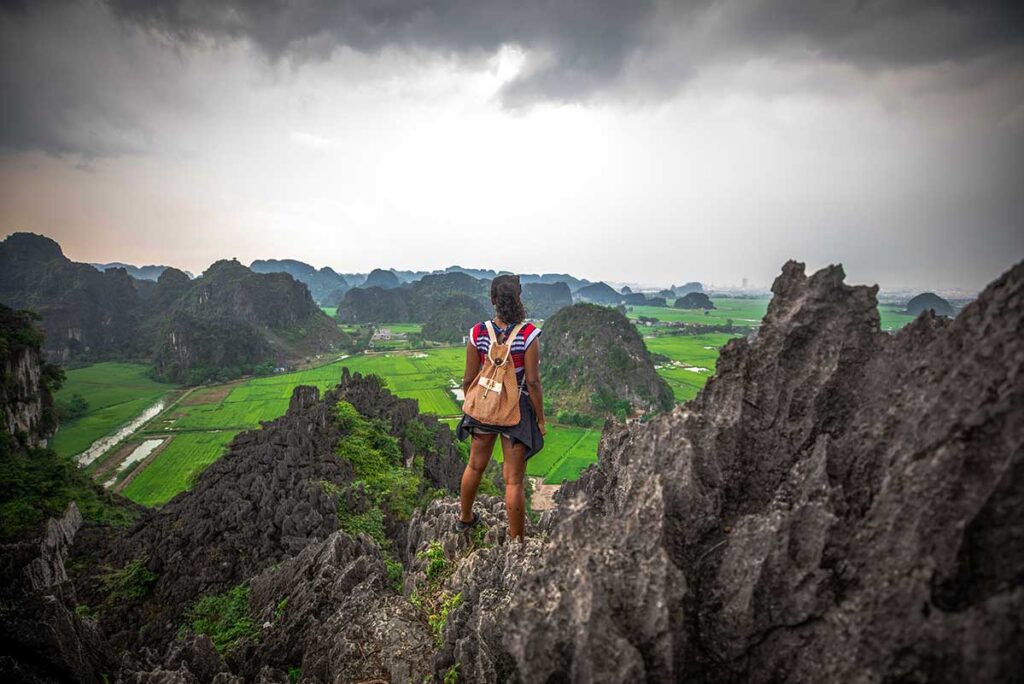
Ninh Binh’s landscape — karst mountains rising from flat rice paddies, slow rivers, and ancient temples — makes for strong nature and landscape photography. The view from the top of Mua Cave looking out over Tam Coc is one of the most photographed scenes in northern Vietnam for good reason. For a portrait session, it works best as a backdrop rather than a destination in itself, combined with a boat journey through Tam Coc or an early morning walk through the valley.
It is a practical day trip from Hanoi, which makes it easy to combine with a Hanoi-based photographer for a half-day shoot outside the city.
7. Halong Bay
Halong Bay is one of the most photographed places in Vietnam, but it is not a practical location for hiring a dedicated photographer. Getting a photographer onto your cruise would require them to book the same boat, which most will not do for a standard session fee — and coordinating it in advance adds complexity that rarely feels worth it.
The realistic approach is to bring a good camera or use your phone, and focus on the landscape rather than portraits. The light at sunrise and sunset on the water is genuinely good, and the scenery does the work. Some cruise operators include a photographer as part of a premium package — it is worth asking when you book your cruise, but do not count on it.
If portraits are the priority, book a session in Hanoi before or after your cruise. Halong Bay is best experienced rather than treated as a photoshoot location.
Practical tips for your Vietnam photoshoot
A good location and a capable photographer will only get you so far. A few practical decisions made before the shoot can make a significant difference to the results.
Best time of day to shoot
Golden hour — the hour after sunrise and the hour before sunset — produces the best light for outdoor photography in Vietnam. The light is softer, shadows are less harsh, and the overall mood of the photos improves considerably compared to shooting in the middle of the day.
Early morning has an additional advantage in busy locations like Hoi An or the Hanoi Old Quarter: the streets are quiet. Shooting at 7am in Hoi An produces a completely different experience than shooting at 10am. Less crowds in the background, easier to move between spots, and a calmer atmosphere overall. Most experienced photographers will suggest an early start automatically — if they do not, it is worth raising yourself.
Midday light is generally unflattering and best avoided for portrait work. If an early morning or late afternoon slot is not available, an overcast day is actually preferable to bright midday sun.
What to wear
Clothing choices matter more than most people expect. A few practical guidelines that consistently produce better results:
Light, breathable fabrics work best in Vietnam’s climate, particularly in the south and during the warmer months. Heavy or dark clothing in humid conditions is uncomfortable and shows in photos.
Solid colors generally photograph better than busy patterns. Pastels, earth tones, and muted colors tend to complement Vietnam’s backdrops — the ochre walls of Hoi An, the green terraces of Sapa, the grey stone of Hanoi — without competing with them. Avoid loud logos or graphics.
Bringing two outfits allows for variety within a single session, which most photographers appreciate and many actively encourage.
Renting traditional clothing
Renting an ao dai for a shoot is straightforward in Hoi An, Hanoi, and Ho Chi Minh City. Most rental shops are clustered near the main photoshoot locations and charge between $10 and $25 for a few hours, including shoes. Hair accessories are usually included and worth keeping as a souvenir.
A few practical things to know before going: most shops have size limits, typically around 70kg for women and 80kg for men, so checking in advance avoids an awkward situation on the day. Quality varies between shops — looking at photos taken by previous customers, either on the shop’s social media or through your photographer, gives a more honest picture than the racks inside.
Some photographers have preferred shops they work with regularly and can recommend one that suits the location and style of your shoot. It is worth asking.
Weather and season
Vietnam’s weather varies significantly by region, and the best time to shoot depends entirely on where you are going. As a general rule, the dry season in each region produces the most reliable conditions — but Vietnam’s geography means that the north, centre, and south follow different cycles.
Central Vietnam, including Hoi An and Hue, is at its best from February to August. The north, including Hanoi, Sapa, and Ninh Binh, is most pleasant from October to April. The south, including Ho Chi Minh City and the Mekong Delta, is driest from December to April.
An overcast sky is not necessarily a problem for photography — diffused light can actually be flattering for portraits. Heavy rain is a different matter. Having a backup plan or a flexible cancellation policy with your photographer is sensible during the wet season.
Read more about: best time to visit Vietnam
How far in advance to book
For popular locations during peak season, booking at least two to four weeks in advance is advisable. Hoi An in particular has a limited number of genuinely good photographers, and the best ones fill up quickly between November and February.
For less popular destinations or outside peak season, a week’s notice is usually sufficient. That said, there is no downside to booking early, and most photographers are happy to confirm a date well in advance.
Posing — what to expect
Most travelers are not used to being photographed professionally, and feeling awkward in front of a camera is completely normal. A good photographer will guide you through the session with simple directions — where to look, how to stand, when to move — so that very little prior experience is needed.
The photos that tend to look best are rarely the fully posed ones. Walking, looking away from the camera, interacting with the surroundings — these produce more natural results than standing still and smiling directly at the lens. Communicating this preference to your photographer at the start of the session helps set the right tone for the whole shoot.
Doing the photoshoot yourself
Not everyone wants to hire a photographer, and Vietnam is an easy country to shoot in independently. The light is good, the locations are visually rich, and a decent camera or modern smartphone produces strong results without any professional help.
The main challenge is getting quality photos that actually include you. If traveling solo or as a couple without a extra person to help, a lightweight travel tripod solves most situations and takes up almost no space in a bag. A remote shutter or the self-timer function handles the rest.
For anyone who wants to go deeper — best camera settings, locations worth seeking out, and how to approach street photography respectfully in Vietnam — there is a full guide to photography in Vietnam worth reading before the trip.